
Ride Sharing Market Outlook: Urban Mobility Solutions and Growth Opportunities
The Ride Sharing Market is experiencing rapid growth driven by increasing demand for convenient and cost-effective urban transportation solutions.

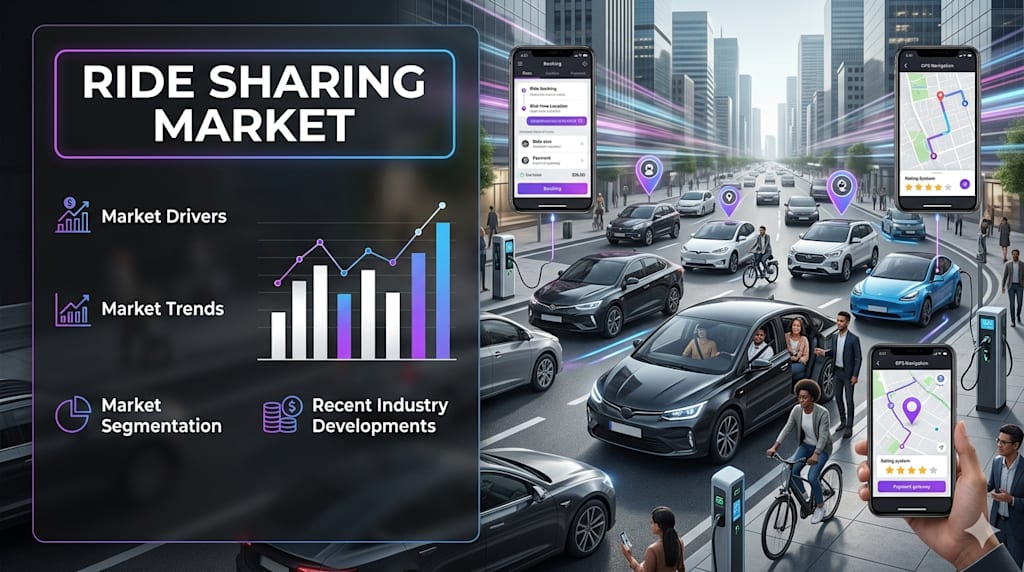
According to IMARC Group's latest research publication, The global ride sharing market size reached USD 150.5 Billion in 2025. Looking forward, IMARC Group expects the market to reach USD 525.9 Billion by 2034, exhibiting a growth rate (CAGR) of 14.47% during 2026-2034.
How AI is Reshaping the Future of the Ride Sharing Market
- Dynamic Pricing and Demand Optimization: AI allows ride-hailing platforms to dynamically adjust prices based on real-time market demand, traffic conditions, and external factors such as local events or holidays. When demand for rides increases during rush hour or after a major concert, AI algorithms automatically adjust prices to reflect this increase, while prices drop during off-peak hours, making rides more affordable for users.
- AI-Powered Customer Service and Safety Management: Lyft's partnership with Amazon and Anthropic focuses on deploying language models to handle rider safety incidents and customer support in real time, with the aim of faster resolution and verifiable AI-assisted documentation of every safety interaction for liability management purposes.
- Autonomous Fleet Intelligence: The fusion of AI-based perception, advanced automation features, connected sensors, high-speed networks, and real-time fleet intelligence is reshaping how self-driving fleets function. These technologies support accurate maneuvering, predictive routing, collision-avoidance decision processes, and continuous monitoring of vehicle performance. Through adaptive learning models, route simulation environments, and cloud-coordinated fleet tools, operators improve safety outcomes and reduce operational disruptions.
Ride Sharing Industry Overview
Rising smartphone adoption, the spread of 5G, corporate sustainability mandates, and supportive policy measures such as congestion pricing are reinforcing demand. Platform-led electrification of driver fleets is lowering per-mile economics, while super-apps bundle scooters, bikes, and transit tickets to lift user retention. Asia-Pacific contributed 38.44% of the ride-hailing market size. China, propelled by its dense urban landscapes, widespread smartphone penetration, and favorable mobility policies, is at the forefront of the autonomous vehicle revolution. In India, two-wheelers through platforms like Rapido are the preferred choice for commuters looking to navigate traffic congestion affordably. In Southeast Asia, the patchwork nature of public transit is giving rise to super-apps, with companies such as Grab leading the charge in ride bookings.
Ride Sharing Market Trends and Drivers
Waymo's fleet grew from approximately 1,500 robotaxis in May 2025 to roughly 2,500 in November 2025. The company reached 100 million fully autonomous miles driven on public roads and now completes more than 250,000 paid rides per week. Waymo also began serving Detroit, marking the first deployment in a Midwest city with winter weather conditions, and announced expansion into Baltimore, Philadelphia, St. Louis, and Pittsburgh. Depreciation costs per mile for a representative autonomous vehicle could drop from about 35 cents in 2025 to 15 cents in 2040, enabled in part by lower hardware costs. Insurance costs are also expected to decline significantly over the same timeframe, making autonomous ride-sharing an increasingly cost-competitive model. Corporate and Government Adoption Broadening the User Base
The U.S. General Services Administration launched a governmentwide ridesharing solution available from April 2025 through April 2030, covering all civilian and defense employees, contractors, veterans, and mission-related personnel for travel, fleet augmentation, and shuttle replacement services across both domestic and overseas service areas. As corporate clients prioritize ESG-aligned suppliers, operators that track and disclose ride-level emissions are capturing long-term contracts. Autonomous-ride pilots enhance brand prestige and reduce driver-related legal exposure, further consolidating leadership in the global ridesharing market.
Lyft's app users can now rent scooters and Citi Bikes, completing 45 million rides across 35,000 bikes in 2024. Cities such as San Francisco have rolled out unified permits that let one operator serve multiple mobility modes, reinforcing the shift toward integrated urban transport ecosystems. The global robotaxi market is projected to reach USD 45.7 billion by 2030, driven by rising demand for ride-hailing services, high research and development investments, and government focus on reducing emissions and developing infrastructure. Robotaxi platforms are being built on technological developments in autonomous vehicle technologies, including AI, machine learning, and sensor capabilities.
Leading Companies Operating in the Global Ride Sharing Industry
- ANI Technologies Pvt. Ltd. (OLA)
- BlaBlaCar
- Bolt Technology OU
- Cabify
- Curb Mobility LLC
- Gett
- Grab Holdings Inc.
- HyreCar Inc.
- Lyft, Inc.
- TomTom International B.V.
- Uber Technologies Inc.
Ride Sharing Market Report Segmentation
By Service Type:
- E-Hailing
- Car Sharing
- Station-Based Mobility
- Car Rental
E-hailing represents the largest segment, retaining 73.62% of revenue, while robotaxis are posting the fastest growth rate, pointing toward an inflection beyond manual driver models.
By Booking Mode:
- App-based
- Web-based
App-based booking represents the largest segment, driven by widespread smartphone adoption and the convenience of real-time matching and tracking capabilities.
By Membership Type:
- Fixed Ridesharing
- Dynamic Ridesharing
- Corporate Ridesharing
Corporate ridesharing holds the largest market share, reflecting the growing preference of enterprises for managed, ESG-compliant transportation solutions over traditional company car fleets.
By Commute Type:
- ICE Vehicle
- Electric Vehicle
- CNG/LPG Vehicle
- Micro Mobility Vehicle
Electric vehicles represented the largest commute type segment, with battery-electric vehicles tracking the fastest growth rate through 2031, driven by sustainability commitments and improving charging infrastructure.
Regional Insights:
- North America (United States, Canada)
- Asia Pacific (China, Japan, India, South Korea, Australia, Indonesia, Others)
- Europe (Germany, France, United Kingdom, Italy, Spain, Russia, Others)
- Latin America (Brazil, Mexico, Others)
- Middle East and Africa
North America exhibits clear dominance in the ride sharing market due to high smartphone penetration, urban traffic congestion, strong environmental awareness, and the presence of major global platforms. The United States held an 88% share of the autonomous ride-sharing services market, reflecting robust digital capabilities, a well-developed mobility ecosystem, and early adoption of autonomous technologies supported by extensive testing programs and significant investment in large-scale fleet rollout.
Recent News and Developments in the Ride Sharing Market
- May 2026: Virginia Governor Spanberger signed rideshare safety bills requiring identity verification technology and overhauling background check processes for drivers. The new laws mandate screenings covering a driver's full history, including all addresses where a driver has lived since age 18, with the measures set to take effect July 1, 2026.
- May 2026: Colorado legislators advanced House Bill 26-1424 targeting ride-hailing driver vetting, requiring large ride-hailing companies to conduct background checks on drivers every six months and bar drivers convicted of assault, harassment, or domestic violence, while creating opt-in audio and visual recording policies for rides.
- July 2025: Lyft completed the acquisition of FREENOW for EUR 175 million, broadening its reach to 11 countries and nearly 1,000 cities, significantly expanding its European addressable market.
- July 2025: Uber signed a global deal with Baidu to launch thousands of Apollo Go autonomous cars on the Uber network outside mainland China, with initial deployments targeted across select Asian and Middle Eastern cities.
- July 2025: Uber invested hundreds of millions of dollars in Lucid and Nuro to roll out more than 20,000 robotaxis over six years, each based on the Lucid Gravity SUV running Nuro's self-driving technology stack.
- October 2025: California Governor Gavin Newsom signed Senate Bill 371 to reduce ride-hailing fares for consumers. The legislation addressed insurance cost burdens, with data showing that 45% of a typical ride fare in Los Angeles went toward government-mandated insurance, and Lyft calculating that an average of USD 6 per ride in California went to insurance costs, double the national average.
- January 2026: California's law granting union rights to the state's 800,000 rideshare drivers came into effect, brokered by Governor Newsom between organized labor and major rideshare companies including Uber and Lyft, representing one of the most significant expansions of collective bargaining coverage in recent decades.
Note: If you require specific details, data, or insights that are not currently included in the scope of this report, we are happy to accommodate your request. As part of our customization service, we will gather and provide the additional information you need, tailored to your specific requirements. Please let us know your exact needs, and we will ensure the report is updated accordingly to meet your expectations.
About the Creator
Olivia Smith
Olivia Smits is a Research and Marketing Analyst who specializes in market research, trend analysis, and consumer insights. I help businesses make smarter marketing and strategy decisions by turning data into clear, actionable insights.
Enjoyed the story? Support the Creator.
Subscribe for free to receive all their stories in your feed.
Comments
There are no comments for this story
Be the first to respond and start the conversation.