
Richard Feynman, the Safe Cracker
How a young physicist exposed a surprising weakness in the security of the atomic bomb project
Introduction
In a secret laboratory in New Mexico, some of the world’s finest scientists were working on the most dangerous weapon ever conceived. Armed guards watched the entrances, letters were checked, and the project’s very existence was concealed from the public. Yet Richard Feynman discovered that sensitive papers could be far easier to reach than anyone wanted to believe.
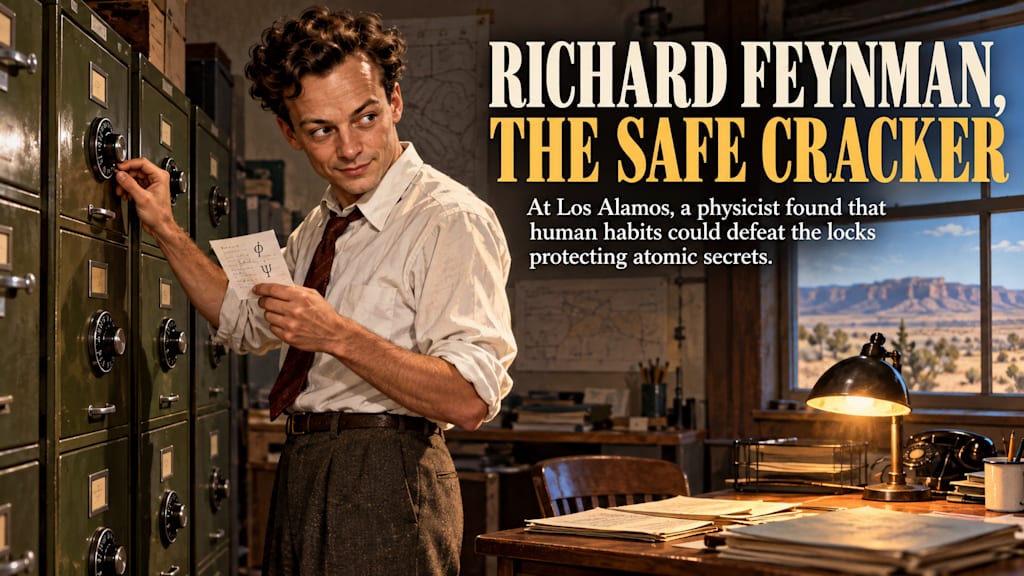
Feynman was a young physicist working at Los Alamos during the Second World War. He was curious, mischievous and unwilling to assume that a locked cabinet was secure simply because somebody had locked it. His experiments with locks earned him a reputation as the laboratory’s safe cracker, although the real weakness often lay with the people using the locks.
The Secrets in Wooden Cabinets
Early in the project, important documents were stored in wooden filing cabinets secured with ordinary padlocks. Feynman found that some papers could be removed without opening the locks at all. He raised the problem at meetings because the documents concerned work that the laboratory was supposed to protect at all costs.
His warnings were not always received with the urgency he expected. To Feynman, that made the challenge more interesting: if the cabinets were so safe, why could he get inside them? He learnt about their locks and demonstrated that the apparent protection was weaker than his colleagues assumed. What looked like a prank also made a serious point about security.
A Reputation Grows
As the laboratory acquired metal cabinets with combination locks, Feynman continued investigating. He discovered weaknesses in the way the locks were used and gathered enough information to open certain cabinets much faster than their owners expected.
Sometimes a colleague needed a document from a locked cabinet while its owner was away. Feynman would be asked to help, and he would disappear into the room with a screwdriver tucked into his back pocket. According to his own account, he often opened the cabinet quickly, then waited before emerging so that the job would appear more difficult. His reputation as a remarkably skilled safe cracker grew.
The screwdriver was largely a prop. The most valuable tools were observation and an understanding of how people behaved. A lock might be well made, but it offered little protection if its combination was easy to discover or was reused on several cabinets.
The Saturday Afternoon Discovery
After the war, Feynman returned to Los Alamos to finish some work and needed a document from the library. The library vault was guarded and fitted with a lock he did not know how to open. Then he remembered that a colleague, Frederic de Hoffmann, kept copies of a vast collection of documents in filing cabinets in his office.
Feynman went to the office and found it open, but de Hoffmann was absent. While waiting, he tried a few possible combinations without success. He then searched for a clue and found a sheet showing the Greek alphabet, with the digits of a familiar mathematical constant written across the top. He thought he had found the answer, but several attempts based on those digits failed.
As he was about to give up, Feynman reconsidered his colleague’s habits. If de Hoffmann liked mathematical constants, perhaps he had chosen a different one. Feynman tried a combination based on another well-known constant, and the cabinet opened. He then discovered that the other cabinets used the same combination. According to Feynman’s account, those cabinets held copies of an extraordinary range of documents about the atomic bomb project.
A Joke With a Serious Message
Feynman enjoyed telling the story, and his delight in the unexpected is easy to understand. Yet the incident exposed a troubling gap between security procedures and actual security. The guarded vault had been difficult to approach, while copies of its contents sat in an office protected by a combination someone familiar with its owner could guess.
The lesson reaches well beyond Los Alamos. A strong lock cannot compensate for a predictable combination, and protecting an original document achieves little if an accessible copy is less carefully guarded. Feynman was testing assumptions that other people had stopped questioning.
Conclusion
Richard Feynman later became famous for his work in physics, his teaching and his ability to explain difficult ideas. His adventures with the Los Alamos cabinets reveal the same habit of mind in a different setting. He looked at something everyone accepted, asked whether it really worked, and tested the answer for himself.
The nickname “safe cracker” suggests a man defeating ingenious machinery through extraordinary skill. Feynman’s story is more revealing than that: the greatest weakness was often an ordinary human decision made on the assumption that nobody would think to check.
About the Creator
Alan Spencer
Have been an author and writer for over 20 years. Have been a journalist, editor, proofreader, and a designer and presenter of training courses. Have written over 100 articles, two books, and around 20 training courses.
Enjoyed the story? Support the Creator.
Subscribe for free to receive all their stories in your feed. You could also become a paid subscriber, letting them know you appreciate their work.
Comments
There are no comments for this story
Be the first to respond and start the conversation.