
Rice Market Trends: Rising Global Consumption, Export Demand & Forecast to 2033
How rising global food consumption, expanding export demand, and evolving dietary preferences are driving growth and innovation in the rice market

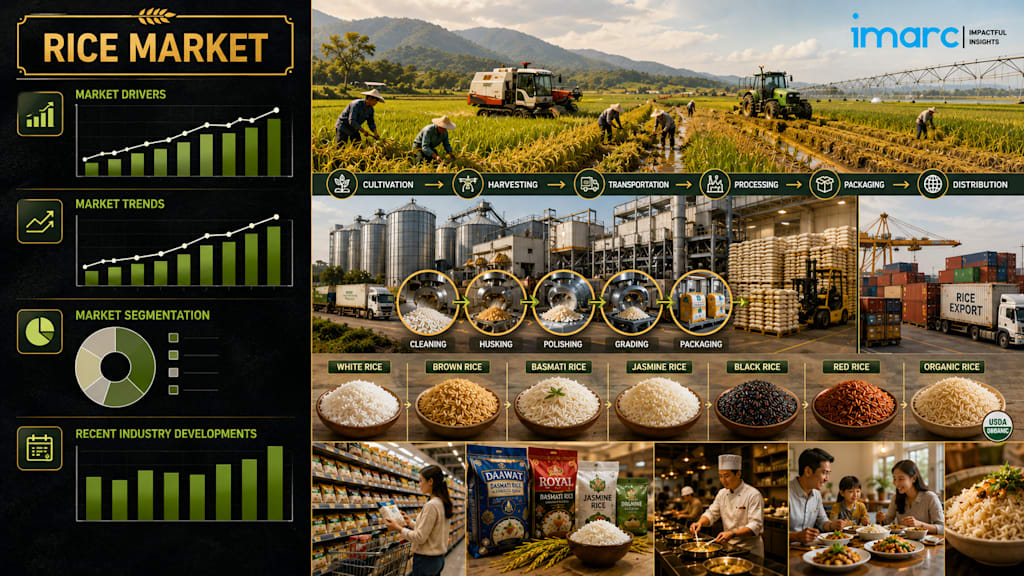
According to IMARC Group's latest research publication, The global rice market size reached USD 309.8 Billion in 2024. Looking forward, the market is expected to reach USD 380.4 Billion by 2033, exhibiting a growth rate (CAGR) of 2.19% during 2025-2033.
How AI is Reshaping the Future of the Rice Market
- Precision Farming and Genome-Edited Crop Development: AI-integrated genomic tools are enabling the development of next-generation rice varieties with enhanced agronomic traits. In May 2025, India became the first country in the world to release genome-edited rice varieties, DRR Rice 100 (Kamla) and Pusa DST Rice 1, designed to boost yields by 19%, reduce greenhouse gas emissions by 20%, and conserve 7,500 million cubic meters of water annually. Machine learning algorithms assist researchers in mapping genetic sequences, identifying stress-resilient traits, and shortening the crop development cycle from decades to a few years, significantly compressing research timelines across major rice-producing nations.
- Smart Irrigation and Water Management Systems: AI-powered sensor networks and predictive models are optimizing water usage across paddy fields, a critical need given that conventional rice cultivation accounts for nearly 30% of global freshwater consumption. Automated irrigation systems use real-time soil moisture readings and weather forecasting data to determine precise water release schedules, reducing water use without yield compromise. These tools are particularly relevant in water-stressed regions of South and Southeast Asia where over 90% of the world's rice is grown, helping farmers maintain productivity under increasingly erratic monsoon conditions.
- Supply Chain Analytics and Price Stabilization: AI-driven demand forecasting platforms help governments and grain traders anticipate supply shortfalls and manage national reserves proactively. Japan's government demonstrated this approach in February 2025 by releasing up to 210,000 tons of rice from strategic reserves in two coordinated phases to counter a 64.5% surge in rice prices recorded as of December 2024, the steepest price increase since 1971. Reserve management systems now integrate trade flow analytics, harvest projections, and consumer demand signals to inform intervention timing with far greater precision than traditional manual assessments.
- Sustainable Production Monitoring and Carbon Accounting: AI platforms are enabling rice-producing nations to quantify and reduce the environmental footprint of paddy cultivation at scale. The "Thai Rice for Life" program, launched through a partnership between Khon Kaen University and the Sustainable Rice Platform in June 2025, achieved over 30% yield increases, 30% cost reductions, and a 4.5 tCO2e per hectare reduction in greenhouse gas emissions. The program is targeting 40,000 farmers across 56,000 hectares by 2028, using data-driven agronomic advisory tools to standardize sustainable practices nationwide and position Thailand as a global benchmark for low-emission rice production.
- E-Commerce Integration and Digital Distribution Optimization: AI-powered recommendation engines and logistics platforms are reshaping how rice products reach end consumers, particularly in urban markets. Online rice sales are expanding access to specialty and premium varieties, including Basmati, Jasmine, Black Rice, and Arborio, beyond traditional retail channels. Predictive logistics tools optimize last-mile delivery routing, manage cold storage for premium packaged products, and personalize assortment displays based on regional dietary patterns, enabling companies like LT Foods Ltd. to extend premium rice-based snack brands such as Kari Kari into markets like Australia and the UAE.
Rice Industry Overview
The global rice industry is shaped by a combination of demographic pressures, policy frameworks, and evolving consumer behavior across diverse regional markets. Asia Pacific leads global production and consumption, with China and India together accounting for a dominant share of total output. Rice cultivation in the region benefits from long-established farming traditions, government price support systems, and the sheer scale of domestic demand driven by populations where rice constitutes the primary dietary carbohydrate source.
Government intervention is a defining feature of the rice market globally. Subsidies, minimum support prices, and procurement programs protect farmer incomes and stabilize market pricing during periods of weather-driven volatility. India's release of genome-edited varieties in May 2025 reflects a broader policy push toward science-led productivity enhancement as an alternative to area expansion under land scarcity constraints. Similarly, Japan's structured two-phase reserve release in February 2025 illustrates how governments use managed supply interventions to prevent food inflation from cascading into broader economic disruption.
In North America, rice production is concentrated in states like Arkansas and California, with domestic consumption driven by its versatility across Mexican, Cajun, and Asian culinary traditions. Europe is a net importer, relying on international supply chains to meet demand for specialty varieties, especially in Italy and Spain where risotto and paella anchor national cuisines. Latin America, led by Brazil and Colombia, supports robust domestic production while maintaining rice as a dietary staple across most countries. The Middle East and Africa are growth markets where rice features prominently in traditional dishes such as pilaf and biryani, supported by both imports and nascent domestic production initiatives.
Rice Market Trends and Drivers
The rapid growth of urban populations across Asia and Africa is the primary structural driver of the global rice market. Rice serves as a dietary staple for over three billion people, and as urbanization accelerates, demand for convenient, ready-to-eat, and easy-to-prepare rice formats is increasing alongside traditional bulk grain consumption. Microwaveable rice pouches, instant rice noodles, frozen rice bowls, and flavored rice snacks are expanding the market beyond raw grain into processed food categories with higher margins and faster shelf turnover.
Health-conscious consumer trends are reshaping product preferences within the rice category. Whole grain varieties, including Brown Rice and Black Rice, are gaining traction among urban consumers who prioritize fiber, antioxidants, and lower glycemic impact. Black Rice, rich in anthocyanins and often positioned as a superfood, is seeing increased use in premium retail and food service applications across North America, Europe, and Japan. Red Rice and Rosematta Rice are similarly attracting consumers seeking nutritional differentiation beyond conventional white rice offerings.
Export market diversification is creating new revenue streams for major producing nations. International trade agreements are reducing cross-border barriers, enabling countries like India, Thailand, Vietnam, and Pakistan to access a broader range of importers. Strict quality certification requirements, including food safety standards and origin traceability protocols, are helping exporting nations build sustained importer confidence and command premium pricing for certified varieties such as GI-tagged Basmati rice.
Retail sector evolution is supporting incremental demand growth across both offline and online channels. Supermarkets and hypermarkets are expanding their frozen and specialty rice sections, while e-commerce platforms are enabling niche variety discovery and direct-to-consumer purchasing for premium and organic rice products. The shift toward online grocery shopping, accelerated by changing urban lifestyles, is particularly benefiting companies that can offer competitive variety depth and reliable delivery for bulk rice purchases.
Leading Companies Operating in the Global Rice Industry
- Anheuser-Busch Companies LLC (AB InBev)
- Bunge Limited
- California Family Foods
- Cargill Incorporated
- Farmers' Rice Cooperative
- ITC Limited
- KRBL Limited
- Louis Dreyfus Company B.V.
- LT Foods Ltd.
- Riceland Foods Inc.
- Riviana Foods Inc. (Ebro Foods S.A.)
- Tamaki Rice Corporation
- Rice Market Report Segmentation
By Product Type:
- Regular
- Aromatic
Regular rice accounts for the largest share of global consumption due to its versatility across everyday culinary applications in households and food service establishments worldwide.
By Type:
- Red Rice
- Arborio Rice
- Black Rice
- Grain Fragrance Rice
- Brown Rice
- Rosematta Rice
- Grain Parboiled Rice
- Sushi Rice
- Others
By Grain Size:
- Long Grain
- Medium Grain
- Short Grain
Long grain rice holds the largest segment share, led by globally recognized varieties such as Basmati and Jasmine, valued for their aromatic profile and fluffy texture across diverse cuisines.
By Distribution Channel:
- Offline Stores
- Online Stores
Offline stores represent the dominant distribution channel, as consumers prefer in-store purchasing for quality inspection and routine grocery buying. Online stores are the fastest-growing channel, driven by e-commerce expansion and demand for specialty variety access.
By Application:
- Food
- Feed
- Others
The food application segment leads the market, spanning staple household consumption, food service supply, and rice-based processed product manufacturing including noodles, flour, cakes, and ready meals.
Regional Insights
- North America (United States, Canada)
- Asia Pacific (China, Japan, India, South Korea, Australia, Indonesia, Others)
- Europe (Germany, France, United Kingdom, Italy, Spain, Russia, Others)
- Latin America (Brazil, Mexico, Others)
- Middle East and Africa
Asia Pacific holds the largest share of the global rice market, driven by the region's role as both the world's primary production base and its largest consumption market. North America is an emerging growth region. Europe relies on imports to meet specialty variety demand. Latin America maintains rice as a dietary staple across most national cuisines, and the Middle East and Africa represent expanding markets with rising per capita rice consumption.
Recent News and Developments in the Rice Market
- May 2025: India became the first country globally to release genome-edited rice varieties, DRR Rice 100 (Kamla) and Pusa DST Rice 1. The varieties are designed to increase yields by 19%, reduce greenhouse gas emissions by 20%, and save 7,500 million cubic meters of water, with planned deployment across multiple Indian states.
- June 2025: Khon Kaen University and the Sustainable Rice Platform formalized their partnership under the "Thai Rice for Life" program, reporting yield improvements of over 30%, production cost reductions of 30%, and greenhouse gas reductions of 4.5 tCO2e per hectare. The initiative targets 40,000 farmers and 56,000 hectares by 2028.
- February 2025: Japan's government announced the release of up to 210,000 tons of rice from national reserves across two phases to stabilize domestic supply, responding to a 64.5% increase in rice prices as of December 2024, the largest recorded increase since 1971. The release was structured with repurchase conditions to prevent long-term market disruption.
- November 2024: LT Foods Ltd. expanded its premium rice-based snack brand Kari Kari into Australia and the UAE, establishing retail presence in Perth, Sydney, and Dubai, including distribution through the Aldi grocery chain in Australia.
- September 2024: Anheuser-Busch Companies LLC and USA Rice extended their sustainable rice farming partnership, providing rice growers with technical and financial support to transition to efficient irrigation, nutrient management, and energy practices while developing wildlife habitat on active rice farmland.
Note: If you require specific details, data, or insights that are not currently included in the scope of this report, we are happy to accommodate your request. As part of our customization service, we will gather and provide the additional information you need, tailored to your specific requirements. Please let us know your exact needs, and we will ensure the report is updated accordingly to meet your expectations.
About the Creator
Abhay Rajput
I am working in market research company that provides market and business research intelligence across the globe.
Enjoyed the story? Support the Creator.
Subscribe for free to receive all their stories in your feed.
Comments
There are no comments for this story
Be the first to respond and start the conversation.