
Reverse Logistics Market Trends: E-Commerce Returns, Cost Optimization & Forecast to 2034
How rising e-commerce returns, evolving consumer expectations, and efficient inventory recovery systems are reshaping supply chain operations and cost structures in the reverse logistics market

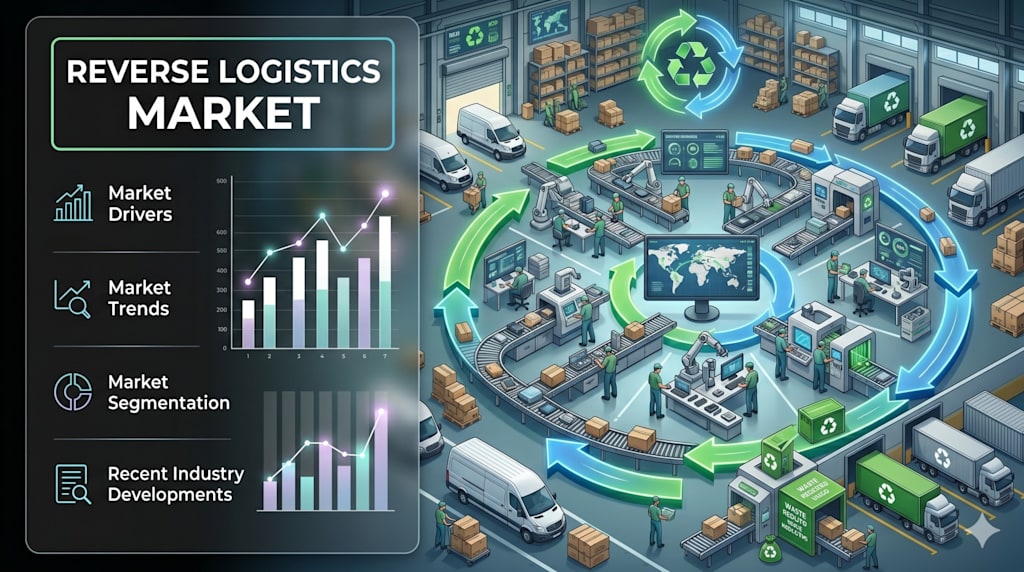
According to IMARC Group's latest research publication, the global reverse logistics market size reached USD 711.1 Billion in 2025. Looking forward, IMARC Group expects the market to reach USD 1,076.3 Billion by 2034, exhibiting a growth rate (CAGR) of 4.70% during 2026-2034, exhibiting steady expansion driven by the rise of e-commerce returns, environmental regulations, technological advancements, and the growing emphasis on circular economy principles and sustainable supply chain practices.
How Technology and Sustainability are Reshaping the Future of Reverse Logistics Market
- AI and Machine Learning in Predictive Returns Management: Artificial intelligence and machine learning are fundamentally transforming how businesses anticipate and manage product returns before they become operational bottlenecks. AI-powered platforms analyze return patterns, consumer behavior data, and seasonal demand signals to build predictive return management systems that enable retailers and logistics providers to allocate resources more efficiently. These intelligent systems are reducing processing times, cutting handling costs, and improving recovery value from returned merchandise. Companies deploying AI-driven returns management are gaining measurable competitive advantages by shifting from reactive to proactive reverse logistics operations, creating more agile and cost-effective supply chains capable of handling the accelerating volume of returns generated by e-commerce growth.
- Blockchain for Transparency and Supply Chain Traceability: Blockchain technology is emerging as a critical enabler of transparency and accountability across the reverse logistics supply chain, allowing all stakeholders to access a secure and immutable record of every product movement from the point of return through to final disposition. This end-to-end visibility is particularly valuable in industries such as pharmaceuticals, consumer electronics, and luxury goods, where product authenticity and chain-of-custody documentation are regulatory and commercial imperatives. By creating verifiable audit trails, blockchain reduces the risk of fraud in secondary markets, ensures compliance with disposal and recycling regulations, and builds consumer trust in refurbished or resold products. Leading logistics providers are actively piloting blockchain integrations to differentiate their reverse logistics service offerings and meet the traceability expectations of brand-conscious clients.
- Automation and Robotics in Return Processing Centers: Advanced automation technologies, including robotics, automated sorting systems, and smart conveyor infrastructure, are being deployed across dedicated return processing centers to handle the growing complexity and volume of returned goods at speeds impossible to achieve through manual operations. These automated facilities can inspect, sort, repackage, and route returned items for resale, refurbishment, recycling, or disposal with significantly higher throughput and accuracy than traditional labor-intensive approaches. The integration of computer vision systems enables real-time quality assessment during the sorting process, ensuring that items eligible for resale or refurbishment are identified and recovered efficiently. This technological investment is directly improving recovery rates and reducing the per-unit cost of returns processing for major retailers and third-party logistics providers operating at scale.
- Growth of Specialized Reverse Logistics Service Providers: The increasing complexity and strategic importance of returns management is driving the emergence and rapid growth of specialized third-party reverse logistics providers that offer dedicated expertise, infrastructure, and technology solutions tailored specifically to the reverse supply chain. Unlike traditional logistics operators who treat returns as a secondary function, these specialized providers build their entire operational model around maximizing the speed, efficiency, and recovery value of returned goods. Retailers and manufacturers are increasingly outsourcing their reverse logistics functions to these specialists, recognizing that building equivalent in-house capabilities requires substantial capital investment and operational expertise that falls outside their core competencies. This outsourcing trend is expanding the addressable market for dedicated reverse logistics service providers across all major end-user industries.
Reverse Logistics Industry Overview:
The global reverse logistics market is experiencing strong growth momentum, underpinned by a convergence of structural trends that are simultaneously increasing the volume of returns and elevating the strategic importance of managing those returns efficiently. The explosive growth of e-commerce has been the single most significant driver of reverse logistics demand, as online retail consistently generates return rates substantially higher than traditional brick-and-mortar retail, creating a persistent and expanding flow of returned merchandise that requires specialized handling, processing, and disposition infrastructure. Asia Pacific currently leads the global market with the largest regional share, driven by the rapid expansion of cross-border e-commerce, rising internet and smartphone penetration, and the increasing focus on sustainability and environmental responsibility among businesses and consumers across the region. North America maintains a strong market position supported by advanced logistics infrastructure, high e-commerce penetration, and stringent regulatory requirements governing waste management, recycling, and product disposal. Commercial returns represent the dominant segment by return type, reflecting the complexity of modern product portfolios and the elevated return rates characteristic of online retail. The e-commerce sector accounts for the largest share among end users, as online retailers continue to face the highest volumes and the most operationally demanding return management challenges across all industry segments. Key players in the market are actively pursuing technological differentiation through investments in blockchain, IoT, and AI platforms, while simultaneously forming strategic partnerships and pursuing mergers and acquisitions to expand their geographic reach and service capabilities. The competitive landscape rewards providers that can offer integrated, technology-enabled reverse logistics solutions with measurable improvements in recovery value, processing speed, and environmental compliance, as clients across all industries raise their expectations for returns management performance.
Reverse Logistics Market Trends and Drivers
The acceleration of global e-commerce is the most powerful structural force driving demand for reverse logistics services, creating a self-reinforcing cycle of returns volume growth that is compelling businesses across all retail segments to invest significantly in reverse supply chain capabilities. Online retail affords consumers unprecedented convenience in purchasing but simultaneously removes the physical inspection experience that helps buyers make confident decisions, resulting in consistently higher return rates compared to traditional retail channels. Impulse buying behaviors enabled by one-click purchasing, combined with the expectation of free and frictionless returns embedded in the policies of major e-commerce platforms, have made high return volumes a permanent feature of the digital commerce landscape rather than an exceptional operational challenge. Retailers must now manage reverse logistics as a core business function with dedicated infrastructure, technology, and staffing, driving sustained investment in third-party reverse logistics partnerships and proprietary returns processing capabilities. The growth of cross-border e-commerce adds a further layer of complexity to returns management, as international shipments require navigation of customs regulations, varying national standards for refurbishment and resale, and longer transit times that can affect the recovery value of returned merchandise. Specialized reverse logistics providers that can offer seamless cross-border returns solutions with full regulatory compliance are capturing significant market share as international e-commerce volumes continue to expand rapidly.
Environmental concerns and evolving regulatory frameworks are increasingly shaping how businesses design and operate their reverse logistics systems, elevating returns management from a purely operational consideration to a strategic priority with board-level visibility. Governments across Europe, North America, and Asia Pacific are implementing progressively stricter requirements for waste reduction, product recycling, and responsible disposal, making compliance-grade reverse logistics capabilities a legal necessity for businesses operating across multiple jurisdictions. Extended producer responsibility regulations, which hold manufacturers financially accountable for the end-of-life management of their products, are particularly influential in driving investment in take-back schemes, refurbishment programs, and recycling partnerships that require sophisticated reverse logistics infrastructure. Beyond regulatory compliance, the growing importance of environmental, social, and governance criteria in investment decision-making and supplier evaluation is motivating businesses to demonstrate measurable sustainability outcomes from their reverse logistics operations. Companies that can show documented reductions in waste, improvements in material recovery rates, and lower carbon emissions from their return supply chains are gaining competitive advantages in procurement processes and building stronger brand equity with environmentally conscious consumers. This regulatory and reputational pressure is translating directly into increased spending on sustainable reverse logistics technologies, processes, and partnerships across virtually every industry that manages significant product return volumes.
Technological advancements are rapidly transforming the economics and capabilities of reverse logistics, enabling businesses to extract greater value from returned products while simultaneously reducing the operational costs associated with returns processing and disposition. Data analytics platforms are providing supply chain leaders with granular visibility into return patterns, enabling more accurate demand forecasting, smarter inventory positioning, and more strategic decision-making about the disposition of returned items. The proliferation of IoT sensors across logistics networks is enabling real-time tracking of returned goods from the moment a return is initiated through every stage of the processing and disposition journey, reducing loss rates and improving operational control. Customer loyalty programs integrated with returns management systems are emerging as a strategic tool for converting the returns experience into a driver of repeat purchasing, with retailers using seamless, rewarding return processes to differentiate their customer experience and reduce churn. The growing secondary market for refurbished and certified pre-owned products, particularly in consumer electronics and luxury goods, is creating new revenue opportunities from reverse logistics that are improving the overall return on investment of returns management infrastructure and incentivizing further innovation across the sector.
Leading Companies Operating in the Global Reverse Logistics Industry:
- C.H. Robinson Worldwide, Inc
- Core Logistic Private Limited
- DB Schenker
- FedEx
- Happy Returns
- Kintetsu World Express, Inc
- Reverse Logistics Group (RLG)
- Safexpress Private Limited
- United Parcel Service of America, Inc.
- Yusen Logistics Global Management Co., Ltd.
Reverse Logistics Market Report Segmentation:
By Return Type:
- Recalls
- Commercial Returns
- Repairable Returns
- End-of-Use Returns
- End of Life Returns
Commercial returns represent the largest segment, driven by the increasing complexity of modern product portfolios, elevated online retail return rates, and the growing sophistication required to manage diverse product configurations through the reverse supply chain efficiently.
By Service:
- Transportation
- Warehousing
- Reselling
- Replacement Management
- Refund Management Authorization
- Others
The report has provided a detailed breakup and analysis of the market based on service type, covering transportation, warehousing, reselling, replacement management, refund management authorization, and other emerging service categories within the reverse logistics ecosystem.
By End User:
- E-Commerce
- Automotive
- Pharmaceutical
- Consumer Electronic
- Retail
- Luxury Goods
- Reusable Packaging
E-commerce represents the largest end-user segment owing to the significantly higher return rates characteristic of online retail, the consumer expectation of frictionless return experiences, and the operational scale of returns volumes generated by major digital commerce platforms globally.
Regional Insights:
- North America (United States, Canada)
- Asia Pacific (China, Japan, India, South Korea, Australia, Indonesia, Others)
- Europe (Germany, France, United Kingdom, Italy, Spain, Russia, Others)
- Latin America (Brazil, Mexico, Others)
- Middle East and Africa
Asia Pacific exhibits a clear dominance in the reverse logistics market, accounting for the largest regional share due to the rapid expansion of cross-border e-commerce, rising digital infrastructure penetration, and increasing regulatory and consumer pressure toward environmentally responsible product lifecycle management across the region's major economies.
Recent News and Developments in Reverse Logistics Market
- March 2025: UPS announced the expansion of its dedicated returns processing network across Southeast Asia, establishing new automated return sorting facilities in Singapore and Thailand to accommodate the rapid growth in cross-border e-commerce returns volumes across the Asia Pacific region.
- January 2025: Happy Returns launched an enhanced version of its box-free, label-free returns platform in partnership with a major US retail consortium, expanding its drop-off return location network to over 10,000 points across the United States and significantly reducing per-return processing costs for participating retailers.
- November 2024: DB Schenker announced a strategic investment in AI-powered returns management technology, integrating predictive disposition algorithms into its reverse logistics operations across Europe to improve recovery value from returned merchandise and reduce the volume of returned goods directed to landfill disposal.
- September 2024: C.H. Robinson Worldwide introduced a new blockchain-based traceability solution for pharmaceutical reverse logistics, enabling end-to-end chain-of-custody documentation for returned and recalled drug products in compliance with evolving serialization and track-and-trace regulations across North American markets.
Note: If you require specific details, data, or insights that are not currently included in the scope of this report, we are happy to accommodate your request. As part of our customization service, we will gather and provide the additional information you need, tailored to your specific requirements. Please let us know your exact needs, and we will ensure the report is updated accordingly to meet your expectations.
About the Creator
Abhay Rajput
I am working in market research company that provides market and business research intelligence across the globe.
Enjoyed the story? Support the Creator.
Subscribe for free to receive all their stories in your feed.
Comments
There are no comments for this story
Be the first to respond and start the conversation.