
Reverse Logistics Market Trends: E-Commerce Returns, Cost Optimization & Forecast to 2034
How rising e-commerce returns, increasing consumer expectations, and efficient inventory recovery solutions are reshaping supply chain strategies in the reverse logistics market

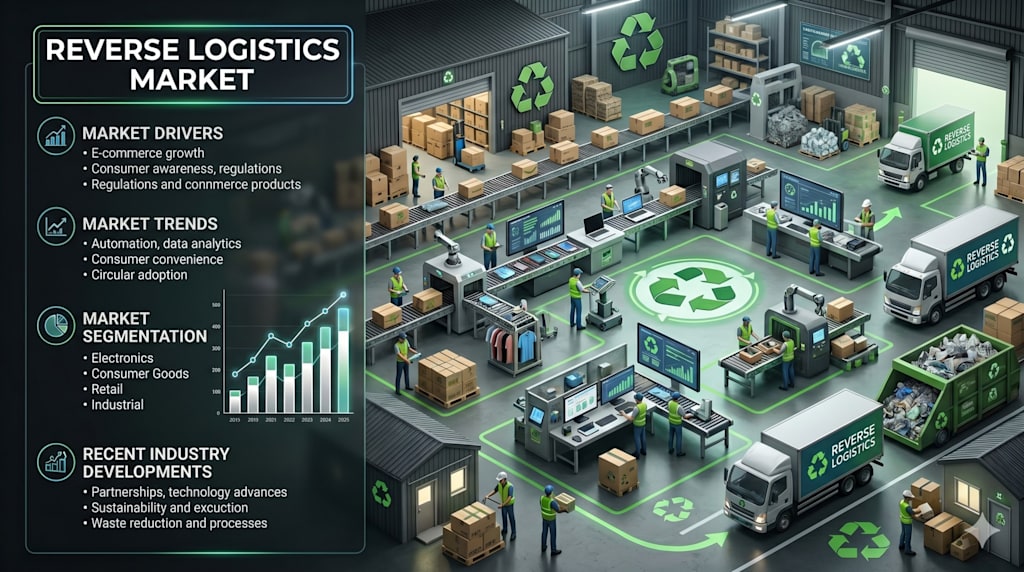
According to IMARC Group's latest research publication, the global reverse logistics market size reached USD 711.1 Billion in 2025. Looking forward, IMARC Group expects the market to reach USD 1,076.3 Billion by 2034, exhibiting a growth rate (CAGR) of 4.70% during 2026-2034.
How AI is Reshaping the Future of the Reverse Logistics Market
- Predictive Return Management Through AI and Machine Learning: AI-powered systems are transforming how businesses anticipate and process product returns. Machine learning algorithms analyze purchase patterns, customer behavior, and SKU-level return histories to predict return probability before a product even leaves the warehouse. Retailers using these predictive tools have reported measurable improvements in return routing efficiency, reducing the time from return initiation to restocking by significant margins. This capability is especially critical for e-commerce operators managing high return volumes across apparel, consumer electronics, and home goods categories, where return rates routinely exceed those seen in traditional retail environments.
- Blockchain for Transparency and Chain-of-Custody Integrity: Blockchain technology is being integrated into reverse logistics platforms to create tamper-proof records of product condition, ownership transitions, and handling at every stage of the return journey. This is particularly valuable in pharmaceutical recalls and luxury goods authentication, where regulatory compliance and brand protection demand complete traceability. Companies operating in these sectors are deploying blockchain-based reverse supply chain systems to meet increasingly strict documentation requirements while enabling rapid response when product integrity issues are detected.
- IoT-Enabled Real-Time Visibility Across Return Networks: Internet of Things sensors embedded in return packaging and logistics containers now provide end-to-end visibility into the condition and location of returned goods. These sensors monitor temperature, humidity, and physical shock during transit, ensuring that returned items requiring special handling such as pharmaceuticals, electronics, or perishables arrive at processing centers in assessable condition. Leading logistics providers have integrated IoT dashboards into their return management platforms, dramatically reducing the uncertainty that historically made reverse logistics operations expensive and difficult to standardize.
- Robotics and Automation in Return Processing Centers: Advanced robotics systems are replacing manual sorting and inspection processes inside dedicated return processing facilities. Automated conveyor networks, computer vision-based defect detection systems, and robotic arms that disassemble returned products for parts harvesting are enabling companies to process returns at speeds and accuracy levels impossible through manual labor alone. These systems evaluate returned items for resale eligibility, refurbishment potential, or responsible disposal routing, ensuring that every returned product reaches its highest-value second-life destination.
- Data Analytics for Disposition Optimization: AI-driven analytics platforms assess returned inventory across thousands of variables including product age, condition grade, remaining warranty, regional demand, and secondary market pricing to determine the most profitable disposition channel in real time. Companies leveraging these tools are maximizing recovery value from returned goods by dynamically routing items toward resale, certified refurbishment programs, parts harvesting, or certified recycling streams rather than applying one-size-fits-all return policies that generate unnecessary waste and financial loss.
Reverse Logistics Industry Overview:
Environmental regulations and corporate sustainability mandates are fundamentally restructuring reverse logistics operations across every major economy. The European Union's Ecodesign for Sustainable Products Regulation requires manufacturers to design goods for disassembly, repairability, and recyclability, creating structural upstream demand for capable reverse logistics networks. Extended Producer Responsibility frameworks active in France, Germany, and the United Kingdom legally obligate brand owners to finance the collection and recycling of their own products, transforming reverse logistics from a discretionary service into a compliance necessity. India's E-Waste Management Rules impose collection targets on electronics producers, pushing companies to establish certified reverse channels across a geographically complex and rapidly digitizing market. In the United States, state-level battery disposal legislation particularly in California and the EPA's circular economy framework are compelling automotive and consumer electronics companies to build formalized take-back and recycling programs at scale. The result is a global regulatory environment where reverse logistics infrastructure is no longer optional but legally mandated and commercially consequential.
Reverse Logistics Market Trends and Drivers
The explosive growth of e-commerce is the single most powerful demand driver for reverse logistics services worldwide. Online retail generates return rates that are structurally higher than physical retail because consumers cannot inspect products before purchase, leading to sizing mismatches, quality disappointments, and impulse purchases that are quickly reversed. This dynamic has forced retailers to compete on return policy quality as a meaningful differentiator, with free and frictionless returns now considered a baseline consumer expectation rather than a premium benefit. Major platforms have responded by building dedicated return infrastructure including consolidated drop-off networks, carrier partnerships for package pickup, and regional processing hubs that batch returns before forwarding to centralized disposition facilities.
The resale and refurbishment economy is emerging as a powerful secondary driver, converting what was once treated as a cost center into a revenue-generating channel. Consumer demand for certified pre-owned electronics, refurbished appliances, and secondhand luxury goods is expanding rapidly, driven by a combination of price sensitivity and growing environmental consciousness among younger demographic segments. Specialized third-party logistics providers have developed vertical expertise in grading, certifying, and remarketing returned goods through dedicated resale platforms, enabling brands to recover significant value from products that would previously have been liquidated at deep discounts or sent to landfill. This shift toward value recovery is changing how companies calculate the true cost of returns and invest in the systems needed to manage them.
Digital transformation and the proliferation of cloud-based return management platforms are reshaping how businesses coordinate reverse logistics across complex multi-channel operations. Return management authorization systems now integrate directly with e-commerce platforms, warehouse management systems, and carrier networks to automate the entire return journey from customer initiation through final disposition. AI-powered pricing optimization tools embedded in these platforms enable dynamic decision-making on refund amounts, exchange offers, and return routing that balances customer satisfaction with operational cost management. The cloud kitchen and delivery-only restaurant model presents an adjacent application, where suppliers managing perishable ingredient returns require similarly agile digital coordination to minimize waste and maintain quality compliance across distributed fulfillment networks.
Leading Companies Operating in the Global Reverse Logistics Industry:
- C.H. Robinson Worldwide, Inc.
- Core Logistic Private Limited
- DB Schenker
- FedEx
- Happy Returns
- Kintetsu World Express, Inc.
- Reverse Logistics Group (RLG)
- Safexpress Private Limited
- United Parcel Service of America, Inc.
- Yusen Logistics Global Management Co., Ltd.
Reverse Logistics Market Report Segmentation:
By Return Type:
- Recalls
- Commercial Returns
- Repairable Returns
- End-of-Use Returns
- End-of-Life Returns
Commercial returns represent the largest segment, driven by the increasing complexity of products and supply chains and the sustained growth of e-commerce generating higher return volumes compared to traditional retail formats.
By Service:
- Transportation
- Warehousing
- Reselling
- Replacement Management
- Refund Management Authorization
- Others
The transportation segment is driven by increasing demand for efficient and cost-effective return shipping solutions, while warehousing benefits from growing requirements for specialized facilities capable of sorting, inspecting, and repackaging returned goods at scale.
By End User:
- E-Commerce
- Automotive
- Pharmaceutical
- Consumer Electronics
- Retail
- Luxury Goods
- Reusable Packaging
The e-commerce segment commands the largest share owing to structurally elevated return rates and the competitive importance of seamless return experiences in driving customer loyalty and repeat purchase behavior.
Regional Insights:
- North America (United States, Canada)
- Asia Pacific (China, Japan, India, South Korea, Australia, Indonesia, Others)
- Europe (Germany, France, United Kingdom, Italy, Spain, Russia, Others)
- Latin America (Brazil, Mexico, Others)
- Middle East and Africa
North America exhibits clear dominance in the reverse logistics market due to its advanced logistics infrastructure, high e-commerce penetration, and a stringent regulatory environment that mandates efficient waste management and recycling practices across consumer and industrial product categories.
Recent News and Developments in the Reverse Logistics Market
- November 2024: UPS completed its acquisition of Happy Returns, integrating the company's box-free, label-free return bar network into its broader logistics ecosystem. The combined operation now enables consumers to drop off returns at thousands of convenient locations, with UPS consolidating shipments before forwarding to processing centers, substantially reducing per-item return costs for participating retailers.
- October 2024: DB Schenker announced the expansion of its dedicated returns management division across key European markets, investing in automated sorting infrastructure and IoT-enabled tracking to support growing volumes from e-commerce clients managing cross-border returns under new EU consumer protection and ecodesign compliance requirements.
- March 2025: Amazon expanded its Renewed program globally, broadening the categories of certified refurbished products available to consumers and deepening its investments in return processing center capacity across North America and Europe. The move reflects the company's strategic repositioning of reverse logistics from a cost function into a profit-generating secondhand commerce channel.
- January 2025: Kintetsu World Express launched an enhanced reverse logistics service platform targeting pharmaceutical clients in Asia Pacific, incorporating blockchain-based chain-of-custody documentation and temperature-controlled return routing to meet evolving drug recall and serialization compliance mandates across the region.
- February 2026: FedEx introduced an AI-powered return disposition optimization tool integrated into its e-commerce logistics suite, enabling retail clients to automatically route returned inventory toward resale, refurbishment, or recycling channels based on real-time condition assessment and secondary market pricing data at the point of return processing.
Note: If you require specific details, data, or insights that are not currently included in the scope of this report, we are happy to accommodate your request. As part of our customization service, we will gather and provide the additional information you need, tailored to your specific requirements. Please let us know your exact needs, and we will ensure the report is updated accordingly to meet your expectations.
About the Creator
Abhay Rajput
I am working in market research company that provides market and business research intelligence across the globe.
Enjoyed the story? Support the Creator.
Subscribe for free to receive all their stories in your feed.
Comments
There are no comments for this story
Be the first to respond and start the conversation.