
Rent AI or Own It? The Choice That Will Separate Marketing Companies in the Next Few Years
Your competitors can subscribe to the same AI tool you use. They can’t subscribe to a feature you built yourself.

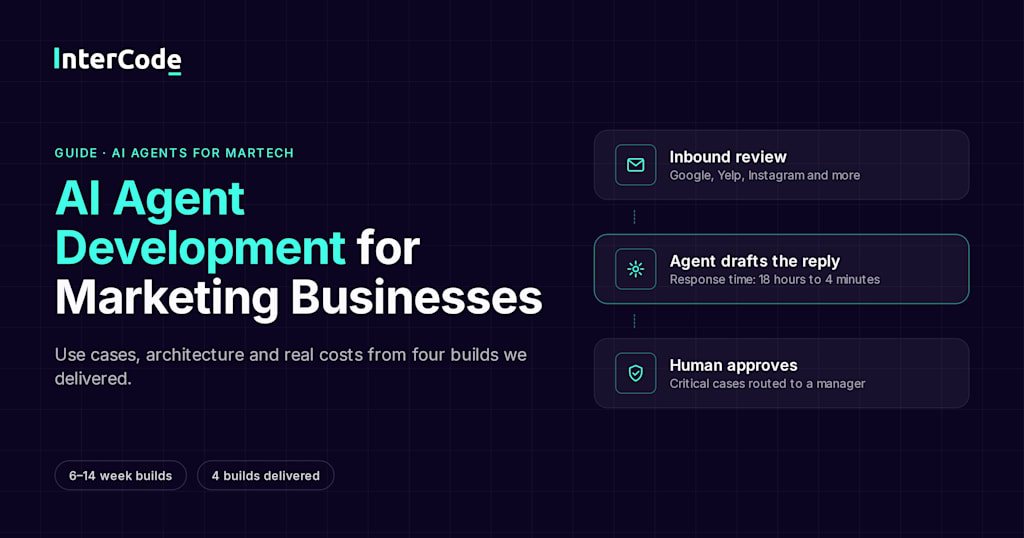
It’s 11 PM on a Friday. A customer leaves a furious one-star review for a restaurant, one of 1,200 locations of the same chain. A few years ago that review would have sat there until Monday morning, when someone on the marketing team finally got to it. By then the damage was done.
Today, a few minutes later, a reply is ready. It’s polite, on-brand and specific to what the customer complained about. If the review mentions something serious, like a safety issue, a refund demand or a legal threat, nothing gets posted automatically. Instead, a regional manager gets an alert.
That isn’t a chatbot. It’s an AI agent, and the difference matters more than most people think.
Chatbots answer. Agents act.
The simplest way to understand the trend: a chatbot responds to what you ask it. An agent is given a goal and figures out the steps on its own. It decides what to do, uses tools to do it, and knows when to hand the job to a human.
In the restaurant example, the agent reads the review, checks the brand’s tone guidelines, writes a reply, decides whether the case is critical, and routes it to the right person. That’s five steps, and no human touched the first four.
This is exactly what happened at Localyser, a reputation platform for multi-location restaurant chains. Its review agent works across 1,200 locations and cut the average response time from 18 hours to 4 minutes. The build took six weeks, and it paid for itself within three months.
Why this matters for marketing businesses
Agencies and marketing platforms are in an awkward spot. They sell marketing to their clients, and those clients now ask the same question everywhere: “When are you adding AI?”
There are two ways to answer:
Rent it. Subscribe to someone else’s AI tool and offer it next to your product.
Build it. Make the agent part of your own product, running on your own data.
Renting is faster, but it has a catch: your competitors can rent the exact same tool tomorrow. A feature you built yourself is different. Nobody can buy it, and you can price it, improve it and defend it. That’s why the companies in the examples below chose to build.
What these agents actually do
Forget the academic lists of “reactive” and “deliberative” agents. In real marketing products, agents take on a handful of practical jobs:
The responder. It drafts replies to reviews, comments and messages, and escalates anything it shouldn’t answer. The hard part isn’t the writing. It’s knowing what not to write.
The qualifier. It answers first questions from leads when nobody’s at a desk. Respage, a multifamily leasing platform, noticed that most prospects reach out after 5 PM with simple questions about pet policy or tour times. Its leasing assistant now handles 62% of those first conversations without a human.
The researcher. It gathers background on a prospect before a salesperson picks up the phone. At Street Digital, a multifamily marketing company, this cut manual prospect research by 73% and grew outbound capacity 3.2x without new hires.
The adapter. It reshapes one campaign or story for every placement and format, so nobody rebuilds it by hand ten times.
The analyst. It answers plain-language questions about performance, like “Why did ratings drop at this location?”, instead of making someone dig through dashboards.
One agent does one job well. The real product appears when several agents work as a team and a coordinating layer decides which one runs, in what order, and when a human steps in. Builders call this AI agent orchestration, and it’s what Street Digital’s system runs on.
The surprising part: the AI is the easy bit
You’d expect the AI model to be the hardest and most expensive part. Usually it isn’t. The real work sits around it:
Connections. Localyser pulls reviews from Google, Yelp, TripAdvisor, DoorDash, Instagram, OpenTable and more into one inbox. Each channel has its own rules and is a separate piece of work.
A human checkpoint. Anything the public will see needs someone to approve it, at least at first. That approval step is what later lets you safely loosen supervision.
Many clients, one agent. A marketing business serves lots of clients, so the same agent has to behave differently for each of them and keep their data apart.
Brand voice. A reply that’s factually correct but off-brand still counts as a mistake.
That’s why timelines vary so much. A focused agent like Localyser’s took six weeks with a small team. Respage’s assistant, which serves many property managers and connects to their management systems, took 14 weeks and five people.
When building is the wrong move
Not every business should build an agent, and the honest reasons are simple:
You don’t have the volume. Localyser’s payback came from roughly 1,100 hours of monthly triage across 1,200 locations. At 20 locations, the same agent wouldn’t pay for itself.
A tool already does the job. If an off-the-shelf product covers your needs and you aren’t reselling the capability, just subscribe.
Your process keeps changing. Fix the workflow first, then automate it.
You can’t name the goal. If nobody can say which number the agent should move, it’s too early.
An agent isn’t a strategy. It automates a decision you can already describe. If no one in your company can write down the rule, the AI can’t learn it from nothing.
The takeaway
For marketing businesses, the AI question is turning into a business question: do you rent a capability everyone else can rent, or build one into your own product? Renting is fine when a tool already fits. When AI becomes part of what you sell, owning it is what sets you apart.
And that one-star review at 11 PM? It will get answered either way. What differs is whether the AI answering it belongs to you.
About the Creator
InterCode
InterCode is an AI-first B2B development boutique for SMBs, focused on agentic engineering, and a Claude Certified Services Partner. We build AI agents, AI integrations, cloud & DevOps, mostly for advertising and digital marketing firms.
Enjoyed the story? Support the Creator.
Subscribe for free to receive all their stories in your feed.
Comments
There are no comments for this story
Be the first to respond and start the conversation.