
Renewable Diesel Market: Powering the Transition to Cleaner Transportation
How innovation, policy support, and growing demand are reshaping the future of low-carbon fuel.

The global energy sector is undergoing a significant transformation as governments, businesses, and consumers seek practical ways to reduce greenhouse gas emissions. While electric vehicles often dominate the conversation, liquid fuels remain essential for heavy-duty transportation, aviation, shipping, and industrial operations. In this environment, renewable diesel has emerged as a promising alternative that can lower emissions without requiring major changes to existing engines or infrastructure.
The Renewable Diesel Market is gaining momentum as industries look for scalable solutions that balance environmental goals with operational realities. Supported by regulatory mandates, technological advancements, and increasing investment, the sector is moving from a niche segment into a key part of the broader clean-energy landscape.
Market Highlights
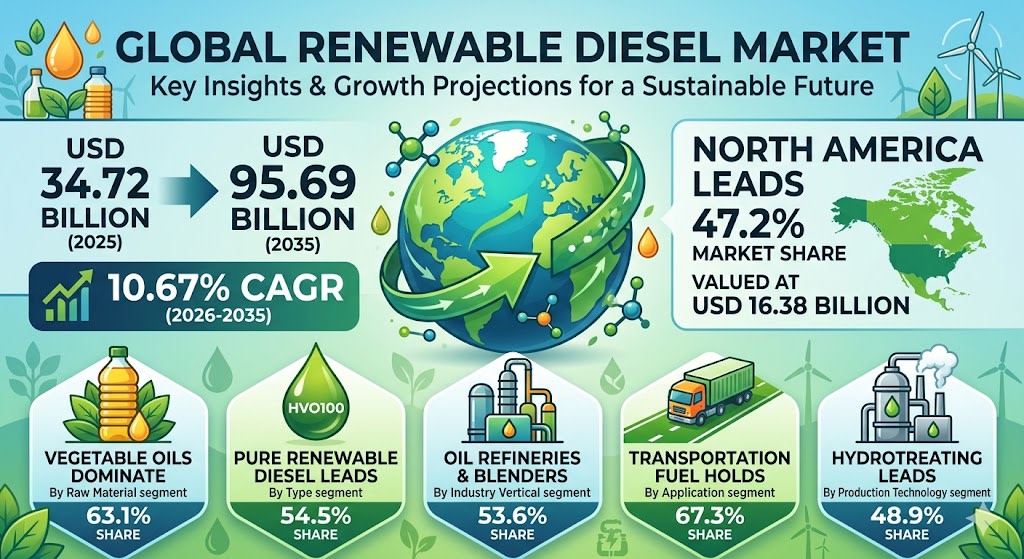
- The Global Renewable Diesel Market size USD 95.69 Billion by 2035 from USD 34.72 Billion in 2025, at a CAGR of 10.67% during the forecast period 2026 to 2035.
- North America leads with a 47.2% market share, valued at USD 16.38 Billion.
- Vegetable Oils dominate the By Raw Material segment with a 63.1% share.
- Pure Renewable Diesel (HVO100) leads the By Type segment with a 54.5% share.
- Oil Refineries and Blenders account for 53.6% of the By Industry Vertical segment.
- Transportation Fuel holds a 67.3% share in the By Application segment.
- Hydrotreating leads the By Production Technology segment with 48.9% share.
Why Renewable Diesel Is Gaining Attention
Renewable diesel is a fuel produced from biological feedstocks such as vegetable oils, animal fats, and used cooking oil. Unlike traditional biodiesel, it closely resembles petroleum diesel at the molecular level, allowing it to be used in existing diesel engines without modifications.
This compatibility is one of its greatest strengths. Fleet operators, logistics companies, and public transportation agencies can adopt renewable diesel without investing in new vehicles or fueling infrastructure. As a result, organizations seeking immediate emissions reductions often view it as a practical bridge between conventional fuels and future technologies.
Environmental performance also plays an important role. Renewable diesel can significantly reduce lifecycle greenhouse gas emissions compared to conventional diesel, making it an attractive option for companies working toward sustainability targets. In sectors where electrification remains difficult, such as long-haul trucking and aviation-related fuel production, renewable diesel offers a realistic pathway to lower carbon intensity.
The Policy Framework Driving Growth
Government policies have become one of the strongest catalysts for industry expansion. Around the world, regulators are introducing emissions-reduction targets, renewable fuel standards, and carbon-credit programs designed to encourage cleaner energy adoption.
In North America, blending requirements and low-carbon fuel initiatives provide financial incentives for renewable fuel producers and users. These programs help create stable demand by rewarding fuels with lower carbon footprints. In Europe, sustainability regulations and greenhouse-gas reduction targets are encouraging refiners and energy companies to increase renewable fuel production capacity.
Policy support reduces uncertainty for investors and producers. When long-term mandates are in place, companies are more willing to commit capital to new facilities, infrastructure upgrades, and feedstock supply agreements. This has contributed to a wave of refinery conversions and expansion projects in recent years.
At the same time, corporations are increasingly setting their own emissions goals. Many businesses now view renewable fuels not only as a compliance tool but also as a strategic asset that supports brand reputation and environmental commitments.
Feedstocks: The Foundation of the Industry
Behind every gallon of renewable diesel is a complex supply chain centered on feedstocks. Vegetable oils currently represent the largest source of raw materials because of their established production networks and compatibility with existing processing technologies.
However, the growing demand for renewable fuels is creating competition for these resources. As more producers enter the market, securing reliable feedstock supplies has become a critical factor in maintaining profitability. Price fluctuations can have a significant impact on production costs, especially when supplies are limited.
To address this challenge, companies are exploring alternative sources such as animal fats, used cooking oil, and emerging energy crops. These options can offer environmental benefits and, in some cases, lower carbon-intensity scores that qualify for additional incentives.
Feedstock diversification is increasingly viewed as a competitive advantage. Producers with access to multiple raw-material streams are often better positioned to manage market volatility and maintain stable operations.
Technology and Production Innovations
The industry's growth is closely tied to advances in production technology. Hydrotreating remains the dominant method for producing renewable diesel because it is commercially proven and compatible with existing refinery infrastructure.
Many traditional oil refiners are adapting current facilities rather than building entirely new plants. This approach reduces capital costs and accelerates production capacity growth. Converting existing assets allows companies to leverage established logistics networks, storage systems, and distribution channels.
At the same time, emerging technologies are attracting attention. Processes such as gasification and pyrolysis have the potential to expand the range of usable feedstocks, including agricultural residues, municipal waste, and certain forms of biomass. Although these technologies are still developing at commercial scale, they could help reduce dependence on conventional feedstock sources over the long term.
Innovation is also extending beyond fuel production itself. Companies are investing in cleaner hydrogen sources, improved catalyst systems, and energy-efficiency upgrades to lower carbon intensity and enhance overall economics.
Regional Trends Shaping the Market
North America currently leads global development thanks to strong policy support, expanding production capacity, and significant investment from major energy companies. The region has become a focal point for refinery conversions and large-scale renewable diesel projects.
Europe remains a major player due to ambitious climate objectives and transportation-sector decarbonization goals. Regulatory frameworks continue to encourage renewable fuel adoption, particularly in applications where electrification is not yet practical.
Meanwhile, the Asia-Pacific region is emerging as an important growth market. Countries across the region are exploring renewable fuel strategies to improve energy security, reduce emissions, and diversify fuel supplies. Growing interest from transportation and industrial sectors is expected to create new opportunities for producers and exporters.
Challenges and Opportunities Ahead
Despite strong growth prospects, the industry faces several obstacles. Feedstock availability remains one of the most significant concerns. As production capacity expands, competition for raw materials may intensify, putting pressure on margins and supply chains.
Operational challenges also exist. Equipment maintenance, catalyst availability, and evolving sustainability certification requirements can affect production efficiency and costs. Companies must navigate these issues while remaining competitive in an increasingly crowded market.
Yet the opportunities remain substantial. Demand for lower-carbon fuels continues to rise across transportation, aviation, marine shipping, and industrial applications. Businesses are seeking solutions that deliver emissions reductions without disrupting operations, and renewable diesel fits that requirement well.
As technology improves and supply chains mature, production costs may become more competitive. New feedstock sources, advanced processing methods, and stronger integration with clean-energy systems could further strengthen the industry's position in the global energy mix.
Conclusion
The Renewable Diesel Market is evolving from an emerging segment into a strategically important component of the global energy transition. Its ability to deliver lower emissions while working within existing infrastructure gives it a unique advantage in sectors that cannot easily electrify. Supported by policy incentives, technological progress, and growing corporate sustainability commitments, renewable diesel is positioned for continued expansion over the coming decade.
Although challenges related to feedstocks and operational efficiency remain, the industry's trajectory suggests increasing adoption across multiple sectors. As governments and businesses pursue practical pathways to decarbonization, renewable diesel is likely to play an increasingly important role in building a cleaner and more resilient energy future.
About the Creator
Yash Mule
SEO Specialist with 10+ years of experience at Evolvance Market Research. Expert in technical SEO, content strategy, and data-driven optimization, with a proven track record of significantly increasing organic traffic and search rankings.
Enjoyed the story? Support the Creator.
Subscribe for free to receive all their stories in your feed.
Comments
There are no comments for this story
Be the first to respond and start the conversation.