
Reconstituted Milk Market to Reach US$ 486.86 Billion by 2033 as Global Dairy Demand Drives Industry Expansion
Rising Consumption, Longer Shelf Life, and Dairy Innovation Position Reconstituted Milk as a Key Solution for Future Food Security

The global dairy industry is experiencing a remarkable transformation. As populations grow, urban lifestyles become increasingly fast-paced, and consumers seek convenient food solutions, the demand for reliable dairy products continues to rise. Among the many segments benefiting from these changes, the reconstituted milk market has emerged as one of the most promising growth areas within the broader dairy ecosystem.
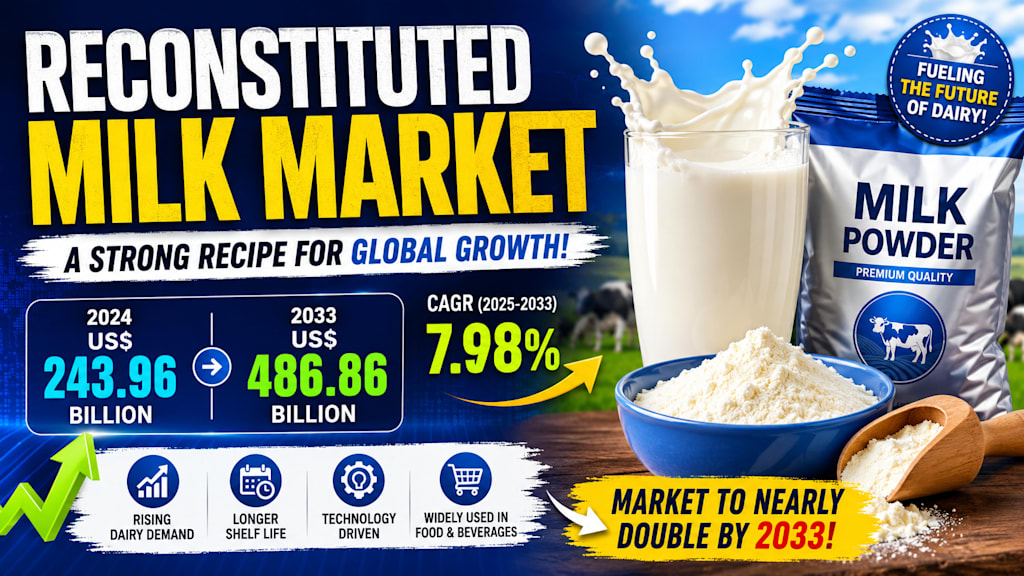
According to Renub Research, the global Reconstituted Milk Market is projected to grow from US$ 243.96 billion in 2024 to US$ 486.86 billion by 2033, registering a CAGR of 7.98% during the forecast period from 2025 to 2033. This impressive expansion reflects changing consumer behavior, growing dairy consumption, technological innovation, and increasing demand for shelf-stable food products across both developed and developing economies.
As governments, food manufacturers, and consumers seek practical solutions to address rising dairy demand, reconstituted milk is becoming an increasingly important component of global food systems.
Understanding Reconstituted Milk and Its Growing Relevance
Reconstituted milk is produced by combining milk powder with water to recreate liquid milk. The process is widely used across the world because it provides a cost-effective and practical alternative to fresh milk, particularly in regions where dairy infrastructure is limited or where transportation and refrigeration challenges exist.
Unlike fresh milk, which requires continuous refrigeration and rapid distribution, milk powder can be stored for extended periods without significant quality degradation. Once water is added, the resulting product closely resembles conventional milk and can be used for direct consumption as well as food processing applications.
The versatility of reconstituted milk makes it valuable across multiple sectors, including household consumption, bakeries, confectionery manufacturing, restaurants, hotels, dairy processing plants, and institutional food services.
As food supply chains become increasingly globalized, products that offer flexibility, affordability, and reliability continue to gain favor among both producers and consumers.
Global Dairy Demand Continues to Rise
One of the primary drivers behind the rapid growth of the reconstituted milk market is the rising worldwide demand for dairy products.
Growing populations, increasing urbanization, and improving income levels are encouraging greater consumption of milk, yogurt, cheese, butter, ice cream, and other dairy-based products. Emerging economies in Asia-Pacific, Africa, Latin America, and the Middle East are particularly important growth centers.
As millions of consumers move into the middle class, dietary preferences are shifting toward protein-rich and nutrient-dense foods. Dairy products remain a crucial source of calcium, protein, vitamins, and essential nutrients.
However, local fresh milk production often struggles to keep pace with rising demand. Seasonal fluctuations, weather-related disruptions, inadequate cold storage facilities, and transportation challenges frequently create supply shortages.
Reconstituted milk offers an effective solution by helping bridge the gap between production and consumption while maintaining affordability and accessibility.
Extended Shelf Life Creates Significant Advantages
One of the strongest advantages of reconstituted milk lies in its exceptional shelf stability.
Milk powder, the primary ingredient used in reconstitution, can be stored for months without refrigeration when packaged correctly. This dramatically reduces spoilage risks and enables efficient inventory management throughout the supply chain.
For governments and humanitarian organizations, shelf-stable dairy products provide critical support during emergencies, natural disasters, and food security programs. In remote communities where fresh milk deliveries may be unreliable, reconstituted milk ensures continuous access to dairy nutrition.
For retailers and distributors, longer shelf life translates into reduced waste, lower storage costs, and improved profitability. Consumers also benefit from greater convenience since milk powder can be stored at home for extended periods without concerns about expiration.
These advantages are becoming increasingly important as global efforts focus on reducing food waste and improving resource efficiency.
Urbanization and Changing Consumer Lifestyles Support Market Growth
Urbanization continues to reshape consumer habits around the world.
As more people relocate to cities, demand for convenient food products increases significantly. Modern consumers often seek products that require minimal preparation while maintaining nutritional value and affordability.
Reconstituted milk aligns perfectly with these preferences.
The product is easy to transport, simple to prepare, and readily available in various packaging formats. Busy households, working professionals, students, and foodservice operators appreciate the flexibility offered by milk powder-based dairy products.
In addition, growing awareness of food storage and emergency preparedness has encouraged some consumers to keep shelf-stable dairy products as part of their household inventory.
These behavioral shifts continue to strengthen market demand across diverse demographic groups.
Technological Innovations Improve Product Quality
The perception of reconstituted milk has improved considerably over the past decade, largely due to technological advancements in dairy processing.
Modern spray-drying technologies allow manufacturers to produce milk powders with superior solubility and nutritional retention. When mixed with water, these products deliver improved taste, texture, and consistency compared to earlier generations of powdered milk.
Advanced packaging technologies further enhance product quality by protecting against moisture, contamination, and environmental exposure. Improved packaging also extends shelf life and supports international transportation.
Automation and digital quality control systems are helping manufacturers achieve greater production efficiency while maintaining strict quality standards.
Perhaps most importantly, innovation has enabled the fortification of reconstituted milk with vitamins, minerals, and additional protein content. This creates opportunities for dairy companies to appeal to health-conscious consumers seeking enhanced nutritional benefits.
As technology continues to evolve, the quality gap between fresh milk and reconstituted milk is becoming increasingly narrow.
Food Manufacturing and Foodservice Applications Continue Expanding
The food manufacturing sector represents a major growth engine for the reconstituted milk market.
Milk powder serves as an essential ingredient in a wide variety of food products, including bakery items, chocolates, confectionery products, infant nutrition formulas, dairy desserts, and ready-to-eat meals.
Food manufacturers appreciate the consistency and reliability that milk powder provides. Unlike fresh milk, powdered dairy ingredients can be stored for extended periods and used precisely when needed.
The foodservice industry also relies heavily on reconstituted milk products.
Restaurants, hotels, cafés, catering companies, and institutional kitchens frequently utilize reconstituted milk due to its cost-effectiveness and ease of storage. These advantages become particularly important in large-scale food operations where inventory management and waste reduction are key priorities.
As the global hospitality sector continues to expand, demand for milk powder-based dairy ingredients is expected to rise accordingly.
Challenges That Could Impact Market Growth
Despite strong growth prospects, the reconstituted milk market faces several important challenges.
Supply Chain Dependency
The industry depends heavily on stable milk powder supplies. Weather events, geopolitical tensions, trade restrictions, transportation disruptions, and fluctuations in raw milk production can significantly affect pricing and availability.
Because milk powder is often traded internationally, global supply chain disruptions can create volatility for manufacturers and distributors.
To address these risks, many companies are diversifying sourcing strategies and investing in stronger supply chain networks.
Competition from Fresh Milk
Fresh milk remains a formidable competitor, particularly in developed markets with strong dairy infrastructure.
Many consumers perceive fresh milk as more natural, nutritious, and flavorful than reconstituted alternatives. Established dairy brands often reinforce these perceptions through marketing campaigns focused on freshness and local sourcing.
Overcoming these consumer attitudes requires continuous investment in product quality, education, and innovation.
Manufacturers must demonstrate that modern reconstituted milk products can provide comparable nutritional value and convenience while offering additional benefits such as longer shelf life.
Regional Market Insights
United States
The U.S. reconstituted milk market is benefiting from growing interest in fortified dairy products, protein-rich nutrition, and convenient food solutions.
Manufacturers are introducing flavored products, sustainable packaging, and value-added dairy offerings designed to appeal to younger consumers.
Although fresh milk continues to dominate many segments, changing consumer preferences and innovation are supporting steady market growth.
Germany
Germany represents an important European market for reconstituted milk products.
Consumers increasingly seek affordable and nutritious dairy solutions while also prioritizing environmental sustainability.
Health-focused dairy products, eco-friendly packaging, and innovative formulations are helping companies strengthen their market presence throughout the country.
India
India is expected to remain one of the fastest-growing markets globally.
Rapid urbanization, population growth, expanding retail networks, and rising dairy consumption are creating significant opportunities for manufacturers.
Affordable pricing and shelf stability make reconstituted milk particularly attractive in a country where dairy demand continues to increase across both urban and rural areas.
Saudi Arabia
Saudi Arabia's market is benefiting from changing lifestyles and increasing demand for convenient food products.
Consumers are showing greater interest in premium dairy offerings, including organic, fortified, lactose-free, and specialty milk products.
This trend is encouraging companies to diversify product portfolios and invest in innovation.
10 Recent Developments from Leading Companies
Arla Foods invested approximately US$ 213 million to expand its Pronsfeld dairy facility in Germany, significantly increasing milk processing capacity.
Lactalis continued strengthening its global dairy operations through expansion initiatives and product innovation programs.
Fonterra enhanced milk powder production capabilities to support growing international demand.
Dairy Farmers of America invested in processing infrastructure improvements to boost operational efficiency.
Saputo expanded its value-added dairy portfolio targeting convenience-focused consumers.
Mengniu Dairy accelerated digital manufacturing initiatives and supply chain modernization efforts.
Meiji Holdings increased investment in nutrition-focused dairy research and development.
Schreiber Foods expanded partnerships within foodservice and industrial dairy segments.
Pine Hill Dairy focused on strengthening regional distribution networks and product quality enhancements.
Multiple global dairy companies introduced sustainability programs aimed at reducing carbon emissions and improving packaging efficiency.
Looking Ahead
The future of the reconstituted milk market appears exceptionally promising. Rising global dairy demand, increasing urbanization, food security concerns, technological innovation, and expanding foodservice applications are creating favorable conditions for long-term growth.
As manufacturers continue improving product quality and consumers become more familiar with the benefits of shelf-stable dairy products, reconstituted milk is expected to play an increasingly important role in the global food supply chain.
With the market forecast to nearly double in value by 2033, industry participants have a significant opportunity to capitalize on evolving consumer preferences and emerging market opportunities.
Final Thoughts
The reconstituted milk industry has evolved far beyond its traditional role as a substitute for fresh milk. Today, it represents a strategic solution to some of the world's most pressing food supply challenges.
By combining affordability, convenience, nutritional value, and long shelf life, reconstituted milk is helping bridge dairy supply gaps across continents. As innovation continues and demand rises, this market is well-positioned to become one of the most influential segments within the global dairy sector over the coming decade.
About the Creator
Enjoyed the story? Support the Creator.
Subscribe for free to receive all their stories in your feed.
Comments
There are no comments for this story
Be the first to respond and start the conversation.