
Rare Earth Elements Market Benefits from Advanced Magnet Demand
How electric vehicle production, renewable energy deployment, and advanced magnet applications are accelerating demand across the rare earth elements marke

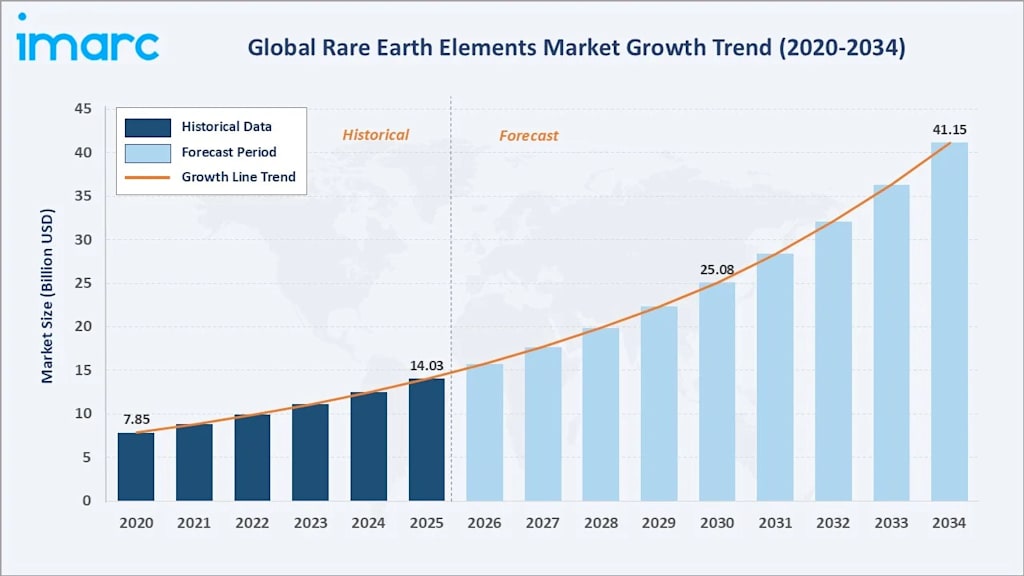
Surging demand for permanent magnets in electric vehicles, expanding renewable energy infrastructure, and tightening global defense requirements are driving rare earth elements demand, supported by clean-energy mandates, processing innovations, and strategic international supply security initiatives. According to IMARC Group’s latest data, The global rare earth elements market size was valued at USD 14.03 Billion in 2025. Looking forward, IMARC Group estimates the market to reach USD 41.15 Billion by 2034, exhibiting a CAGR of 12.32% from 2026-2034.
Rare earth elements now represent a multi-billion-dollar global market exceeding USD 14 billion and exhibiting steady year-on-year expansion. Demand is driven by the explosive growth of clean-energy electrification, industrial automation, and expanding manufacturing of high-performance electronics. Resource security, domestic mining initiatives, and technological breakthroughs in alternative extraction and refining techniques are further accelerating industry uptake. Major segments include magnets, NiMH batteries, auto catalysts, fluid cracking catalysts, and phosphors, with industries prioritizing supply chain resilience, material purity, and high-performance capabilities.
Grab Your "Rare Earth Elements Market" Intelligence Report Sample
Rare Earth Elements Market Growth Drivers:
- Surging Demand for Electric Vehicle Permanent Magnets
Automotive manufacturers heavily prioritize high-performance permanent magnets to improve vehicle efficiency, maximize driving range, and optimize motor weight. This shift directly favors the procurement of specialized neodymium, praseodymium, dysprosium, and terbium formulations over traditional induction motors. Global automotive trends show electric vehicle sales reaching 17 million units annually, requiring substantial volumes of magnet material. Brands are scaling production of advanced powertrains to meet these strict design criteria, as automakers integrate these critical minerals into mainstream automotive production lines to fulfill global zero-emission transport mandates.
- Rapid Wind Energy Infrastructure Expansion
Global investments in offshore and onshore wind power projects require massive quantities of heavy rare earth permanent magnets to secure high-efficiency power generation. Direct-drive generators rely heavily on these elements to reduce structural maintenance needs and operate reliably in harsh offshore marine environments. With international wind capacity installations exceeding 117 gigawatts annually, energy developers are locking in long-term raw material supplies. Widespread deployment across coastal and rural utility-scale projects ensures sustained demand for heavy rare earth oxides, supporting major clean energy generation targets.
- Expanding Defense and High-Tech Electronics Procurement
Aerospace, defense, and consumer tech sectors rely heavily on rare earth elements for specialized properties like exceptional thermal stability, powerful magnetism, and light emissions. These elements are essential for components in guided missiles, laser systems, sonar units, smartphones, and aircraft instrumentation. Expanding defense budgets globally drive substantial procurement of high-purity rare earth alloys. Tech firms and defense contractors use these specialized materials to improve electronic precision, protect communication networks, and ensure military equipment operates reliably under extreme conditions.
Rare Earth Elements Market Trends:
- Development of Independent Sovereign Supply Chains
Governments and industrial consortia are actively funding regional mining, separation, and refining ecosystems to mitigate geopolitical risks and reduce heavy single-source import dependencies. Legislative frameworks, such as the European Union’s Critical Raw Materials Act and targeted federal funding in North America, provide billions in capital to build domestic processing capacity. Major mining companies are setting up localized separation facilities to establish independent supply loops. These cross-border infrastructure investments ensure industries like automotive and defense have consistent access to refined materials during trade disruptions.
- Technological Advances in Extraction and Processing
Industrial operators are adopting advanced solvent extraction, ion exchange, and membrane filtration systems to boost recovery rates from lower-grade deposits while cutting operating costs. These technical innovations help mining facilities comply with strict environmental regulations by minimizing chemical consumption and waste runoff. Enterprises are implementing automated processing loops and data-driven monitoring to lower operational risks and scale output efficiently. These breakthroughs improve the commercial viability of alternative deposits, allowing processing plants to handle complex mineral matrices with minimal environmental impact.
- Commercialization of Circular Recycling and Urban Mining
Processing companies are scaling up recycling programs to extract valuable neodymium-iron-boron magnets and phosphors from end-of-life electronics, industrial scrap, and wind turbines. Establishing circular supply chains helps companies secure alternative material streams and buffer against raw material price volatility. Refiners are partnering with waste management firms to process e-waste into high-purity mixed rare earth oxides. This approach allows manufacturers to reuse secondary materials in automotive and consumer electronics production, lowering the overall environmental footprint of high-tech manufacturing.
Recent News and Developments in Rare Earth Elements Market
- August 2025: MP Materials finalized a long-term supply agreement with a major automotive manufacturer to deliver finished domestic neodymium-praseodymium magnets, establishing an integrated mine-to-magnet supply chain to support regional electric vehicle production.
- September 2025: Solvay announced a joint venture with a circular materials processor to scale up rare earth recycling operations at its France facility, focusing on recovering high-purity oxides from spent wind turbine magnets.
- September 2025: Solvay announced a joint venture with a circular materials processor to scale up rare earth recycling operations at its France facility, focusing on recovering high-purity oxides from spent wind turbine magnets.
Note: If you require specific details, data, or insights that are not currently included in the scope of this report, we are happy to accommodate your request. As part of our customization service, we will gather and provide the additional information you need, tailored to your specific requirements. Please let us know your exact needs, and we will ensure the report is updated accordingly to meet your expectations.
About the Creator
Andrew Sullivan
Hello, I’m Andrew Sullivan. I have over 9+ years of experience as a market research specialist.
Enjoyed the story? Support the Creator.
Subscribe for free to receive all their stories in your feed.
Comments
There are no comments for this story
Be the first to respond and start the conversation.