
PVC Stabilizers Market Strengthens with Advanced Material Adoption
Growing investments in industrial modernization and high-performance materials are supporting innovation and enhancing competitiveness across the PVC stabilizers value chain

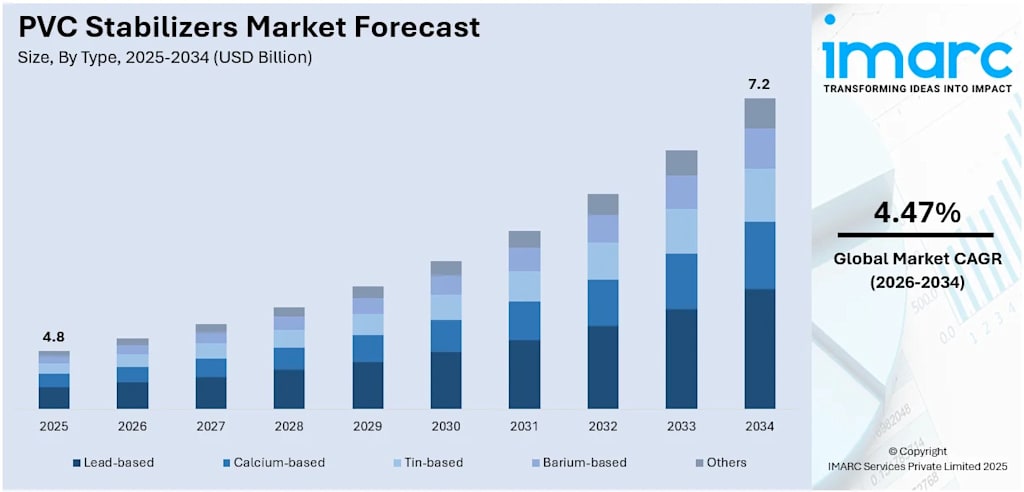
Rapid urbanization, infrastructural expansion, and the rising demand for durable, weather-resistant piping and window profiles are accelerating the global demand for PVC stabilizers. These critical chemical additives protect polyvinyl chloride from thermal and UV degradation during processing and long-term application. According to IMARC Group’s latest data, The global pvc stabilizers market size was valued at USD 4.8 Billion in 2025. Looking forward, IMARC Group estimates the market to reach USD 7.2 Billion by 2034, exhibiting a CAGR of 4.47% from 2026-2034.
The global PVC stabilizers industry represents a vital segment within the industrial additives sector, steadily expanding as polyvinyl chloride continues to serve as a foundational material across modern infrastructure. Growth is heavily supported by massive global investments in water management systems, modern building envelopes, and electrical grids requiring long-lasting insulation. As structural demands shift toward higher durability and prolonged service life, the role of high-efficiency stabilizers becomes increasingly prominent. The industry is also navigating a major technical evolution, characterized by a structural transition toward sustainable, heavy-metal-free formulations to align with strict safety mandates.
PVC Stabilizers Market Growth Drivers:
- Booming Infrastructure and Construction Projects
Rapidly growing urbanization and public infrastructure investments are forcing construction firms to prioritize highly resilient building materials. Polyvinyl chloride is favored for its long service life, lightweight properties, and corrosion resistance, creating a robust baseline demand for protective additives. Stabilizers are completely vital during the high-temperature extrusion of structural components, preventing polymer breakdown during manufacturing. Real-world applications like extensive municipal drainage layouts, modern commercial high-rises, and residential plumbing setups heavily rely on these fortified polymers.
- Expanding Needs in the Automotive Sector
Modern vehicle manufacturers are consistently incorporating lightweight plastic compounds to improve overall fuel efficiency and support the production of electric vehicles. Stabilizers play a key role here by ensuring that interior components, under-the-hood wiring, and external protective trims can withstand high thermal stress and continuous environmental exposure. Global automotive manufacturing surpassed 93 million vehicles recently, creating a substantial demand for resilient plastics. Additives ensure that visible interior dashboards and cable coverings resist cracking or color fading when exposed to intense cabin heat and ultraviolet light, directly improving the vehicle's cabin longevity and aesthetic durability over time.
- Surging Demand for Advanced Wire and Cable Insulation
The rapid expansion of the consumer electronics industry and large-scale renewable energy installations require reliable, heavy-duty electrical wiring. Power transmission grids, household electronics, and industrial machinery depend on PVC-sheathed cables for safe electrical insulation. Chemical stabilizers are blended into these flexible formulations to ensure the protective insulation remains pliable and non-reactive when subjected to constant thermal loads and electrical currents. With retail revenues for consumer electronics hitting hundreds of billions of dollars in major domestic markets, component suppliers are increasingly seeking advanced stabilizer solutions to ensure full compliance with long-term operational safety and fire prevention standards.
PVC Stabilizers Market Trends:
- Strict Regulatory Shifts Away from Lead-Based Compounds
International regulatory bodies are continuously imposing strict environmental limits to reduce toxic chemical exposure across industrial manufacturing processes. A primary example is the European Union's Regulation (EU) 2023/293, which mandated a drop in lead content within PVC polymers to less than 0.1%. This legislative pressure is forcing chemical manufacturers to accelerate the phase-out of traditional lead-based additives. As a result, industrial focus is shifting rapidly toward safer alternatives. This regulatory pressure is transforming supply chains worldwide, compelling companies to redesign production lines to handle newer additive chemistries while meeting regional environmental compliance certifications.
- Rapid Development and Adoption of Calcium-Zinc Systems
To fill the operational void left by restricted heavy metals, chemical processors are scaling up the production of advanced calcium-zinc and organic stabilizer systems. These non-toxic alternatives are highly valued because they deliver excellent thermal stability and prevent polymer discoloration without posing environmental risks during subsequent recycling phases. Industrial manufacturers utilize these systems in food-contact packaging, medical-grade tubing, and residential drinking water pipes. This material shift allows processing companies to achieve clean-label manufacturing standards, ensuring that end products can be safely reprocessed at the end of their life cycle without leaching hazardous compounds.
- Integration of High-Performance Organotin Formulations
Industrial applications requiring exceptional clarity and premium finishes are increasingly relying on organotin-based thermal stabilizers. These specialized additives are highly efficient, ensuring superior color retention and preventing degradation in both rigid sheet extrusion and transparent film packaging. Manufacturers choose these formulations due to their excellent compatibility with other processing lubricants and co-stabilizers, minimizing mechanical friction during high-speed production. This trend is highly evident across premium building aesthetics, such as clear architectural profiles, luxury vinyl flooring, and specialized protective laminates, where optical clarity and absolute material purity are non-negotiable requirements.
Recent News and Developments in PVC Stabilizers Market
- September 2025: Baerlocher GmbH introduced a next-generation series of highly efficient organic stabilizers specifically designed for recycling post-consumer PVC waste, helping processors maintain material performance while advancing circular economy targets.
- September 2025: Valtris Specialty Chemicals finalized a comprehensive modernization program at its primary manufacturing facility to boost the output of liquid and powder stabilizers compliant with updated international chemical safety regulations.
- September 2025: Songwon Industrial expanded its distribution partnership network to secure a more resilient supply chain for high-performance tin stabilizers, directly addressing the growing needs of the global packaging and building sectors.
Note: If you require specific details, data, or insights that are not currently included in the scope of this report, we are happy to accommodate your request. As part of our customization service, we will gather and provide the additional information you need, tailored to your specific requirements. Please let us know your exact needs, and we will ensure the report is updated accordingly to meet your expectations.
About the Creator
Andrew Sullivan
Hello, I’m Andrew Sullivan. I have over 9+ years of experience as a market research specialist.
Enjoyed the story? Support the Creator.
Subscribe for free to receive all their stories in your feed.
Comments
There are no comments for this story
Be the first to respond and start the conversation.