
Pulses Market Witnesses Strong Growth Amid Plant-Based Food Demand
The Pulses Market is experiencing strong growth driven by increasing consumer demand for nutritious, affordable, and sustainable protein sources.

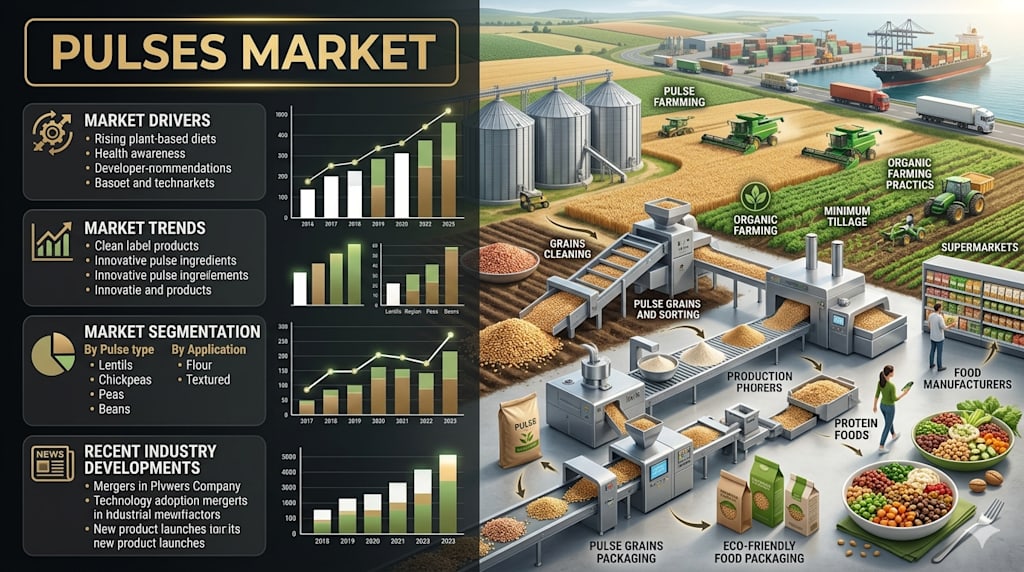
According to IMARC Group's latest research, The global pulses market size reached USD 103.2 Billion in 2025. Looking forward, IMARC Group expects the market to reach USD 138.0 Billion by 2034, exhibiting a growth rate (CAGR) of 3.20% during 2026-2034.
How AI is Reshaping the Future of Pulses Market
- Crop Yield Prediction and Climate Adaptation: Machine learning models analyze soil quality, weather patterns, and historical yields to predict optimal planting conditions and crop performance. AI-driven systems recommend stress-resistant pulse varieties, improving yield consistency by up to 25 percent while reducing dependency on climate variability.
- Supply Chain Optimization and Logistics Management: AI algorithms forecast demand across regions and optimize inventory distribution networks for pulses and processed products. Real-time tracking systems reduce spoilage by approximately 18 percent while minimizing storage costs and ensuring timely delivery to processors and retailers.
- Quality Grading and Sorting Automation: Computer vision-powered systems automatically grade pulses by size, color, and defects at speeds 10x faster than manual sorting. AI systems maintain quality consistency for export markets while reducing labor dependency and contamination risks significantly.
Pulses Industry Overview
India dominates global pulse consumption and production while Canada leads export markets, particularly for lentils and peas destined for Indian processors. Rising demand from major importing countries and government support schemes including Minimum Support Price initiatives strengthen production incentives. Favorable soil conditions across key growing regions, adoption of improved seed varieties, and climate-adapted cultivars like heat-tolerant pigeon peas enhance overall productivity. Strong export demand from countries like India, China, Brazil, and Myanmar drives international trade volume significantly.
Pulses Market Trends & Drivers
Plant-Based Protein Revolution and Health-Conscious Consumption: Consumer shift toward vegetarian and vegan diets is accelerating pulse adoption globally as affordable, nutrient-dense protein alternatives. Pulses containing high fiber, essential minerals, and amino acids align with growing wellness trends and dietary preferences. Younger demographics particularly embrace pulse-based products in ready-to-eat formats, snacks, and flour applications, driving demand across retail and food service channels worldwide.
Government Support Programs and Trade Policy Dynamics: India implemented six-year domestic production programs with increased Minimum Support Prices to boost local pulse cultivation amid weather-related supply challenges. Government procurement initiatives sanctioned 1.11 million tonnes of chickpeas and 940,000 tonnes of lentils for food security programs. Meanwhile, strategic trade policies including selective import tariffs and duty-free extensions reflect government efforts to balance domestic production growth with consumer price stability across major markets.
Processing Innovation and Value-Added Product Development: Pulse flour and protein isolate segments demonstrate fastest growth as manufacturers develop convenient ready-to-cook and ready-to-eat formats. Industrial applications expanding into plant-based snacks, functional foods, and protein supplements cater to global demand for clean-label, allergen-free alternatives. Advanced processing technologies improve shelf-life, digestibility, and nutritional profile while creating premium product categories commanding higher margins throughout distribution channels.
Pulses Market Segmentation
By Type
- Chickpeas: Major segment including Kabuli varieties, popular for hummus, snacks, and export markets
- Kaspa Peas: Largest market segment with diverse culinary and industrial applications
- Lentils: Staple crop in multiple diets; red and green varieties cater to regional preferences
- Pigeon Peas: Significant segment in Indian and East African markets with emerging heat-tolerant cultivars
- Fava Beans: Growing segment with specialty food applications
- Black Gram: Important in Asian cuisine and food formulations
- Mung Beans: Increasing demand for sprouts and processed products
- Dry Beans: Expanding segment including pinto, kidney, and specialty varieties
By End Use
- Home Use: Dominant segment representing majority of market share
- Snack Food Industry: Fast-growing segment with convenience-focused products
- Flour Industry: Expanding application in baking, pasta, and specialty foods
By Region
- India: Leading producer and consumer; represents largest consumption market
- Canada: Major exporter of lentils, peas, and chickpeas
- Myanmar: Significant production and regional supply hub
- China: Large consumer and importer of pulse varieties
- Brazil: Growing production and export capacity
- Australia: Desi chickpea and lentil exporter to Asian markets
- United States: Growing demand for plant-based ingredients
- Europe: Niche pulse fractions and specialty ingredients market
- Leading Companies Operating in Global Pulses Industry
- Hindustan Unilever Limited
- Rajma Group
- Indian Pulses Processors Association (IPPA)
- Canada Grains Council
- Pulse Canada
- Archer Daniels Midland Company
- Bunge Limited
- Cargill Incorporated
- Louis Dreyfus Company
- Associated British Foods plc
Recent News and Developments in Pulses Market
- November 2025: India implemented 30 percent import tariff on peas of all origins to protect domestic farmers and encourage local production growth. This policy shift aims to stabilize domestic pulse prices and reduce import dependency while supporting farmer incomes during elevated global supply conditions across multiple producing regions.
- November 2024: India announced higher Minimum Support Prices for rabi pulse crops harvested in February-April, including significant increases for red lentils and desi chickpeas. Government procurement sanctioned 1.11 million tonnes of chickpeas and 940,000 tonnes of lentils, demonstrating commitment to food security and domestic production expansion through targeted support mechanisms.
- June 2024: India removed import duties on chickpeas and extended duty-free imports of yellow peas until 2026 to address domestic supply shortages caused by adverse weather. Simultaneously, India launched a comprehensive six-year program to boost domestic pulse production, including improved seed varieties, precision irrigation adoption, and technology transfer to smallholder farmers across major pulse-growing regions.
- May 2024: Heat-tolerant pigeon pea cultivars underwent development and testing in India to improve yields under challenging climate conditions. These climate-adapted varieties represent agricultural innovation aimed at enhancing production resilience and addressing yield gaps between smallholder and mechanized farming systems across different growing environments.
- Early 2024: Canada witnessed strong export growth for lentils and peas destined for India, with Canadian lentil exports valued at USD 543.9 million representing 91.6 percent market share to India. Pea exports surged significantly following China's imposition of 100 percent tariffs on Canadian peas, redirecting Canadian pulse production toward Indian and alternative emerging markets.
About the Creator
Michael Richard
Michael Richard is a Market Research Expert specializing in market intelligence, competitive analysis, and data-driven insights. He helps organizations understand trends and emerging opportunities through in-depth research.
Enjoyed the story? Support the Creator.
Subscribe for free to receive all their stories in your feed.
Comments
There are no comments for this story
Be the first to respond and start the conversation.