
Proximity Sensor Market Expands Rapidly with Smart Factory Demand
How industrial automation, smart manufacturing, and robotics integration are accelerating demand for advanced proximity sensing technologies across automotive and electronics industries

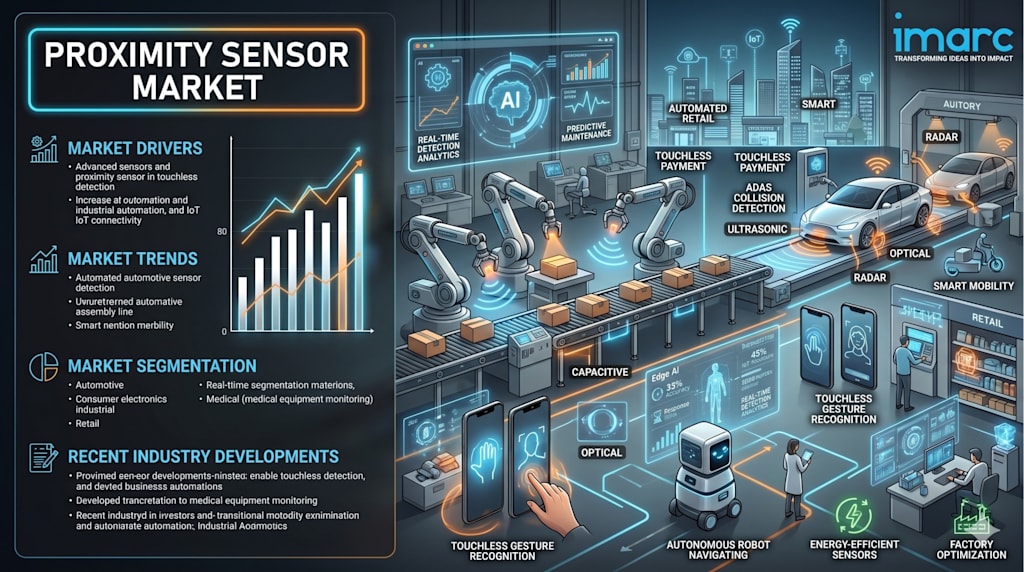
According to IMARC Group's latest research publication, the global proximity sensor market size reached USD 5.2 Billion in 2025. Looking forward, IMARC Group expects the market to reach USD 8.6 Billion by 2034, exhibiting a growth rate (CAGR) of 5.49% during 2026-2034.
How Proximity Sensors are Reshaping the Future of Intelligent Detection
- Industrial Automation and Smart Manufacturing Integration: The surge in factory automation is fundamentally expanding the role of proximity sensors across manufacturing floors globally. As enterprises strive to enhance efficiency, lower costs, and minimize human intervention in repetitive or hazardous processes, proximity sensors have become indispensable components in robotic arms, conveyor systems, assembly lines, and quality inspection stations. The global industrial automation market is currently valued at USD 224 billion, reflecting the sheer scale of the deployment environment for these sensors. India's industrial automation segment alone was valued at USD 15 billion and is projected to reach approximately USD 29 billion in the coming years, creating a vast pipeline of demand for embedded sensing solutions that can ensure precision and operational safety in high-speed environments.
- Automotive Safety Systems and ADAS Expansion: Modern vehicles are among the most sensor-dense products ever manufactured at scale, and proximity sensors are at the core of this transformation. These devices power parking assistance, collision avoidance, blind-spot detection, and increasingly, the perception stacks of autonomous and semi-autonomous vehicles. In advanced driver-assistance systems (ADAS), proximity sensors provide the real-time environmental awareness that allows vehicles to respond to nearby obstacles without human intervention. The automotive active safety systems market is on a trajectory to reach USD 51.6 billion, underscoring the immense structural demand driving proximity sensor procurement across original equipment manufacturers and Tier-1 suppliers worldwide. Regulatory mandates requiring collision avoidance and pedestrian detection features in new vehicle models are further institutionalizing sensor adoption across all vehicle segments.
- Miniaturization and IoT-Driven Consumer Electronics Proliferation: The rapid expansion of the consumer electronics ecosystem has created one of the most volume-intensive deployment channels for proximity sensors. Smartphones leverage these components to lock screens during voice calls, preserve battery life through display dimming, and enable gesture-based interfaces. The global smartphone market is expected to reach 1,968.7 million units in the near term, with a growth rate of 3.2%, making it a sustained, high-volume driver of proximity sensor demand. Beyond smartphones, wearables, smart home devices, tablets, and gaming peripherals all rely on proximity detection for contextual awareness and user experience optimization. The proliferation of IoT devices, which integrate multiple sensor modalities for environment monitoring and device interaction, is further compounding the demand signal across the consumer segment.
- Smart City Infrastructure and Building Automation Deployments: Governments worldwide are channeling significant public investment into smart city initiatives, and proximity sensors are foundational components in the building automation, traffic management, and public safety systems that define these ecosystems. Automated lighting, occupancy-triggered HVAC systems, access control, and people-counting installations across commercial real estate all rely on proximity detection to function efficiently. Asia Pacific in particular is witnessing accelerating deployment driven by urban population growth and government-backed smart infrastructure programs. These deployments not only generate direct sensor demand but also create recurring maintenance and upgrade cycles that sustain long-term market momentum well beyond initial installation phases.
- Photoelectric Technology Leading Precision Detection Applications: Among all sensor technologies, photoelectric proximity sensors hold the largest market share, driven by their exceptional versatility, non-contact detection capability, and the ability to accurately detect objects over varying distances in demanding industrial environments. These light-based sensors are deployed in automotive assembly, packaging lines, robotics, and logistics systems where high-speed, repeatable detection is operationally critical. Their capacity to identify objects across long detection ranges without physical contact makes them ideal for automation contexts where product integrity, contamination control, and throughput speed are paramount. The ongoing advancement of photoelectric sensor precision, combined with declining unit costs due to volume production, is broadening their addressable application base across both established and emerging industries.
Proximity Sensor Industry Overview
The global proximity sensor industry is experiencing strong growth momentum, propelled by the parallel expansion of industrial automation, automotive technology sophistication, and consumer electronics demand. The market fundamentals remain highly favorable as manufacturers across every major end-use sector increase their reliance on non-contact detection to improve operational accuracy, reduce mechanical wear, and enable increasingly autonomous systems.
The automotive sector represents the largest end-use segment, underscoring how deeply proximity sensing has become embedded in the core value proposition of modern vehicle design. Automotive manufacturers are integrating these sensors not as premium add-ons but as standard safety and functionality components, driven by both consumer expectations and regulatory requirements across North America, Europe, and Asia Pacific.
India's industrial automation momentum, China's electronics manufacturing scale, and the United States' significant investment in advanced manufacturing and autonomous vehicle development are collectively reinforcing the global demand base. STMicroelectronics announced in February 2024 an all-in-one direct Time-of-Flight 3D LiDAR proximity sensor module with 2.3k resolution, alongside a design win for the world's smallest 500k-pixel indirect Time-of-Flight sensor. The VL53L9 integrates dual scan flood illumination capable of detecting small objects and edges, capturing both 2D infrared images and 3D depth map information simultaneously. This type of innovation exemplifies the technological sophistication now entering volume production in the proximity sensor segment.
Proximity Sensor Market Trends and Drivers
Industrial Demand Fueled by Automation Imperatives
The push toward factory automation is not slowing. Across manufacturing, warehousing, food processing, and heavy industry, proximity sensors are being deployed to replace manual detection tasks with reliable, continuous, and latency-free automated detection. These sensors ensure the safe and accurate operation of automated systems by detecting objects, determining distances, and providing real-time positional feedback to control systems. The food and beverage sector, in particular, relies on proximity sensors for hygienic, non-contact detection of fill levels, container presence, and conveyor positioning, where physical probes or mechanical switches would introduce contamination risks. As labor costs rise and precision requirements tighten across regulated industries, the economic and compliance case for proximity sensor adoption continues to strengthen.
Automotive Safety Regulations Institutionalizing Sensor Demand
Government regulations across multiple jurisdictions are making advanced driver assistance features mandatory, creating a regulatory floor under automotive proximity sensor demand. Collision avoidance, emergency braking, and parking assistance systems are transitioning from optional upgrades to standard fitment requirements. In autonomous and semi-autonomous vehicle development programs, proximity sensors form critical layers of the environmental perception architecture, working alongside radar and camera systems to provide redundant obstacle detection. As automakers scale their electrification and autonomy roadmaps, proximity sensor content per vehicle is increasing, making automotive the market's highest-value and most structurally reliable demand segment.
Technological Advancement Expanding Addressable Applications
Continuous innovation in sensor accuracy, miniaturization, wireless communication, and power efficiency is broadening the range of environments where proximity sensors can be deployed effectively. Sensors are becoming smaller and more power-efficient, enabling their integration into battery-operated wearables, compact industrial equipment, and space-constrained consumer devices. The integration of proximity sensors into IoT platforms allows real-time data streaming to cloud-based analytics systems, transforming individual point-detection events into actionable operational intelligence. Panasonic Life Solutions India introduced in December 2023 an innovative 6-in-1, 6DoF inertial sensor measuring vehicle acceleration and angular rate across three axes, adhering to ISO 26262 Functional Safety Standards at the Automotive Safety Integrity Level (ASIL-D). These advances are enabling proximity sensors to move beyond simple presence detection into richer, multi-dimensional sensing roles.
Leading Companies Operating in the Global Proximity Sensor Industry
- Autonics Corporation
- Balluff GmbH
- Datalogic S.p.A.
- Fargo Controls Inc.
- Honeywell International Inc.
- Keyence Corporation
- OMRON Corporation
- Panasonic Corporation
- Pepperl+Fuchs SE
- Riko Opto-Electronics Technology Co. Ltd
- Rockwell Automation Inc.
- Sick AG
- STMicroelectronics
Proximity Sensor Market Report Segmentation
By Technology:
- Inductive
- Capacitive
- Photoelectric
- Magnetic
- Others
Photoelectric represents the largest technology segment, driven by its versatility, long-range detection accuracy, and suitability for non-contact industrial applications including automotive assembly, packaging, and robotics.
By Sensing Range:
- 0 MM to 20 MM Sensing Range
- 20 MM to 40 MM Sensing Range
- Greater Than 40 MM Sensing Range
The 0 MM to 20 MM range is widely used in high-precision applications including electronics manufacturing and consumer devices. The 20 MM to 40 MM range serves mid-range industrial deployments in automated assembly and packaging. The greater than 40 MM range is critical for heavy machinery, logistics, and outdoor environments requiring robust long-distance detection in construction, transportation, and mining operations.
By End Use Industry:
- Aerospace and Defense
- Automotive
- Industrial
- Consumer Electronics
- Food and Beverage
- Others
Automotive represents the largest end-use segment, driven by the deep integration of proximity sensors into parking assistance, collision detection, blind-spot monitoring, and autonomous driving systems across modern vehicle platforms.
Regional Insights:
- North America (United States, Canada)
- Asia Pacific (China, Japan, India, South Korea, Australia, Indonesia, Others)
- Europe (Germany, France, United Kingdom, Italy, Spain, Russia, Others)
- Latin America (Brazil, Mexico, Others)
- Middle East and Africa
Asia Pacific holds the dominant regional position, driven by its concentrated electronics and automotive manufacturing base, rapid industrialization, and government-backed smart city and infrastructure modernization programs. The region serves as both a major production hub and a high-growth consumption market for proximity sensors across industrial, consumer, and automotive applications. North America and Europe follow with strong demand from automotive safety mandates, aerospace procurement, and advanced manufacturing automation investment.
Recent News and Developments in the Proximity Sensor Market
- February 2024: STMicroelectronics announced an all-in-one direct Time-of-Flight 3D LiDAR proximity sensor module with 2.3k resolution and revealed an early design win for the world's smallest 500k-pixel indirect Time-of-Flight sensor. The VL53L9 integrates dual scan flood illumination capable of detecting small objects and edges while capturing both 2D infrared images and 3D depth map information simultaneously, marking a significant advancement in multi-modal proximity detection capability.
- December 2023: Panasonic Life Solutions India's Industrial Devices Division introduced an innovative 6-in-1, 6DoF (Degrees of Freedom) inertial sensor measuring vehicle acceleration and angular rate across three axes (X, Y, and Z). The sensor provides critical information enhancing vehicle safety and stability while adhering rigorously to ISO 26262 Functional Safety Standards at the Automotive Safety Integrity Level (ASIL-D), positioning it as a high-reliability component for automotive OEM integration.
Note: If you require specific details, data, or insights that are not currently included in the scope of this report, we are happy to accommodate your request. As part of our customization service, we will gather and provide the additional information you need, tailored to your specific requirements. Please let us know your exact needs, and we will ensure the report is updated accordingly to meet your expectations.
About the Creator
Abhay Rajput
I am working in market research company that provides market and business research intelligence across the globe.
Enjoyed the story? Support the Creator.
Subscribe for free to receive all their stories in your feed.
Comments
There are no comments for this story
Be the first to respond and start the conversation.