
Pressure Sensor Market Outlook: Smart Sensing Technologies and Growth Opportunities
The Pressure Sensor Market is experiencing strong growth driven by increasing demand for precise measurement and monitoring across industries such as automotive, healthcare, industrial automation, and consumer electronics.

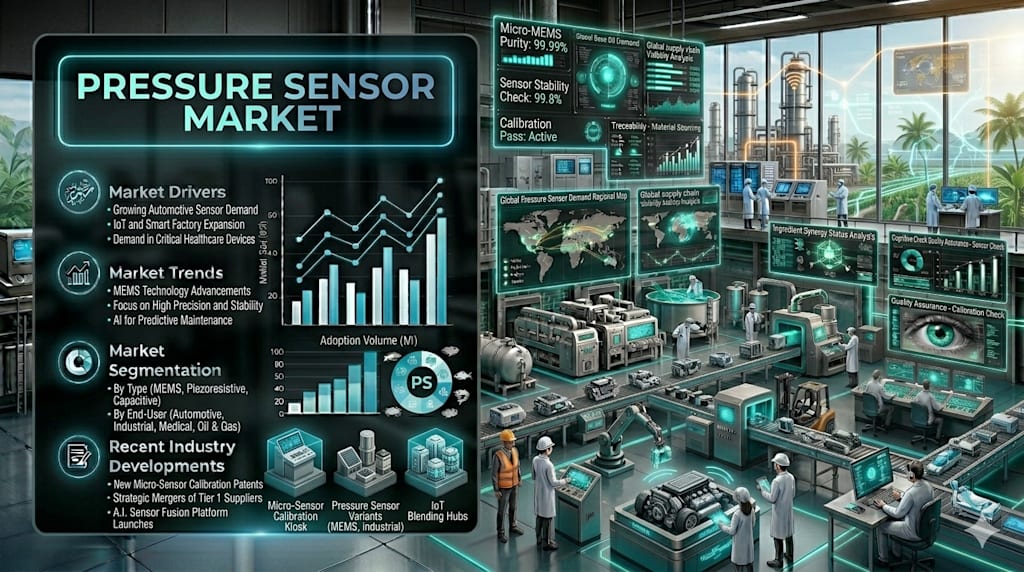
According to IMARC Group’s latest research publication, the global pressure sensor market size was valued at USD 19.1 Billion in 2025. Looking ahead, the market is expected to reach USD 37.0 Billion by 2034, exhibiting a CAGR of 7.41% during 2026–2034.
The pressure sensor market is expanding steadily due to increasing industrial automation, growing adoption of IoT-enabled systems, and rising demand for precise monitoring across multiple sectors. Pressure sensors are widely used in manufacturing, automotive systems, healthcare devices, and energy infrastructure to measure and regulate pressure levels, ensuring operational safety and efficiency.
Role of AI in Pressure Sensor Applications
- Artificial intelligence has started to improve on pressure sensors for various uses․ Predictive Maintenance and Failure Detection: AI-based algorithms analyze data gathered through pressure sensors to identify failure before it occurs․ This leads to predictive maintenance‚ and decreased downtime for industrial equipment․ Machine learning models can also detect anomalies in real time‚ improving reliability and longevity of equipment․
- Smart Calibration and Environmental Compensation: AI algorithms use measurement data to automatically compensate for environmental factors such as changes in temperature and voltage․ High-end AI-based systems maintain accuracy even in extreme environmental conditions․
- Real-Time Process Optimization: AI systems analyze pressure data and optimize industrial processes based on real-time analysis․ They can automatically adjust processing parameters to improve efficiency‚ safety‚ and reduce unplanned manufacturing downtimes․
Pressure Sensor Industry Overview
Industrial automation and the increased use of IoT technologies could expand pressure sensor use to applications beyond customary boundaries‚ especially with the emergence of the AIoT (Artificial Intelligence of Things)‚ which enable advanced monitoring solutions using clever sensing and analytics capabilities․ Wireless technologies have also been developed such as Bluetooth Low Energy‚ LoRaWAN (Low Power Wide Area Networking)‚ which remove the need to wire systems together‚ especially in harsh or narrow industrial environments․
Pressure Sensor Market Trends and Drivers
Rising Demand for Industrial Automation: Increasing adoption of industrial automation is increasing the demand for pressure sensors in manufacturing and logistics applications․ Robotic systems‚ hydraulics‚ automated warehouses‚ and manufacturing assembly lines are all deploying pressure sensors in their monitoring systems․ Sensors connected to the IoT platforms can monitor process parameters like pressure‚ temperature‚ and vibration in real time‚ increasing efficiency and reducing unexpected failures․
Growth in Automotive and Electric Vehicles: Automotive is the largest application of pressure sensors including TPMS‚ engine management‚ emission control‚ brake systems‚ and battery safety․ The introduction of electric vehicles is taking the sensor market further‚ providing the capability to add safety features within the system‚ save energy and support the development of new vehicle technologies‚ such as autonomous driving systems․
Pressure sensors are used in a variety of medical devices such as breathing devices‚ diagnostic equipment‚ and wearable medical equipment․ Medical pressure sensors must have high accuracy and reliability because their measurements are critical․ Building automation is including sensors to improve HVAC efficiency and energy management in smart buildings․ Consumer electronics is a developing market‚ with pressure sensors used within smartphones‚ wearables and home automation․
Key players operating in the global pressure sensor industry include:
- ABB Ltd
- All Sensors Corporation (Amphenol)
- Bosch Sensortec GmbH (Robert Bosch GmbH)
- Endress+Hauser Group Services AG
- Honeywell International Inc.
- Infineon Technologies AG
- Kistler Group
- NXP Semiconductors N.V.
- Rockwell Automation Inc.
- Sensata Technologies Inc.
- Siemens AG
- Texas Instruments Incorporated
- Market Segmentation
- By Product
- Absolute Pressure Sensors
- Differential Pressure Sensors
- Gauge Pressure Sensors
Absolute pressure sensors hold the largest share due to their ability to provide stable and accurate readings using a vacuum reference.
By Type
- Wired
- Wireless
Wired sensors dominate the market, supported by their reliability and consistent performance across various operating environments.
By Technology
- Piezoresistive
- Electromagnetic
- Capacitive
- Resonant Solid-State
- Optical
- Others
Piezoresistive sensors lead the segment due to high sensitivity and strong thermal stability.
By Application
- Automotive
- Oil and Gas
- Electronics
- Medical
- Industrial
- Others
The automotive segment accounts for the largest share, driven by increasing integration of sensor technologies for safety and performance improvements.
Regional Insights
- North America
- Asia Pacific
- Europe
- Latin America
- Middle East and Africa
Asia Pacific leads the global pressure sensor market, supported by strong manufacturing activity, rapid technological adoption, and increasing industrial demand.
Recent Developments
- In June 2025‚ Bosch introduced the SMP290 tire pressure sensor‚ which uses Bluetooth for direct communication to smartphones and needs less energy․
- Crane Company announced plans to acquire Precision Sensors & Instrumentation in June 2025‚ expanding its sensor technology portfolio․
- May 2025: IFM introduced new high-resolution pressure sensors for hygienic processes‚ for instance in the food and beverage industry․
- In April 2025‚ Trensor announced that it would open its first manufacturing facility outside North America in Malaysia․
- In March 2025‚ Honeywell released the TruStability NSC Series of sensors with user-selectable calibration points and improved accuracy and repeatability․
Note: If you require specific details, data, or insights that are not currently included in the scope of this report, we are happy to accommodate your request. As part of our customization service, we will gather and provide the additional information you need, tailored to your specific requirements. Please let us know your exact needs, and we will ensure the report is updated accordingly to meet your expectations.
About the Creator
Olivia Smith
Olivia Smits is a Research and Marketing Analyst who specializes in market research, trend analysis, and consumer insights. I help businesses make smarter marketing and strategy decisions by turning data into clear, actionable insights.
Enjoyed the story? Support the Creator.
Subscribe for free to receive all their stories in your feed.
Comments
There are no comments for this story
Be the first to respond and start the conversation.