
Powering Tomorrow: The Global Surge of Lithium-Ion Batteries
From electric cars to clean energy storage, a fast-growing technology is reshaping how the world runs on power

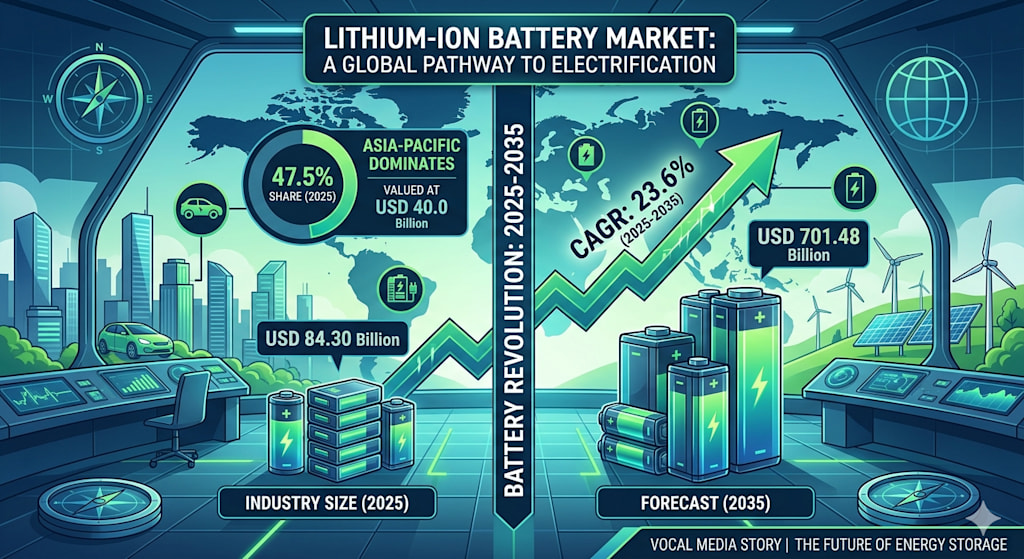
Powering the Future – The Global Rise of Lithium-Ion Batteries
Across the world, a quiet transformation is underway. It’s not happening on stage or in headlines every day, but it’s shaping how we travel, how we store energy, and how we live. At the center of this shift is a powerful technology—lithium-ion batteries.
These batteries are now everywhere. They power our phones, laptops, electric cars, and even entire energy systems. And their importance is only growing. In 2025, the global lithium-ion battery market is valued at just over 84.30 billion dollars. But within the next decade, that number could rise to more than 701.48 billion dollars.
This isn’t just growth—it’s a massive surge.
Market Highlights
- The Global Lithium-ion Battery Market valued at USD 84.30 Billion in 2025, projected to reach USD 701.48 Billion by 2035, at a CAGR of 23.6% during the forecast period 2026-2035
- Asia-Pacific dominates the market with 47.5% share, valued at USD 40.0 Billion in 2025
- Lithium Cobalt Oxide (LCO) segment dominates By Battery Type with 43.5% market share in 2025
- Automotive application leads with 47.2% share, driven by electric vehicle demand
- Electric Vehicle (EV) Industry holds 41.7% share in By End User segment
- The 3,001 to 10,000 mAh capacity range captures 37.6% market share.
So, what’s behind it?
The biggest driver is the rise of electric vehicles. Around the world, carmakers are moving away from petrol and diesel engines. Governments are setting targets to reduce emissions, and consumers are becoming more open to electric cars. Every electric vehicle relies on a battery, and that demand is pushing the industry forward at high speed.
The world is turning to renewable energy. Solar panels and wind turbines are producing cleaner electricity, but they don’t generate power all the time. That’s where batteries come in. Lithium-ion systems can store energy when it’s available and release it when needed—making renewable energy more reliable.
Together, electric transport and clean energy are driving a powerful shift.
Behind the scenes, production is expanding rapidly. Countries in Asia, especially China, are leading the way. Massive factories—often called gigafactories—are producing batteries at an enormous scale. This high production volume helps lower costs, making batteries more affordable for companies and consumers alike.
Lower costs are a key part of the story. In recent years, battery prices have dropped significantly. This makes electric cars more competitive with traditional vehicles and allows businesses to invest in energy storage systems without huge financial risk.
Today’s batteries last longer, charge faster, and store more energy than before. Some new systems can charge a vehicle in less than 20 minutes. Researchers are even working on next-generation batteries that could be safer and more powerful.
But not all lithium-ion batteries are the same.
Different types are used for different purposes. Some are designed for small devices like smartphones and laptops. These batteries focus on high energy in a compact size. Others are built for electric vehicles, where balance between power, safety, and range is essential.
There are also batteries made for large-scale energy storage. These systems can power homes, businesses, or even entire neighborhoods during outages or peak demand times.
In fact, the use of lithium-ion batteries has expanded far beyond consumer electronics. While phones and laptops still rely on them, the biggest growth now comes from transportation and energy systems.
The automotive sector alone accounts for nearly half of total battery demand. Electric vehicles require large battery packs, often made up of thousands of individual cells working together. These packs are carefully designed to ensure safety, performance, and long life.
Energy storage systems are another fast-growing area. Utilities and companies are installing large battery units to manage electricity supply more efficiently. These systems help reduce energy waste and support the transition to cleaner power sources.
Even industries like healthcare and telecommunications depend on batteries for backup power and portable equipment. From hospital devices to remote communication towers, reliable energy storage is essential.
However, this rapid growth comes with challenges.
One of the biggest concerns is safety. Lithium-ion batteries can overheat if damaged or poorly managed. In rare cases, this can lead to fires. As a result, companies and governments are focusing on stricter safety standards and better battery management systems.
Another challenge is the supply of raw materials. Batteries require elements like lithium, cobalt, and nickel. These materials are mined in specific regions, and supply can be affected by political, economic, or environmental factors. Price fluctuations can create uncertainty for manufacturers and slow down production.
There is also the issue of cost. While prices have dropped, batteries are still expensive to produce. Building factories, developing technology, and securing materials all require significant investment.
But the industry is working to overcome these barriers.
One promising solution is recycling. Instead of relying only on new raw materials, companies are developing ways to recover valuable elements from used batteries. This not only reduces waste but also strengthens supply chains and lowers costs over time.
Another trend is the push for local production. Countries in North America and Europe are investing in their own battery factories to reduce dependence on imports. Government incentives and partnerships are helping accelerate this shift.
Meanwhile, innovation continues at a rapid pace. Scientists are exploring new battery designs, including solid-state technology, which could offer higher energy density and improved safety. While still in development, these advancements could redefine the market in the future.
The impact of lithium-ion batteries is not limited to industry. It’s changing everyday life.
Electric cars are becoming more common on roads. Homes are installing battery systems to store solar energy. Portable devices are lasting longer on a single charge. Even public transportation systems are moving toward electric power.
All of this points to a larger transformation.
The world is moving toward cleaner, more efficient energy systems—and lithium-ion batteries are at the heart of that change.
The market is expected to grow at an impressive pace. As technology improves and costs continue to fall, adoption will likely increase across multiple sectors. Governments, businesses, and consumers are all playing a role in this transition.
What started as a solution for portable electronics has now become a key pillar of the global energy future.
This is more than just a technological shift. It’s a rethinking of how energy is stored, used, and managed.
And as lithium-ion batteries continue to evolve, they are not just powering devices—they are powering a new era.
About the Creator
Yash Mule
SEO Specialist with 10+ years of experience at Evolvance Market Research. Expert in technical SEO, content strategy, and data-driven optimization, with a proven track record of significantly increasing organic traffic and search rankings.
Enjoyed the story? Support the Creator.
Subscribe for free to receive all their stories in your feed.
Comments
There are no comments for this story
Be the first to respond and start the conversation.