
Power on Demand: The Rise of Grid Energy Storage
As clean energy grows, large-scale battery systems are transforming how electricity is stored, managed, and delivered worldwide

Storing Power for Tomorrow – The Rapid Rise of Grid Energy Storage
Around the world, the way we produce and use electricity is changing fast. More countries are turning to clean energy sources like solar and wind. These sources are better for the environment, but they come with one big challenge—they don’t produce power all the time.
The sun doesn’t always shine, and the wind doesn’t always blow.
So how do we keep the lights on when energy isn’t being generated?
The answer lies in grid energy storage.
Grid energy storage systems are designed to store electricity when it is available and release it when it is needed. Think of them as giant batteries connected to the power grid. They help balance supply and demand, making electricity systems more stable and reliable.
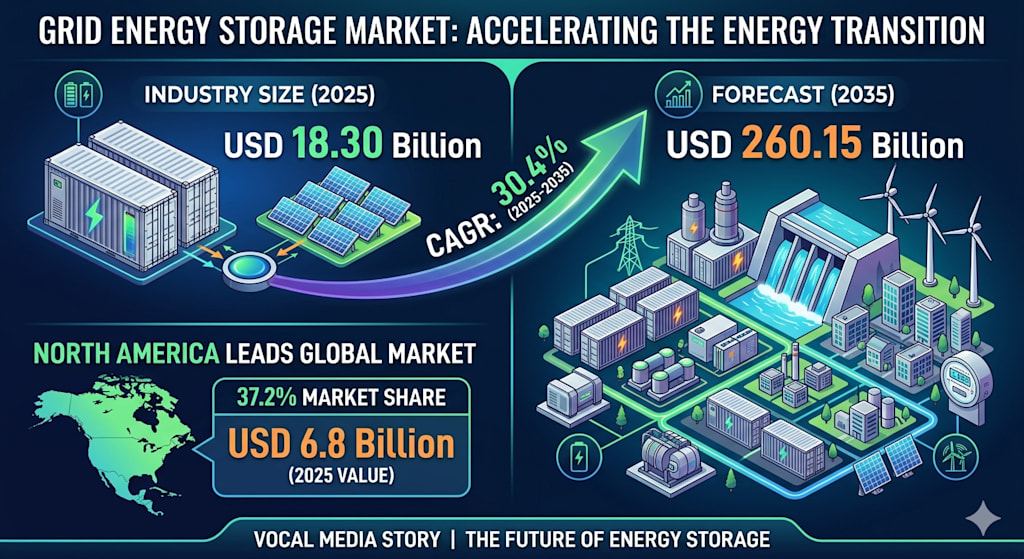
In 2025, the global Grid Energy Storage Market is valued at just over 18.30 billion dollars. But by 2035, it could reach more than 260.15 billion dollars. That’s a massive jump, showing how important this technology has become.
One of the biggest reasons for this growth is the push toward clean energy. Governments around the world are setting targets to reduce carbon emissions. To meet these goals, they are investing heavily in renewable energy—and that requires storage.
Without storage, much of the energy produced by solar and wind can go to waste. With storage, that energy can be saved and used later, especially during times of high demand.
Market Highlights
- The Global Grid Energy Storage Market valued at USD 18.30 Billion in 2025, reaching USD 260.15 Billion by 2035, at a CAGR of 30.4% from 2026 to 2035.
- North America leads all regions with 37.2% market share, valued at USD 6.8 Billion
- Front-of-the-Meter (FIM) segment dominates with 58.6% market share in 2025
- Lithium-ion chemistry holds 64.2% of the battery chemistry segment in 2025
Another key factor is the rising demand for electricity. As populations grow and industries expand, energy use continues to increase. At the same time, extreme weather events are putting pressure on power systems. Heatwaves, for example, can cause sudden spikes in electricity demand.
Grid storage helps manage these peaks. It allows operators to store energy when demand is low and release it when demand is high. This not only improves reliability but can also reduce costs.
Large-scale storage systems, often connected directly to the power grid, are leading the way. These systems are known as “front-of-the-meter” storage. They are used by utilities to support entire regions, providing backup power and stabilizing the grid.
These systems have proven their value. During periods of high demand, they have helped prevent blackouts by supplying additional power when it was needed most. This has made them a key part of modern energy planning.
Smaller storage systems are becoming more common. These are installed at homes, businesses, and industrial sites. Known as “behind-the-meter” storage, they allow users to store their own electricity, often generated from solar panels.
For homeowners, this means more control over energy use and lower electricity bills. For businesses, it provides backup power and protection against outages, which can be costly.
One of the most important technologies behind these systems is the lithium-ion battery. This type of battery is widely used because it is efficient, reliable, and increasingly affordable. Thanks to large-scale manufacturing, costs have dropped significantly over the past few years.
However, lithium-ion is not the only option. New technologies are emerging, offering different advantages. Some are designed for longer storage times, while others use more abundant materials. These innovations are helping expand the range of applications for energy storage.
Despite its rapid growth, the grid energy storage market does face challenges.
One major issue is the cost of raw materials. Prices for key materials like lithium can change quickly, making it difficult for companies to plan long-term projects. These fluctuations can affect the overall cost of building storage systems.
Another challenge is the time it takes to connect new projects to the grid. In many regions, there is a backlog of projects waiting for approval. This can delay the rollout of new storage systems and slow down progress.
Still, the industry is moving forward.
Governments are playing a major role in supporting growth. Many countries are offering incentives, funding programs, and tax benefits to encourage investment in energy storage. These policies are helping reduce financial risks and attract more companies to the market.
Private investment is increasing. Companies are signing long-term contracts to secure storage capacity, ensuring they have access to reliable energy in the future.
New systems are becoming more efficient, easier to install, and capable of storing energy for longer periods. Some are even designed in modular formats, allowing them to be expanded as needed.
Regionally, North America is currently leading the market. Strong government support and large-scale projects have driven rapid growth in the United States and Canada. Europe is also expanding quickly, with many countries investing in storage to support their clean energy goals.
Asia-Pacific is another major player. Countries like China are building large storage systems to support their growing renewable energy capacity. These developments are helping drive global supply and reduce costs.
The role of grid energy storage will only become more important.
As the world continues to move toward cleaner energy, the need for reliable storage will grow. Without it, renewable energy cannot reach its full potential. With it, power systems can become more flexible, efficient, and resilient.
This is not just about technology—it’s about building a better energy system for the future.
From preventing blackouts to supporting clean energy, grid storage is changing how electricity works. It’s helping create a system that is not only more sustainable but also more reliable for everyone.
And while most people may never see these systems, their impact will be felt every day—in the power that keeps homes running, businesses operating, and cities alive.
In many ways, grid energy storage is becoming the backbone of the modern energy world.
A silent force, storing power for when it matters most.
About the Creator
Yash Mule
SEO Specialist with 10+ years of experience at Evolvance Market Research. Expert in technical SEO, content strategy, and data-driven optimization, with a proven track record of significantly increasing organic traffic and search rankings.
Enjoyed the story? Support the Creator.
Subscribe for free to receive all their stories in your feed.
Comments
There are no comments for this story
Be the first to respond and start the conversation.