
Power Electronics Market Insights: Robotics Adoption, Factory Automation & Industry Forecast to 2034
How robotics adoption, industrial electrification, and automation technologies are increasing reliance on high-efficiency power electronics components and systems across manufacturing industries

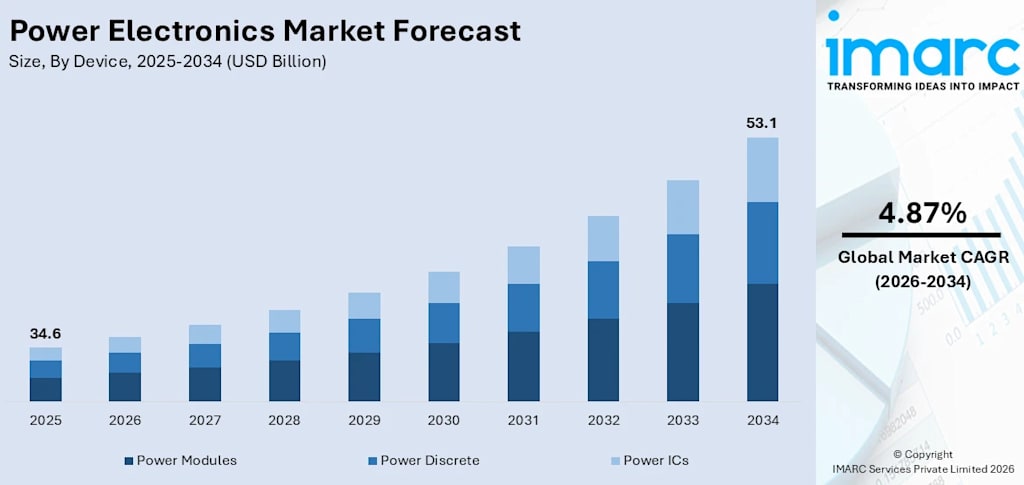
Rising demand for energy-efficient systems, the rapid electrification of the automotive sector, and the expansion of renewable energy infrastructure are driving the global power electronics market. Supported by the adoption of wide-bandgap semiconductors like Silicon Carbide (SiC) and Gallium Nitride (GaN), the industry is witnessing a shift toward higher power density and miniaturization in industrial and consumer applications. According to IMARC Group’s latest data, the global power electronics market size was valued at USD 34.6 Billion in 2025. Looking forward, IMARC Group estimates the market to reach USD 53.1 Billion by 2034, exhibiting a CAGR of 4.87% from 2026-2034.
The power electronics sector has evolved into a critical pillar of the modern energy economy, now representing a multi-billion-dollar global industry essential for the transition to a low-carbon future. Growth is primarily propelled by the aggressive roll-out of electric vehicles (EVs), where power modules are indispensable for traction inverters and onboard chargers. Furthermore, the integration of solar and wind energy into national grids relies heavily on sophisticated converters and inverters to manage variable outputs.
Power Electronics Market Growth Drivers:
- Accelerated Adoption of Electric and Hybrid Vehicles
The automotive industry’s pivot toward electrification is a primary engine for market expansion. Modern electric vehicles require complex power electronic systems, including DC-DC converters and battery management systems, to optimize range and performance. With global EV sales reaching nearly 17 million units recently, the demand for high-performance modules has surged. Manufacturers are increasingly adopting Silicon Carbide technology to handle 800V architectures, which allow for faster charging times and reduced vehicle weight. This transition is further supported by government mandates worldwide aiming to phase out internal combustion engines by the next decade.
- Integration of Renewable Energy and Smart Grids
Decarbonization efforts across the globe are forcing a massive overhaul of aging power infrastructures. Renewable energy sources, such as solar and wind, generate DC power or variable AC that must be converted to stable grid-quality electricity. Power electronics provide the necessary switching and control mechanisms to minimize energy loss during this conversion. Schemes like the U.S. Inflation Reduction Act and India’s PM-KUSUM are funneling billions into green energy projects, directly boosting the need for utility-scale inverters. As nations strive to reach net-zero targets, the reliance on these components for grid stabilization becomes a non-negotiable requirement.
Get Instant Access to the "Power Electronics Market" Sample Report for Free!
- Advancements in Wide-Bandgap (WBG) Semiconductors
The industry is moving beyond the physical limitations of traditional silicon to leverage the superior properties of Silicon Carbide (SiC) and Gallium Nitride (GaN). These materials allow devices to operate at much higher temperatures, voltages, and frequencies while significantly reducing energy dissipation. This technological leap is crucial for data centers, which currently consume approximately 1% to 2% of global electricity. By utilizing GaN-based power supplies, data centers can achieve higher efficiency in a smaller footprint, reducing cooling costs and operational expenses. The commercialization of these materials is transforming sectors from aerospace to consumer electronics.
Power Electronics Market Trends:
- Strategic Shift Toward Silicon Carbide (SiC) Commercialization
A major trend is the rapid scaling of SiC production to meet the demands of the high-voltage EV market. Leading semiconductor firms are investing heavily in 200mm wafer fabrication to lower costs and increase supply. For example, major players are establishing dedicated SiC corridors to ensure a steady flow of material for automotive OEMs. This shift is not just about material science but about systemic efficiency; SiC-based inverters can improve overall EV efficiency by up to 10%, translating to smaller battery packs and lower total vehicle costs for consumers in the long run.
- Rise of AI-Driven Power Management and Generative Design
Artificial Intelligence is being integrated into the design and operation of power electronic systems to enhance reliability and performance. AI algorithms are now used to forecast thermal behavior in high-power modules, allowing for proactive cooling adjustments and preventing hardware failure. In industrial settings, AI-enhanced motor drives are optimizing energy consumption by adjusting to load changes in real-time. Furthermore, engineers are utilizing generative design software to explore thousands of circuit iterations, achieving unprecedented power densities that were previously impossible with traditional manual design methods, particularly in miniaturized consumer devices.
- Industrial Electrification and Industry 4.0
The emergence of Industry 4.0 is driving the adoption of automated assembly lines and robotics, all of which require precise power control. Variable frequency drives (VFDs) and high-efficiency motor controllers are being deployed to reduce the carbon footprint of heavy manufacturing and oil and gas operations. This trend toward "all-electric" industrial platforms is gaining momentum as companies seek to mitigate rising energy costs. Modern factories are now integrating smart power modules that provide diagnostic data, allowing for predictive maintenance and reducing unplanned downtime in critical production environments.
Recent News and Developments in the Power Electronics Market:
- May 2026: Delta Electronics showcased its latest AI-integrated power solutions at SEMICON Southeast Asia, highlighting new semiconductor packaging techniques designed to enhance power density for next-generation data center applications.
- March 2026: A strategic collaboration was announced between major semiconductor leaders to accelerate the development of 300mm GaN-on-Silicon technology, aiming to make high-efficiency power electronics more affordable for the mass consumer market.
- February 2026: Solis Inverters expanded its product line in the North American market by introducing high-capacity string inverters, specifically designed to support utility-scale solar projects and improve grid integration efficiency.
Note: If you require specific details, data, or insights that are not currently included in the scope of this report, we are happy to accommodate your request. As part of our customization service, we will gather and provide the additional information you need, tailored to your specific requirements. Please let us know your exact needs, and we will ensure the report is updated accordingly to meet your expectations.
About the Creator
Andrew Sullivan
Hello, I’m Andrew Sullivan. I have over 9+ years of experience as a market research specialist.
Enjoyed the story? Support the Creator.
Subscribe for free to receive all their stories in your feed.
Comments
There are no comments for this story
Be the first to respond and start the conversation.