
Polyvinyl Chloride Market Gains Momentum Amid Infrastructure Demand
How infrastructure expansion, urban development, and rising construction activities are accelerating demand for durable and cost-effective polyvinyl chloride materials worldwide

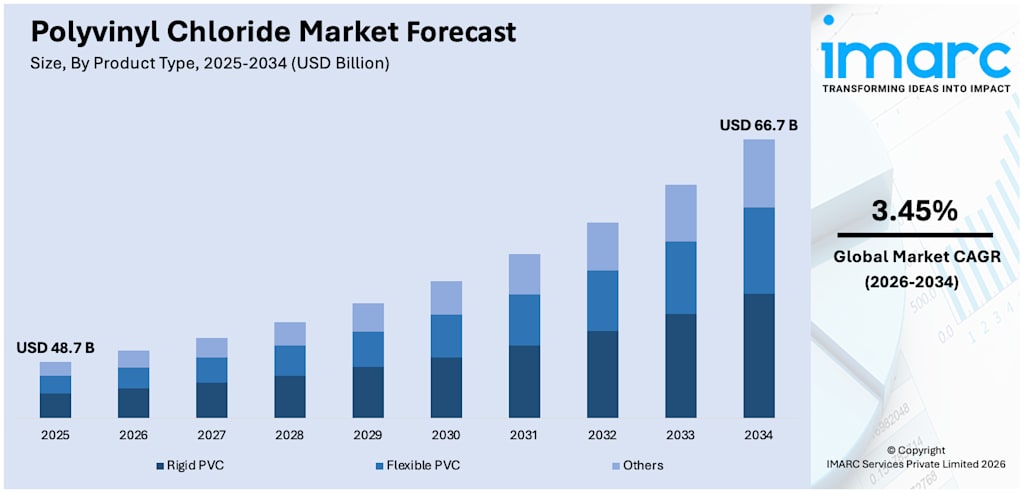
Rising demand from the building and construction sectors, coupled with expanding infrastructure development and industrial applications, is driving polyvinyl chloride (PVC) consumption. This growth is heavily supported by urbanization, increasing utilization in pipes and fittings, and product advancements in flexible and rigid variants across key manufacturing hubs. According to IMARC Group’s latest data, the global polyvinyl chloride market size was valued at USD 48.7 Billion in 2025. Looking forward, IMARC Group estimates the market to reach USD 66.7 Billion by 2034, exhibiting a CAGR of 3.45% during 2026-2034.
Polyvinyl chloride now represents a critical multi-billion-dollar global polymer market exceeding tens of billions of dollars and displaying steady structural expansion. Demand is driven by the material's unique blend of durability, chemical resistance, and cost-efficiency, making it a preferred choice over traditional materials like metal or wood. Heavy investments in municipal water infrastructure, residential construction, and automotive interiors are further accelerating uptake. Major segments include rigid PVC and flexible PVC, with applications spanning across pipes and fittings, film and sheets, wires and cables, and profiles, where manufacturers prioritize long lifespans and low maintenance requirements.
Polyvinyl Chloride Market Growth Drivers:
- Accelerating Infrastructure and Urbanization
Rapidly expanding urban landscapes require reliable utility networks, directly boosting the consumption of heavy-duty polymer materials. Municipalities rely extensively on durable piping networks for drinking water distribution and sewage systems because they resist corrosion and maintain water quality over long deployment periods. Real-world applications show that these infrastructure pipelines boast a operational lifespan exceeding several decades, significantly reducing public maintenance costs. This widespread civil engineering demand ensures a consistent foundation for bulk material procurement in both emerging and developed regions.
- Surging Demand in the Automotive Sector
Modern vehicle manufacturing increasingly prioritizes lightweight materials to improve overall fuel efficiency and reduce vehicle emissions. Industrial designers utilize flexible polymer formulations for interior door panels, dashboard skins, seat coverings, and complex wiring harnesses due to their high scratch resistance and flexibility. By substituting heavy metal components with advanced synthetic polymers, automotive manufacturers achieve vital weight reduction goals while meeting stringent safety standards. This integration within high-volume automotive assembly lines provides a sustained growth path as global vehicle production scales up.
- Expanding Building and Construction Activities
The global real estate and commercial construction sectors depend heavily on cost-effective, weather-resistant materials for modern building envelopes. Rigid profiles find extensive application in window frames, doors, and structural cladding due to their excellent thermal insulation properties and low maintenance needs. In regions like Europe, industrial data indicates that approximately half of all new and renovated window installations utilize polymer frames to enhance structural energy efficiency. This preference over wood or aluminum stems from superior resistance to environmental degradation and long-term cost benefits for property developers.
Request Your Complimentary "Polyvinyl Chloride Market" Report Sample
Polyvinyl Chloride Market Trends:
- Strategic Shift Toward Bio-Attributed Feedstocks
Chemical manufacturers are actively integrating renewable raw materials into existing production lines to address shifting corporate environmental mandates. Companies are introducing bio-attributed polymers derived from agricultural or industrial waste byproducts rather than relying entirely on fossil fuels. This manufacturing shift allows industrial end-users to secure high-performance materials while meeting strict supply chain carbon-reduction goals. Real-world applications include sustainable packaging and green building certifications, where demonstrating a lower environmental footprint directly influences large-scale commercial procurement decisions across major international markets.
- Technological Advancements in Formulation and Stabilizers
The polymer processing sector is experiencing significant innovation in additive chemistry to improve safety profiles and material performance. Advanced compounders are replacing legacy lead-based stabilizers with eco-friendly calcium-zinc or organic alternatives during the extrusion process. These modern stabilizer packages prevent thermal degradation during high-temperature manufacturing while ensuring the final product complies with modern environmental regulations. This trend enables the safe utilization of the material in sensitive applications, including medical tubing, blood containers, and consumer electronics, expanding the overall addressable market.
- Focus on Closed-Loop Recycling Systems
Industrial players are investing heavily in mechanical and chemical recycling infrastructure to create a circular economy for end-of-life synthetic products. Large-scale collection initiatives focus on recovering post-industrial window profiles and demolition pipes to process them back into high-quality manufacturing pellets. Advancements in sorting technology allow recycling facilities to separate distinct polymer grades efficiently, ensuring the recycled output meets structural integrity standards. This closed-loop approach reduces raw material dependency and aligns with zero-waste manufacturing goals increasingly mandated by multinational corporate clients.
Recent News and Developments in Polyvinyl Chloride Market
- August 2025: A major chemical manufacturer announced the successful expansion of its specialized chlor-alkali and polymer production facility, increasing regional capacity to address the growing demand for high-durability infrastructure components.
- September 2025: An international plastics compounding firm introduced a new line of medical-grade flexible compounds formulated completely free of restricted plasticizers, targeting advanced clinical fluid management applications.
- November 2025: A prominent engineering firm completed a pilot project utilizing advanced bio-attributed structural sheets in a commercial real estate development, validating the material's viability for sustainable architecture.
Note: If you require specific details, data, or insights that are not currently included in the scope of this report, we are happy to accommodate your request. As part of our customization service, we will gather and provide the additional information you need, tailored to your specific requirements. Please let us know your exact needs, and we will ensure the report is updated accordingly to meet your expectations.
About the Creator
Andrew Sullivan
Hello, I’m Andrew Sullivan. I have over 9+ years of experience as a market research specialist.
Enjoyed the story? Support the Creator.
Subscribe for free to receive all their stories in your feed.
Comments
There are no comments for this story
Be the first to respond and start the conversation.