
Plywood Market Benefits from Innovation in Engineered Wood Technologies
How technological advancements in engineered wood processing, automation, and quality control are enhancing product performance and operational efficiency in plywood manufacturing

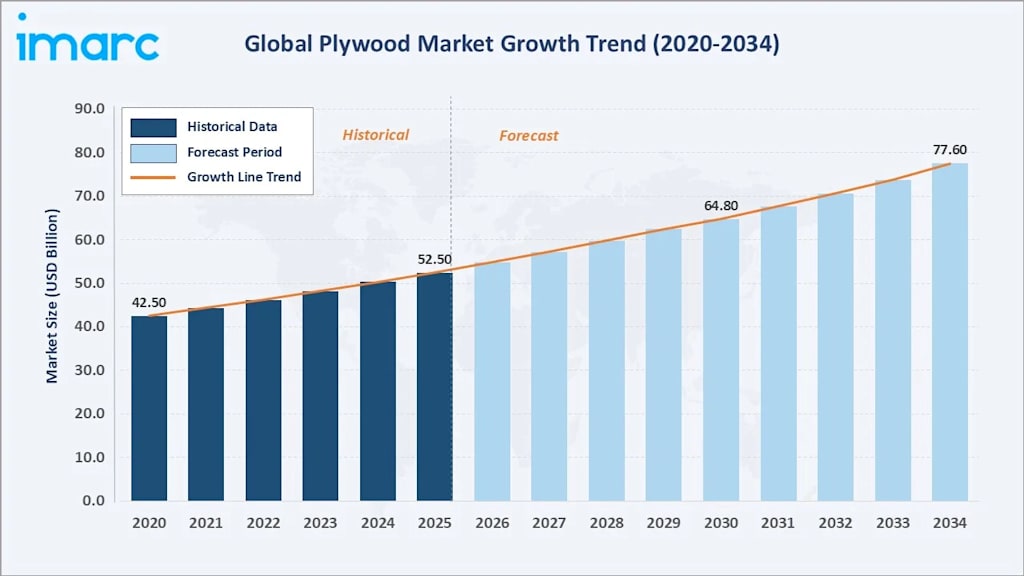
Rising structural engineering demands, expanding residential real estate, and a surging preference for modular, eco-friendly furniture solutions are driving plywood demand, supported by green building certifications, product innovation, and massive investments in public infrastructure. According to IMARC Group’s latest data, The global plywood market size was valued at USD 52.5 Billion in 2025. Looking forward, IMARC Group estimates the market to reach USD 77.6 Billion by 2034, exhibiting a CAGR of 4.31% from 2026-2034.
Plywood now represents a multi-billion-dollar global market exceeding several tens of billions and exhibiting steady year-on-year expansion. Demand is driven by accelerating urbanization across emerging economies, robust residential and commercial construction activity, and sustained demand from the furniture and interior design industries worldwide. Retail and supply chain innovation, increasing penetration of plywood in prefabricated and modular construction, and the rising adoption of sustainable, certified products are further accelerating uptake. Major segments include softwood and hardwood types applied across construction, residential, commercial, industrial, and packaging sectors, with consumers prioritizing dimensional stability, moisture resistance, and specific performance ratings.
Plywood Market Growth Driver:
- Accelerating Global Urbanization and Housing Demand
Rapid population shifts toward urban centers intensify the global demand for immediate housing and commercial real estate. UN projections indicate that nearly 60 percent of the world population will occupy urban environments by 2030, drastically scaling up requirements for residential infrastructure. Because plywood provides high dimensional stability and structural strength for subflooring, wall sheathing, and roofing, it remains the standard choice for large-scale developments. Builders rely heavily on its uniform thickness and structural reliability to speed up project delivery timelines across dense metropolitan zones.
- Surging Government Expenditure on Public Housing
National infrastructure initiatives and public-sector housing schemes heavily inject capital into the building materials sector. In developing nations like India, programs such as the Pradhan Mantri Awas Yojana target the delivery of millions of affordable urban and rural housing units, creating massive supply agreements for domestic mills. These government-backed funding pipelines ensure a stable, long-term order book for standard structural panels. By utilizing performance-grade panels, contractors efficiently satisfy strict safety benchmarks while keeping material costs within strictly regulated public budgetary limits.
- Expansion of Modular and Prefabricated Construction
The modern building sector increasingly pivots toward off-site fabrication and modular construction assembly to bypass labor shortages and reduce job site waste. Plywood panels serve as an essential material component in factory-controlled settings due to their excellent nail-holding power, light weight, and predictability during automated CNC precision cutting. Manufacturers of prefabricated wall panels and temporary field structures utilize softwood and hardwood veneers to maintain structural rigidity during transport. This structural integrity minimizes installation defects when assembling modular units on-site.
Plywood Market Trends:
- Sustainability, Green Certification, and Deforestation Compliance
Environmental regulations and consumer preferences force a major shift toward fully transparent timber sourcing pipelines. International compliance framework mandates, such as the European Union Due Diligence requirements and Forest Stewardship Council standards, compel plywood mills to thoroughly audit their raw material inputs. Major global distributors actively favor certified wood products to mitigate regulatory risks and align with corporate green building certifications. Consequently, manufacturers heavily invest in secure supply chains to protect their access to highly profitable Western retail markets.
- Adoption of Low-Emission and Sustainable Adhesive Technologies
The wood panels industry faces intensifying regulatory scrutiny regarding indoor air quality and formaldehyde off-gassing limits. To counter these challenges, leading manufacturers cooperate with chemical suppliers to implement advanced bio-based resins and ultra-low emitting formaldehyde formulations. These advanced resin systems significantly enhance water resistance and inner-ply bonding without compromising environmental safety. This transition allows decorative and structural panels to secure strict indoor air certifications, making them highly desirable for interior cabinetry, school buildings, and hospital projects.
- Premiumization Through Advanced Performance-Grade Panels
Consumer demand continues to shift toward specialized engineered wood variants that exhibit superior fire-retardant, moisture-proof, and insect-resistant behaviors. Companies capitalize on this trend by showcasing high-end veneer collections and specialized architectural lines at major global trade exhibitions. For example, Duroply Industries highlighted its premium craftsmanship and structural advancements at the Matecia exhibition, while Century Plyboards introduced its highly specialized, abrasion-resistant product lines manufactured with premium equipment. These advanced product launches expand consumer design options across high-traffic commercial environments.
Recent News and Developments in Plywood Market
- September 2024: Duroply Industries Limited leveraged the Matecia exhibition platform in New Delhi to showcase its latest premium structural plywood and luxury veneer collections, highlighting advanced resin development and compliance with Bureau of Indian Standards quality controls.
- October 2025: Leading North American forestry operators reported a combined investment of over USD 45 million dedicated to integrating real-time digital precision cutting and automated quality-monitoring systems across regional mills to combat volatile raw timber overheads.
- January 2026: European wood panel manufacturers formed a strategic consortium to accelerate the commercial rollout of fully biodegradable, non-toxic lignin adhesives across interior-grade production lines, targeting total compliance with updated regional clean-air guidelines.
Note: If you require specific details, data, or insights that are not currently included in the scope of this report, we are happy to accommodate your request. As part of our customization service, we will gather and provide the additional information you need, tailored to your specific requirements. Please let us know your exact needs, and we will ensure the report is updated accordingly to meet your expectations.
About the Creator
Andrew Sullivan
Hello, I’m Andrew Sullivan. I have over 9+ years of experience as a market research specialist.
Enjoyed the story? Support the Creator.
Subscribe for free to receive all their stories in your feed.
Comments
There are no comments for this story
Be the first to respond and start the conversation.