
Pigments Market: Color Innovation, Sustainable Manufacturing & Growth Outlook
How advancements in nanotechnology, color consistency, and dispersion techniques are supporting efficiency improvements and product innovation across the pigments market worldwide

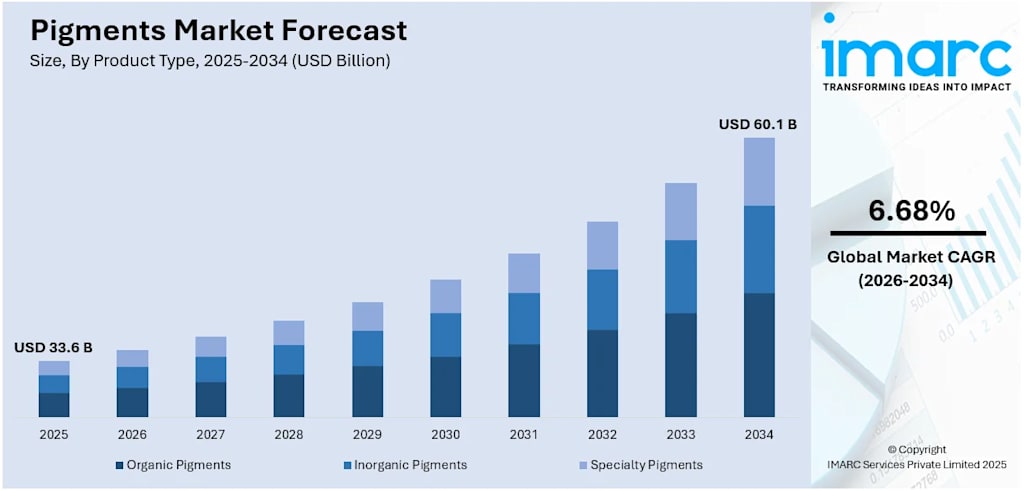
Rising infrastructure development, expanding industrial sectors, and growing demand for high-performance colorants are driving pigment consumption, supported by eco-friendly product innovations, protective surface coatings, and expanding construction and packaging industries worldwide. According to IMARC Group’s latest data, the global pigments market size was valued at USD 33.6 Billion in 2025. Looking forward, IMARC Group estimates the market to reach USD 60.1 Billion by 2034, exhibiting a CAGR of 6.68% from 2026-2034.
Pigments now represent an essential multibillion-dollar global sector that fundamentally underpins visual identity and material durability in modern manufacturing. Demand is heavily driven by the booming construction sector, a rising consumer preference for vivid and specialized automotive finishes, and substantial growth in the packaging industry which relies heavily on high-end printing inks. Industrial innovation is largely focused on the development of high-performance and organic alternatives that offer resistance to harsh weather conditions, heat, and ultraviolet radiation.
Pigments Market Growth Drivers:
- Booming Infrastructure and Construction Activities
Rapid global urbanization directly fuels the consumption of industrial colorants used in building materials, concrete, and architectural coatings. Infrastructure projects require highly durable formulations capable of withstand environmental degradation, including extreme temperatures and heavy rainfall. Industry data indicates that structural coatings and decorative paints represent the largest collective volume consumer in the industrial marketplace. Governments in developing countries continue to fund massive housing and transport network expansions, creating a steady stream of commercial demand. Manufacturers respond by supplying specialized compounds like iron oxides that maintain color consistency over prolonged exposure to outdoor weathering.
- Escalating Demand for Protective Coatings in Automotive and Industrial Applications
Heavy industries and automotive manufacturers rely heavily on advanced formulations to provide structural protection alongside aesthetic appeal. Modern vehicle coatings require premium additives that resist scratch damage, corrosion from acid rain, and prolonged exposure to intense sunlight. The aerospace sector similarly demands specialty variants capable of surviving severe operational conditions without losing structural integrity or performance characteristics. Product developments focus on complex inorganic compounds that shield underlying metallic surfaces from thermal stress and corrosive elements. These performance-focused properties make industrial colorants an indispensable asset in modern automotive manufacturing and large-scale industrial assembly lines globally.
- Rapid Expansion of the Consumer Packaging and Printing Ink Sectors
The explosive growth of e-commerce and retail consumer goods directly accelerates the need for high-quality packaging materials and vibrant printing inks. Product manufacturers utilize vivid color profiles on flexible plastics, corrugated boxes, and labels to distinguish their brands on crowded marketplace shelves. This trend has led to an increased requirement for fast-drying, highly stable formulations that integrate seamlessly with high-speed digital printing machinery. As global shipping volumes climb, corporate enterprises are shifting toward high-performance color solutions that do not smudge or fade during long-distance transit, keeping logistics presentation clean and professional.
Pigments Market Trends:
- Strategic Shift Toward Sustainable and Plant-Based Formulations
Regulatory bodies globally are enacting stricter laws regarding chemical toxicity, prompting manufacturers to engineer eco-friendly alternatives with a minimal carbon footprint. Industrial sectors are actively transitioning away from heavy-metal components to reduce corporate environmental impacts and align with modern circular economy goals. In a major industry shift, the Color Pigments Manufacturers Association launched a dedicated Sustainability and Innovation Committee to advance compliant color solutions across architectural applications. Additionally, companies like Nature Coatings introduced bio-based carbon black alternatives sourced from certified wood waste, demonstrating that renewable raw materials can deliver identical structural performance without traditional environmental liabilities.
- Integration of Advanced Nanotechnology and Nano-Pigments
Manufacturing processes are being redefined by the adoption of nano-scale materials that drastically enhance chemical properties, opacity, and overall material longevity. These specialized nano-compounds allow developers to create ultra-thin, highly effective protective films that offer superior corrosion resistance compared to bulk materials. For instance, advanced technology firms like Zentek achieved significant military-grade milestones by testing nano-pigment formulas for chromate-free aerospace coatings designed for harsh defense operations. This technological integration allows industrial users to achieve optimal color saturation and defense attributes while using significantly less material volume per application.
- Surge in High-Performance Digital Inkjet Printing Solutions
The rapid adoption of computerized digital printing over traditional analog methods is reshaping product requirements across the textile and commercial packaging sectors. Industrial equipment manufacturers are heavily rolling out specialized water-based digital printing inks that eliminate volatile organic compound emissions while providing pristine color accuracy. Commercial printing groups, including global packaging leader DS Smith, have notably expanded production lines by installing single-pass water-based digital printers to meet high-volume corporate demands. This technology trend ensures faster turnarounds for consumer brands while optimizing resource efficiency and maintaining vibrant, precise replication across complex material substrates.
Recent News and Developments in Pigments Market
- April 2024: Sparxell, a prominent developer of high-performance color solutions, successfully closed a USD 3.2 Million funding round to accelerate the commercial scale-up of its fully plant-based product lines. This strategic capital injection is aimed at eliminating synthetic chemicals from traditional colorants used across consumer packaging, textiles, and architectural coatings.
- April 2024: Nature Coatings officially unveiled BioBlack, a novel bio-based alternative to traditional petroleum-derived carbon black. The high-performance product utilizes a completely closed-loop, circular manufacturing process utilizing pre-consumer wood waste to offer industrial users a functional carbon-negative alternative.
- June 2024: Digital printing innovators MS Printing Solutions and JK Group showcased their latest joint digital pigment solutions, highlighted by the patent-pending Kiian Pigment 4K ink range. The system provides heavy textile print operations with enhanced color management software and advanced scanning machinery to increase color precision.
Note: If you require specific details, data, or insights that are not currently included in the scope of this report, we are happy to accommodate your request. As part of our customization service, we will gather and provide the additional information you need, tailored to your specific requirements. Please let us know your exact needs, and we will ensure the report is updated accordingly to meet your expectations.
About the Creator
Andrew Sullivan
Hello, I’m Andrew Sullivan. I have over 9+ years of experience as a market research specialist.
Enjoyed the story? Support the Creator.
Subscribe for free to receive all their stories in your feed.
Comments
There are no comments for this story
Be the first to respond and start the conversation.