
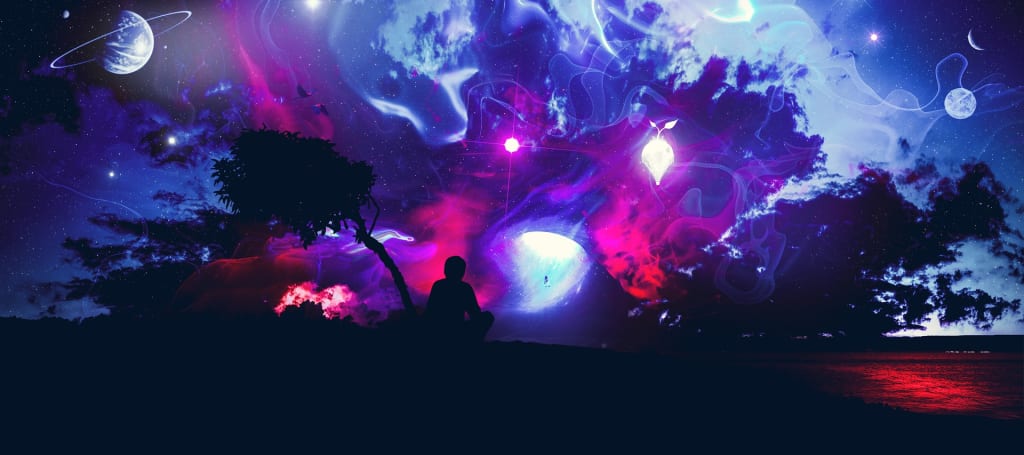
“Nobody can hear a scream in the vacuum of space, or so they say.” Dr. James Vavro began his lecture in typical dramatic fashion, luring in his audience with mystery before striking at his real purpose. “Of course, they also say that Blobs do not feel pain, share no emotions in common with humans, and serve us voluntarily. Do you feel comfortable with those assertions?” Dr. Vavro looked out at the dozens of young faces filling the lecture hall with their varying levels of intellectual promise. They understood the rhetorical nature of this introduction. No hands or voices were raised.
“Let’s back up a little. First, I’ll ask you this: why do we call them Blobs? Is it because they have no self-given name that we are aware of? Is it because the Latin species name assigned to them is so cumbersome I’m not even going to try to pronounce it here today?” Dr. Vavro gestured to the 27-letter genus-species name written in barely-legible cursive on the whiteboard as his audience let out a small collective chuckle. “Using a scientific species name for the Blobs may be trivial, given the fact they exist completely outside Earth’s known phylogenetic tree,” the doctor shrugged.
“After all, Blobs don’t even have DNA, or RNA, or nucleotides, which until their discovery, we believed to be the essential building blocks of life. We don’t know exactly how old they are, but the most informed scientists suspect they significantly predate the first semblance of life on this planet. And we mustn’t forget there are those who still refuse to acknowledge the Blobs as ‘life’ at all,” he paused for a moment to contemplate. “But I trust that perception will soon go the way of the geocentric model of the universe and Flat Earth theory,” he added, making deliberate eye contact with a few students whose smirks showed their appreciation for his jab at ignorance.
“Fortunately, to most of the public, and certainly within the scope of this class, there is no question that the Blobs are indeed living things. But,” He raised his right index finger in a cautionary gesture, “it is after accepting this fact that the most heated debates begin.”
“You see,” he said as though lecturing himself as much as his pupils, “if the Blobs are living things, one is obligated to consider whether they possess motives beyond the basic instincts of simple organisms like our algae or insects of Earth, whether they are self-aware, and if so, how intelligent they are. Did they arrive by accident, drifting through space on solar winds? Were they drawn to Earth by its natural resources or our noisy human activity, as a moth is instinctively drawn to a light source? Or did they come here deliberately to make contact with humans, as one sentient lifeform seeking another, in the desolate vastness of the universe? If contact was deliberate, was it to make peace or war?
“Perhaps the reason these questions remain topics for debate at all is that the Blobs have not taken any definitive action to indicate collective intention. But, as we’ve already seen, it is prudent to remain disciplined when presented with a lack of data. The absence of evidence in support of one conclusion should not be mistaken for the presence of evidence in support of another,” Dr. Vavro spoke as though reciting from a textbook before continuing with renewed passion. “Far more importantly, though, it must be asked, have we given the Blobs the chance to express their intentions?” He looked out at his students with a wrinkled brow, his bright green eyes piercing their ambivalence.
“Why do we call them Blobs?” he asked again, this time with a heavier tone. “After confirming the first Blob to arrive was not an asteroid or anything else we had previously observed, we immediately set about trapping it like wild game. To our uneducated eyes, it was simply an amorphous substance to be physically and chemically analyzed. Those first headlines, most of you probably remember hearing as kids, announcing the arrival of an ‘unidentified celestial blob.’ They echoed this assumption and produced a seemingly irrevocable designation. We all latched onto the nomenclature like school children hearing the class bully proclaiming the superficial nickname of an ostracized fellow student.” Dr. Vavro lowered his eyes in somber reflection.
“Even after realizing beyond doubt that the Blobs possess some level of intelligence, including the capacity to respond to environmental stimuli and our own treatment of them, there was little effort to undo this apparent misclassification. Now why is that?” The doctor now had an indignance in his voice.
He gestured to the course title written in dry-erase marker on the whiteboard:
Exploring Space: Consequences and Controversies
“As we’ve discussed, the human response to discovery is multi-faceted. We seek out and approach new worlds and new lifeforms with ravenous curiosity. There is a strong desire to show our human empathy, even toward something unimaginably foreign. Yet the strongest emotion in the face of the unknown, inevitably, is fear.” Dr. Vavro looked around the lecture hall to confirm that the graveness of his words sunk in.
“Bear in mind, in the early minutes, hours, and days of the Blob’s arrival, many unprecedented things were happening that must have been quite frightening for those close to the situation. By the time the Blob was spotted by telescope, it was only moments away from colliding with satellite USA-384. Nobody saw the Blob coming, and the first thing it did upon arrival was destroy a communications satellite. President Williams could be forgiven for interpreting that as an act of aggression.” The doctor began to pace feverishly back and forth before his class, his voice matching the tenor of his feet.
“The President responded quickly. Even while the leaders of the world were being alerted to a possible collision scenario, she was ordering the U.S. Space Force to scramble low orbit defenses for intercept and all other branches of the military to DEFCON 1 readiness. The Blob was clearly not an asteroid, but luckily for us, that loony and previously untested Asteroid Catch and Release system worked like a charm. We had it bagged and tagged within a few very tense minutes.” Dr. Vavro stopped pacing to turn once more toward his now thoroughly engrossed audience.
“During that maneuver, though, is when we first saw signs of intelligence from the Blob. It did not go quietly into the night like a lump of space goo. It attempted to evade capture. It wriggled and writhed enough to nearly crash the interceptor craft that caught it. Ultimately, it couldn’t escape the ACR bag before being further contained aboard the USS Sentinel.”
“That,” he continued while placing his right hand on his chest by way of introduction, “is where I involuntarily enter this scene. At the time, I was aboard the USS Sentinel researching the effects of space travel on cellular metabolism, having recently earned my PhD in Astrobiology. And in case you were wondering, the effects of space travel on cellular metabolism? They aren’t good. I couldn’t wait to get off that ship. But I digress.” Dr. Vavro paused to allow his wide-eyed students a chance to process his revelation. More than one student exclaimed in response to finding out their professor had been present for one of the most influential moments in modern human history.
“I was in the middle of a cycling workout when the ship went to red alert. My first thought was one of relief that I could get off the bike early, but then I was called in to advise on how to handle the contained Blob. News had traveled fast that the Blob demonstrated signs of life, and we had an explicit directive from the President to sequester and neutralize the lifeform. Some, of course, interpreted that directive as an order to summarily destroy the first extraterrestrial intelligent lifeform humankind had ever encountered. Thankfully, not everyone onboard was so trigger-happy. Still, the next step was to subdue the creature to prevent any sort of conflict, and in doing so, the first major discovery about the Blob was made.” The doctor leaned forward as if he were about to share a secret.
“In the process of enclosing the Blob in an improvised box made from spare blast shield panels, the crew accidentally lopped off a chunk.” He raised his eyebrows, anticipating the collective gasp from his audience. “Nobody knew what to expect. Would this piece of Blob fall limp the way a human limb falls limp once amputated? Or would it temporarily squirm like a severed octopus arm before the electrical impulses fade away? The greatest fear was that it would act as a fully autonomous entity, as if produced from binary fission. But, we found, the reality was a mixture of all the above.” The doctor continued with a child-like enthusiasm.
“This small piece of the Blob continued to move about, but very slowly and without clear direction. Unlike an octopus arm, though, the smaller Blob persisted as an autonomous entity, with no apparent need for the primary Blob. The smaller Blob was merely a lesser version of the source Blob. And this is where an opportunity was seized to neutralize the Blob without utterly destroying it.” Dr. Vavro returned to his lectern, reassuming a more formal tone, as if suddenly aware of a lapse in decorum.
“Upon division into smaller parts of the whole, the Blob’s intelligence notably diminished at an exponential rate. While the collective Blob, roughly the size of the extinct African elephant, moved with great speed and interacted with its environment as though vigorously inquisitive, the smaller portions lacked that behavior so intuitively representative of sentience. By the time it was apportioned into parts small enough to hold in the palm of your hand, it became sedentary and docile, as though, to the human eye, awaiting instructions. So, naturally, we concentrated on learning how to provide those instructions until we could put the Blobs to work.” There was a hint of shame in his voice.
“Of course, to control the Blobs, we first needed to understand the Blobs. This meant investigating their physiology, preferred environmental conditions, behaviors, their strengths, and their weaknesses. Although the origin of the initial Blob is still unknown, important deductions could be made based on its biochemistry.” Dr. Vavro now reverted to a perfunctory, didactic tone, reviewing the notes on his lectern.
“Instead of water as a lone biochemical solvent, like Earth life, the Blob contains water mixed in a dynamic ratio with ammonia, which, as you all know, has a much lower freezing temperature. This likely aids in its ability to continue metabolizing in the frigid vacuum of space. The Blob, very much like Earth life, relies on carbon as a chemical backbone, but, unlike Earth life, utilizes an expansive array of amino acids well beyond the 20 naturally occurring amino acids we are familiar with. Furthermore, these amino acids and resulting protein structures are the chiral opposite of Earthly molecules. A fact we should be particularly thankful for, as it makes the Blobs largely incompatible with the food chain of Earth. All these characteristics suggest that the origin planet of the Blob is both larger than Earth and set further away from its star, producing greater gravitational force in a colder area of space, but similarly abundant with water and carbon.” He looked up from his notes.
“The arrival and subsequent vivisection of the Blob and its now thousands of constituents undoubtedly opened up new pathways in medicine and industry. The diverse proteins of the Blobs offer catalytic and metabolic solutions even our most advanced AI had not yet conceived. But the characteristic of the Blobs that has most influenced humankind is surely their remarkable ability to perform electrolysis at a rapid and continuous rate, inspiring a new generation of biological fuel cells for spacecraft in which a small Blob is the living engine.” The doctor related this information as if he could hardly believe it himself.
“I want to revisit our initial question, but first, I would ask you ponder this,” Dr. Vavro paused for a solemn breath. “The splitting of the atom changed the course of human history by yielding incredible technological advancements. It drove progress in nearly every facet of civilization, and yet its first impact was one of cataclysm. The splitting of the Blob, as it were, has similarly ignited a fresh surge in space exploration and quite literally fueled a new technological revolution at an opportune time in human history. While these benefits appear to be irresistibly serendipitous, our eagerness to wield the forces of nature often proves more consequential than we could have imagined. Despite our efforts to subdue them, the Blobs may yet make their intentions known, and that should be respected in the same way one respects the potential energy of a nuclear bomb.” The doctor looked around the room once more before beginning his concluding remarks.
“I am sure many of you are already aware of what prompted this detour from the syllabus, but some of you may not yet have heard the news. Today, they detected another Blob heading toward Earth. They don’t know where it is coming from. They don’t know why it is coming here now. So, I again pose to you the question, are you comfortable with the assertions they have made regarding the Blobs? Do you believe that nobody can hear a scream in the vacuum of space? Because another Blob is coming, and this one, they say, is much bigger.”
About the Creator
J. A. Snyder
I am a real-world microbiologist with a love for science fiction. In my writing, I aim to contemplate the human condition through thought experiments that are firmly rooted in real modern science and technology.
Enjoyed the story? Support the Creator.
Subscribe for free to receive all their stories in your feed.
Comments
There are no comments for this story
Be the first to respond and start the conversation.