
Payment Gateways Market Gains Momentum Amid Digital Payments
How AI-powered fraud detection, contactless payments, and digital banking innovations are transforming transaction security and consumer payment experiences in the payment gateways market

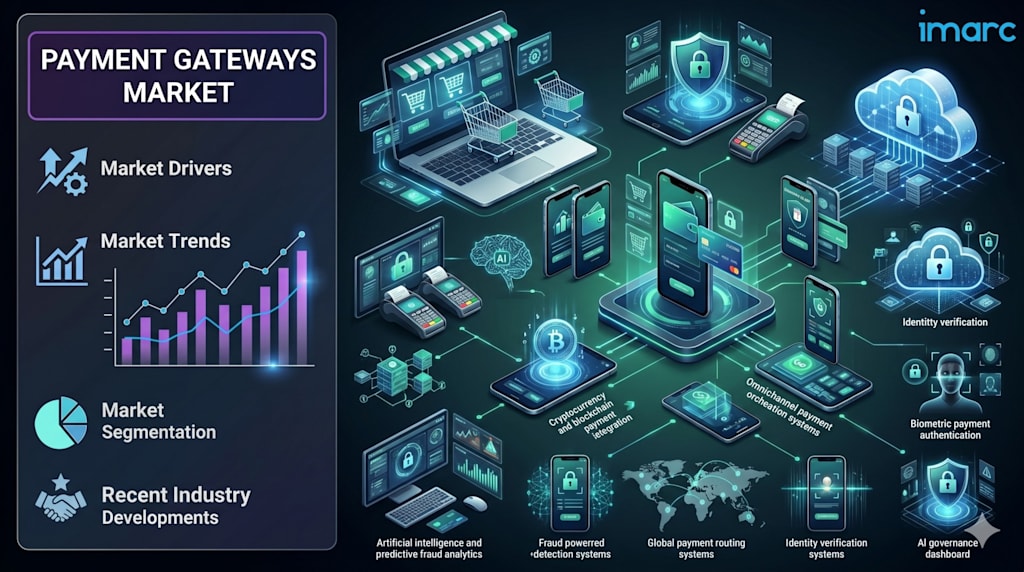
According to IMARC Group's latest research publication, The global payment gateways market size reached USD 27.6 Billion in 2025. Looking forward, IMARC Group expects the market to reach USD 45.4 Billion by 2034, exhibiting a growth rate (CAGR) of 5.51% during 2026-2034.
How Technology is Reshaping the Future of the Payment Gateways Industry
- Advanced Security Architecture and Fraud Prevention Intelligence: Modern payment gateways are investing heavily in tokenization, end-to-end encryption, and AI-powered fraud detection as the volume and sophistication of digital transaction threats continue to grow. Machine learning models analyze transaction patterns in real time, flagging anomalies and blocking fraudulent activity before settlements are processed, reducing chargebacks and minimizing financial exposure for both merchants and consumers. Compliance with Payment Card Industry Data Security Standard requirements remains a baseline expectation, but leading providers are now layering behavioral biometrics, device fingerprinting, and dynamic authentication protocols on top of these standards to address threat vectors that static rule-based systems cannot handle. As digital payment volumes scale, the ability to deliver security without adding friction to the checkout experience has become a primary competitive differentiator among payment gateway providers serving large enterprise and mid-market clients alike.
- Seamless Integration with Digital Wallets and Alternative Payment Methods: The rapid proliferation of digital wallets including PayPal, Apple Pay, Google Pay, and regional platforms has fundamentally changed consumer expectations at checkout, making multi-method support a non-negotiable feature for any payment gateway seeking broad merchant adoption. Gateways that offer plug-and-play integration with these wallets alongside traditional credit and debit card rails allow merchants to reduce cart abandonment, increase conversion rates, and serve customer segments that have shifted entirely away from card-based payments. The ability to support Buy Now, Pay Later options, real-time bank transfers, and cryptocurrency payments within a unified gateway interface is creating meaningful differentiation in a market where checkout experience directly impacts merchant revenue. Providers that offer diverse payment method support through a single integration point are gaining preference over those requiring merchants to manage multiple separate payment relationships.
- Subscription Management and Recurring Billing Infrastructure: The explosive growth of subscription-based business models across streaming, software, healthcare, and e-learning sectors has created structural demand for payment gateways capable of handling the operational complexity of recurring billing at scale. Gateways that offer configurable billing cycles, automated retry logic for failed payments, dunning management, proration handling, and mid-cycle plan changes give subscription businesses the flexibility they need to minimize involuntary churn and sustain predictable revenue flows. This capability set has moved from a premium feature to a standard expectation as the subscription economy matures, and providers that built these capabilities natively are capturing disproportionate share from industries where recurring revenue is the primary business model. The ability to manage the full lifecycle of a subscriber relationship, from trial conversion through upgrade, downgrade, pause, and cancellation, within the payment infrastructure layer is now a meaningful factor in gateway selection for enterprise clients.
- Cross-Border Transaction Support and Multi-Currency Processing: As e-commerce continues its geographic expansion, businesses of all sizes are increasingly transacting across borders, creating demand for payment gateways that can handle currency conversion, local payment method compliance, and regional regulatory requirements without forcing merchants to manage country-specific integrations individually. Gateways with strong cross-border capabilities allow merchants to present pricing in local currencies, settle in preferred base currencies, and accept locally preferred payment instruments, all of which materially improve conversion rates in international markets. Emerging economies in Asia Pacific, Latin America, and the Middle East and Africa are driving a significant portion of new cross-border e-commerce volume, and gateways that have invested in local acquiring relationships and regulatory compliance frameworks in these regions are positioned to capture the associated transaction flow as middle-class consumer spending in these markets continues to expand.
- AI-Driven Checkout Optimization and Real-Time Processing: Payment gateways are embedding artificial intelligence and machine learning not just for fraud detection but for active optimization of the checkout experience, including smart routing of transactions across acquiring networks to maximize authorization rates and minimize processing costs. Real-time payment processing infrastructure is becoming the baseline expectation as consumers and businesses alike reject the latency of batch settlement models, and gateways that have invested in low-latency processing architecture are benefiting from the resulting shift in enterprise procurement preferences. In January 2026, Google introduced a universal commerce protocol developed alongside major retailers including Shopify, Target, and Walmart, with endorsement from approximately 20 major payments players including Adyen, PayPal, Stripe, Mastercard, and Visa, designed to enable seamless payment processing within AI-driven chat and agentic commerce environments, signaling the next frontier for payment gateway integration.
Payment Gateways Industry Overview:
The global payment gateways market is being shaped by the convergence of e-commerce growth, smartphone penetration, and the structural shift away from cash-based transactions across both developed and emerging economies. Asia Pacific leads the market with the region's large population, expanding internet access, and a highly competitive e-commerce landscape creating sustained demand for reliable, feature-rich payment processing infrastructure. Countries including China, India, Japan, South Korea, and Indonesia are each generating significant transaction volumes through both domestic platforms and cross-border channels, and payment gateway providers with strong regional presence and local payment method coverage are capturing the bulk of that growth.
North America represents a mature but continuously evolving market where innovation in checkout experience, fraud management, and embedded finance is driving competitive differentiation among established players. The U.S. payment gateway market reached USD 9.8 Billion in 2025, supported by a highly connected digital economy, high smartphone and internet penetration, and consumer behavior firmly oriented toward instant, secure digital transactions. In February 2025, PayPal and J.P. Morgan Payments announced an expansion of their strategic relationship, with J.P. Morgan Payments planning to offer Fastlane by PayPal for merchant clients across the UK and European markets while PayPal simultaneously expands merchant acquiring capabilities by leveraging J.P. Morgan Payments' Commerce Platform. The collaboration addresses a well-documented friction point in digital commerce, with 70% of consumers reporting that guest checkout is important while simultaneously abandoning purchases due to checkout complexity, and Fastlane demonstrating checkout speed improvements exceeding 36% compared to traditional guest checkout flows.
In April 2024, Stripe announced a partnership with URBN to manage online and in-store retail transactions for Urban Outfitters, Anthropologie Group, Free People, and FP Movement, with the retailer adopting Stripe as its primary payment infrastructure to improve authorization rates, enhance checkout consistency, and expand its payment capabilities across channels. That same month, Dwolla launched Open Banking Services using a single API integration with pre-built connections to major open banking providers, designed to streamline Account-to-Account payment adoption for businesses seeking to reduce reliance on card network rails. In April 2024, BitPay announced a major platform update expanding support to over 100 cryptocurrencies, reflecting the growing merchant demand for digital asset payment acceptance within mainstream gateway infrastructure.
Payment Gateways Market Trends and Drivers
The underlying driver of the payment gateways market is straightforward: global e-commerce is growing, digital payment adoption is accelerating, and every online transaction requires a gateway to process it. The rising popularity of online shopping, the proliferation of e-commerce platforms across verticals and geographies, and the widespread adoption of smartphones as the primary device for both browsing and purchasing are collectively expanding the addressable transaction base that payment gateways serve. This growth is not evenly distributed. Emerging markets in Asia Pacific, Latin America, and the Middle East and Africa are generating a disproportionate share of new transaction volume as internet access expands into previously underserved populations and local e-commerce platforms mature to serve them. Payment gateways that have invested in regional infrastructure, local acquiring relationships, and support for locally preferred payment instruments are capturing the most valuable positions in these high-growth corridors.
The demand for contactless and real-time payment processing is reshaping product priorities across the gateway ecosystem. Consumers who have experienced the speed and convenience of tap-to-pay, digital wallet checkout, and instant bank transfers are unwilling to revert to slower payment experiences, and merchants who fail to offer these options face measurable conversion penalties. This behavioral shift is forcing payment gateway providers to upgrade their processing architectures, expand their payment method libraries, and invest in the authorization rate optimization capabilities that enterprise clients require to compete in high-volume digital commerce environments. The integration of AI and machine learning for both fraud prevention and checkout optimization is accelerating this evolution, with providers that have deployed intelligent routing, behavioral fraud scoring, and predictive retry logic demonstrating materially better performance metrics than those relying on static rule sets.
Regulatory modernization is also creating both demand and complexity for payment gateway operators. Open banking frameworks across Europe, the UK, India, and a growing number of other markets are creating new direct-to-bank payment pathways that gateways must support to remain relevant to merchants seeking lower transaction costs and broader payment method coverage. Compliance requirements including strong customer authentication mandates, data localization rules, and evolving anti-money laundering standards are adding operational complexity for gateways serving cross-border merchants, but are simultaneously raising the barriers to entry that protect established providers who have already built compliant infrastructure across multiple regulatory jurisdictions. Large enterprises with high transaction volumes and multi-currency, multi-geography operations continue to represent the most valuable customer segment, as their scale and complexity create switching costs and ongoing service requirements that generate durable revenue relationships for gateway providers with the technical depth to serve them.
Leading Companies Operating in the Global Payment Gateways Industry:
- Adyen
- Amazon.com Inc.
- Authorize.Net (Visa Inc.)
- BitPay Inc.
- JPMorgan Chase and Co.
- PayPal Holdings Inc.
- PayTm (One97 Communications)
- PayU (Naspers Limited)
- Razorpay Software Private Limited
- Stripe, Inc.
- Verifone Inc.
Payment Gateways Market Report Segmentation:
By Application:
- Large Enterprises
- Micro and Small Enterprises
- Mid-Size Enterprises
Large enterprises represent the largest segment, driven by their high website traffic, large transaction volumes, and multi-region operations that require robust, scalable payment gateway infrastructure with advanced security features, fraud prevention capabilities, and multi-currency support. The complexity and scale of large enterprise payment needs drives continuous innovation among gateway providers and sets the performance benchmark for the broader market.
By Mode of Interaction:
- Hosted Payment Gateways
- Pro/Self-Hosted Payment Gateways
- API/Non-Hosted Payment Gateways
- Local Bank Integrates
- Direct Payment Gateways
- Platform-Based Payment Gateways
Hosted payment gateways hold the largest share, offering a secure and convenient payment processing solution that supports diverse payment methods including credit and debit cards, digital wallets, and bank transfers. Their strong data encryption, ease of integration, and broad payment method coverage make them the preferred choice for businesses seeking to provide a reliable checkout experience without managing the full complexity of PCI compliance infrastructure internally.
Regional Insights:
- North America (United States, Canada)
- Europe (Germany, France, United Kingdom, Italy, Spain, Others)
- Asia Pacific (China, Japan, India, South Korea, Australia, Indonesia, Others)
- Middle East and Africa
- Latin America (Brazil, Mexico, Others)
Asia Pacific exhibits clear dominance in the global payment gateways market, supported by rapid e-commerce expansion, high smartphone and internet penetration, a growing middle class with rising disposable incomes, and strong adoption of digital wallets and mobile payment platforms across the region's major economies.
Recent News and Developments in the Payment Gateways Market
- February 2025: PayPal and J.P. Morgan Payments announced a strategic expansion of their existing relationship, with J.P. Morgan Payments planning to offer Fastlane by PayPal for merchant clients across the UK and European markets. PayPal simultaneously announced plans to expand merchant acquiring capabilities in these markets by leveraging J.P. Morgan Payments' Commerce Platform, targeting the documented friction in digital guest checkout that results in significant cart abandonment for online retailers.
- January 2026: Google introduced a universal commerce protocol developed alongside major retailers including Shopify, Target, and Walmart, designed to enable seamless payment processing within AI-driven chat and agentic commerce sessions. The protocol was endorsed by approximately 20 major payments players including Adyen, PayPal, Stripe, Worldpay, Mastercard, and Visa, marking a significant step toward embedding payment gateway functionality directly into AI-powered shopping experiences.
- April 2024: Stripe announced a partnership with URBN, the parent company of Urban Outfitters, Anthropologie Group, Free People, and FP Movement, to serve as the primary payment infrastructure across the group's online and in-store retail operations. The partnership targets improvements in authorization rates, checkout consistency, and omnichannel payment capabilities across URBN's portfolio of retail brands.
Note: If you require specific details, data, or insights that are not currently included in the scope of this report, we are happy to accommodate your request. As part of our customization service, we will gather and provide the additional information you need, tailored to your specific requirements. Please let us know your exact needs, and we will ensure the report is updated accordingly to meet your expectations.
About the Creator
Abhay Rajput
I am working in market research company that provides market and business research intelligence across the globe.
Enjoyed the story? Support the Creator.
Subscribe for free to receive all their stories in your feed.
Comments
There are no comments for this story
Be the first to respond and start the conversation.