
Oyster Market Witnesses Strong Growth Amid Premium Seafood Demand
The Oyster Market is experiencing steady growth driven by increasing demand for premium seafood products and rising consumer interest in nutrient-rich diets.

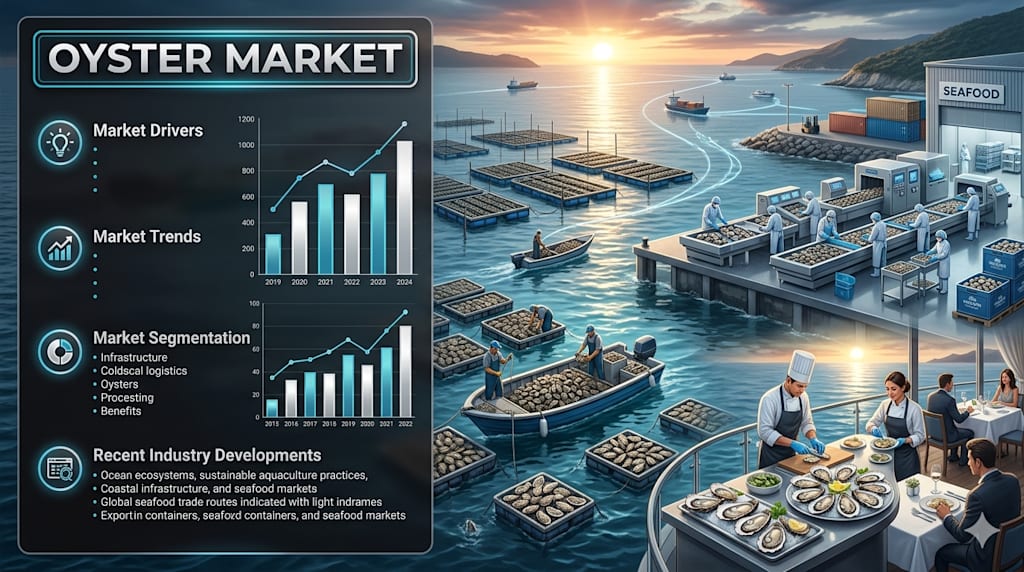
According to IMARC Group's latest research, The global oyster market size reached at 7.61 Million Tons in 2025 and is projected to reach 9.00 Million Tons by 2034, exhibiting a CAGR of 1.88% during the forecast period 2026-2034.
How AI is Reshaping the Future of the Oyster Market
- Intelligent Hatchery Optimization and Disease Resistance: AI-driven genomic selection programs identify oyster strains with superior disease resistance, reducing larval mortality rates by 20-35% in commercial trials. Machine learning accelerates selective breeding cycles, enabling faster development of disease-resistant varieties suited to climate-sensitive production environments globally.
- Automated Sorting and Grading Systems: AI-powered optical grading systems process 1.5 million oysters hourly with precision, sorting by size and quality while significantly reducing labor costs. Automated systems eliminate manual inconsistencies, ensuring standardized product quality and enabling processors to meet strict buyer specifications efficiently.
- Real-Time Environmental Monitoring and IoT Integration: Sensor networks track dissolved oxygen, temperature, pH, and salinity across grow-out sites, enabling AI algorithms to optimize environmental conditions automatically. Predictive analytics reduce stress-related mortality while improving growth-rate predictability, lowering operational costs and production losses substantially.

Oyster Industry Overview
Asia Pacific commands an extraordinary 94.9 percent global market dominance, anchored by China's vast commercial oyster farming ecosystem spanning Fujian, Guangdong, Shandong, and Guangxi provinces. Japan and South Korea contribute premium-quality production with strong export positioning, while Vietnam and Indonesia represent emerging aquaculture expansion regions. Government-backed aquaculture investments exceeding $2.8 billion have strengthened infrastructure across producing nations, supporting long-term production capacity growth.
Oyster Market Trends & Drivers
Sustainable Seafood Demand and Eco-Certification Expansion: Rising global preference for responsibly farmed oysters drives adoption of sustainability certifications including Aquaculture Stewardship Council and Best Aquaculture Practices across 35 countries. Oysters' natural water-filtering properties and low-input aquaculture systems appeal to environmentally conscious consumers. Certification programs improve consumer confidence while enabling producers to access premium retail channels and command higher market prices globally.
Fresh Packaging Dominance and Cold-Chain Development: Fresh oysters maintain 70 percent market share, reflecting strong consumer preference for live, chilled shellfish in sophisticated seafood markets. Well-established cold-chain logistics infrastructure in Asia Pacific, North America, and Europe supports 3-7 day shelf-life windows from harvest to consumption. Direct-to-consumer express shipping has enabled premium producers to achieve retail margins 3-5 times higher than wholesale pricing, transforming oyster distribution economics.
Premium and Value-Added Product Development: Frozen half-shell, smoked, and specialty preserved formats command 25-50 percent price premiums over commodity fresh products, expanding into foodservice supply chains across North America, Middle East, and Southeast Asia. Innovation including cryogenic freezing techniques extending shelf-life to 21 days and triploid breeding improving productivity by 30 percent creates differentiated margin opportunities. International oyster bar culture proliferation generates dedicated premium retail and foodservice demand structures globally.
Oyster Market Segmentation
By Packaging Form
- Fresh: 70.0% share - Live, chilled shellfish reflecting consumer preference for minimally processed products
- Frozen: 18.5% share - Preferred format for export trade and food manufacturing applications
- Canned: 8.2% share - Value-oriented positioning in retail grocery and military provisioning
- Others: 3.3% share - Smoked, marinated, and specialty preserved formats in premium retail
By End User
- Retail: 64.7% share - Supermarket fresh seafood counters, specialty retailers, and online direct-to-consumer platforms
- Foodservice: 35.3% share - Restaurants, hotels, catering operations, and dedicated oyster bar establishments
By Oyster Type
- Cupped Oyster: Primary farming variety
- Pacific Cupped Oyster: Crassostrea gigas, widely farmed globally
- American Cupped Oyster: Regional specialty format
- Penguin Wing Oyster: Premium niche variety
- Others: Specialized regional and heritage varieties
By Region
- Asia Pacific: 94.9% - China, Japan, South Korea, Vietnam dominance
- North America: 2.4% - Premium market with ASC-certified producer expansion
- Europe: 1.5% - France artisanal production with geographic protections
- Latin America: 0.7% - Chilean aquaculture development
- Middle East and Africa: 0.5% - UAE and emerging coastal region growth
Leading Companies Operating in the Global Oyster Industry
- Huitres Favier Earl
- Hog Island Oyster Company
- France Naissain
- Mere Point Oyster Company
- Taylor Shellfish Farms
- Yumbah
- Murder Point Oysters
Recent News and Developments in the Oyster Market
- February 2025: India's Department of Fisheries launched multiple initiatives under the Pradhan Mantri Matsya Sampada Yojana to promote natural pearl farming and bivalve cultivation, approving over 2,300 cultivation units with significant government funding. This represents India's commitment to strengthening domestic aquaculture infrastructure and creating sustainable livelihoods across coastal communities.
- January 2025: South Korea's Ministry of Oceans and Fisheries unveiled an ambitious Development Plan for oyster aquaculture, targeting increased annual production from 300,000 tons to 400,000 tons and doubling exports to USD 160 million. This strategic initiative positions South Korea as a major regional export hub for premium oyster products.
- August 2024: Hog Island Oyster Company introduced a Petaluma local pick-up policy, expanding accessibility for regional consumers and reducing logistics costs through hyperlocal distribution. This innovation strengthens the farm's direct-to-consumer positioning while supporting coastal community engagement in sustainable oyster farming.
- Recent Year: France Naissain Group introduced a high-protein oyster variety with 12 percent greater meat yield and opened new hatcheries producing 5 million spat annually. Japan's Farm Suzuki developed a hybrid oyster maturing 6 months faster while expanding coastal aquaculture to 150 hectares, increasing capacity by 20 percent.
- Recent Year: Hog Island Oyster installed solar-powered water filtration reducing energy consumption by 15 percent, demonstrating industry commitment to sustainable production practices. FlipFarm launched high-capacity Sorter and Rigid Mesh Seed Inserts processing 1.5 million oysters hourly, automating critical farming operations across major producing regions.
Note: If you require specific details, data, or insights not currently included in the scope of this report, we are happy to accommodate your request. As part of our customization service, we will gather and provide the additional information you need, tailored to your specific requirements. Please let us know your exact needs, and we will ensure the report is updated accordingly to meet your expectations.
About the Creator
Michael Richard
Michael Richard is a Market Research Expert specializing in market intelligence, competitive analysis, and data-driven insights. He helps organizations understand trends and emerging opportunities through in-depth research.
Enjoyed the story? Support the Creator.
Subscribe for free to receive all their stories in your feed.
Comments
There are no comments for this story
Be the first to respond and start the conversation.