
Outdoor Advertising Market Trends: Digital Billboards, Programmatic Advertising & Forecast to 2034
How digital billboards, programmatic advertising technologies, and rising urbanization are transforming audience engagement and campaign effectiveness in the outdoor advertising market

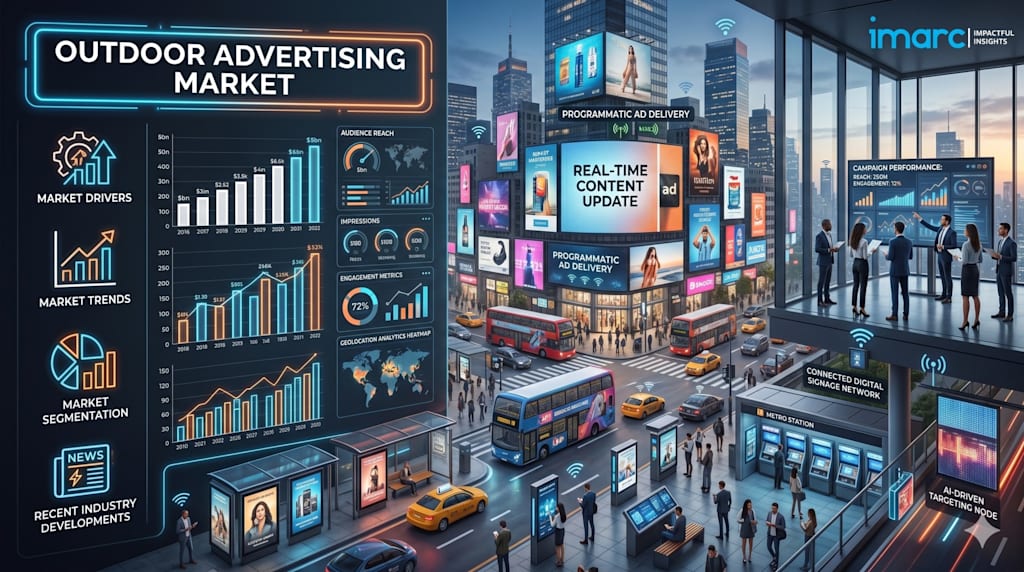
The global outdoor advertising market size was valued at USD 43.3 Billion in 2025. Looking forward, IMARC Group estimates the market to reach USD 71.2 Billion by 2034, exhibiting a CAGR of 5.50% from 2026-2034. Asia currently dominates the market, holding a market share of over 34.5% in 2025. The market is primarily driven by rapid urbanization, widespread smartphone penetration, continuous advancements in digital technology, and the growing adoption of Digital Out-of-Home (DOOH) advertising formats across commercial and public infrastructure.
How AI Is Reshaping the Future of the Outdoor Advertising Market
- Programmatic DOOH and Real-Time Content Delivery: AI-powered programmatic platforms are transforming the Outdoor Advertising Market by enabling advertisers to purchase and deliver digital out-of-home campaigns dynamically, adjusting creative content in real time based on audience data, time of day, weather conditions, and live events. Unlike traditional static billboards that require manual replacement, programmatic DOOH systems allow multiple campaigns to share the same digital screen simultaneously, optimizing inventory utilization and maximizing revenue per display unit. This capability has dramatically improved campaign flexibility and responsiveness for brands operating across large urban networks.
- AI-Driven Audience Analytics and Traffic Pattern Intelligence: Machine learning algorithms are now being deployed to analyze real-time foot traffic data, vehicle movement patterns, and audience demographic signals at outdoor advertising locations, enabling advertisers to identify optimal placement strategies and measure campaign reach with precision previously unavailable in the medium. These AI systems process data from mobile devices, sensors, and connected infrastructure to build accurate audience profiles for specific billboard locations, allowing media buyers to make data-backed placement decisions rather than relying on estimated impressions. The result is a measurable improvement in campaign targeting efficiency and return on advertising spend.
- Augmented Reality and Interactive Billboard Integration: The integration of augmented reality technologies with outdoor advertising formats is creating a new category of immersive, interactive consumer experiences that extend campaign engagement beyond passive viewing. AR-enabled billboards and digital displays allow passersby to interact with brand content through their smartphones, unlocking virtual try-ons, gamified experiences, and location-specific promotions that drive direct consumer action. For instance, Redken launched a 3D Times Square billboard featuring an AR virtual try-on for its Acidic Color Gloss Collection, demonstrating how major brands are leveraging outdoor environments as interactive digital touchpoints rather than one-way broadcast surfaces.
- QR Code and Mobile Integration for DOOH Campaign Amplification: The widespread adoption of smartphones has enabled a powerful convergence between outdoor advertising and mobile marketing, with QR code integrations on digital billboards creating direct pathways from physical ad exposure to digital consumer journeys. AI systems manage the dynamic QR code generation and campaign attribution, linking outdoor impression data with mobile engagement metrics to provide advertisers with end-to-end conversion tracking across both channels. This integration has substantially elevated the measurability of outdoor advertising campaigns, addressing one of the medium's longstanding limitations compared to digital alternatives and driving increased budget allocation from performance-focused advertisers.
- Sustainability and Energy Optimization in Digital Displays: AI is being applied to optimize energy consumption across large networks of digital outdoor advertising screens, with intelligent management systems automatically adjusting screen brightness, scheduling low-power modes during off-peak hours, and prioritizing energy-efficient hardware configurations. Outdoor advertising operators are combining AI-driven energy management with the adoption of solar-powered digital billboards and eco-friendly display materials to reduce the environmental footprint of their infrastructure, responding to both regulatory sustainability requirements and growing advertiser demand for responsible media partnerships. This operational efficiency also reduces network running costs, improving margins for outdoor media owners managing thousands of display units across urban geographies.
Outdoor Advertising Industry Overview
The global Outdoor Advertising Market is experiencing steady expansion, underpinned by rapid urbanization that is concentrating large audiences in metropolitan areas and maximizing the reach of outdoor campaigns. Asia leads all regions with a market share of over 34.5%, driven by the region's vast and diverse population, large-scale residential and commercial construction activity, and government-backed smart city programs that are embedding digital advertising infrastructure into new urban developments across China, Japan, India, and South Korea. The region's high population density in public spaces and heavy reliance on public transportation create consistent, high-frequency exposure opportunities that make outdoor advertising a highly efficient channel for brand communication.
The United States market holds a share of 86.70% within North America, sustained by strong demand for innovative marketing strategies, expanding highway and transit infrastructure that continuously generates new advertising inventory, and high car ownership rates that ensure consistent billboard exposure along major road networks. The shift from traditional static billboards to digital screens is particularly notable in the United States, where advertisers value the ability to display multiple messages in the same space and adapt content instantly based on changing conditions such as weather or local events. The integration of outdoor advertising with omnichannel marketing strategies and the growing focus on sustainability, including solar-powered digital billboards and eco-friendly display materials, are further reinforcing market momentum across the country.
Government policies and infrastructure investment programs globally are creating structural tailwinds for the Outdoor Advertising Market. Urban development initiatives in India, where authorities project more than 40% of the population will reside in urban areas by the next decade, are driving investments in digital billboards and interactive displays across city centers. In Latin America, Brazil's substantial digital transformation investment program is accelerating the adoption of DOOH formats in major cities including São Paulo, Mexico City, and Buenos Aires. Across the Middle East and Africa, urban hubs including Dubai, Riyadh, and Johannesburg are seeing rapid expansion of DOOH infrastructure, with governing agencies simultaneously promoting sustainable advertising practices such as energy-efficient digital displays and the use of recyclable materials across outdoor media networks.
Outdoor Advertising Market Trends and Drivers
The adoption of Digital Out-of-Home advertising is the most consequential trend reshaping the Outdoor Advertising Market at present. Unlike traditional static billboard formats that have been the industry's backbone for decades, DOOH platforms allow advertisers to update campaign content instantly, enabling real-time relevance tied to events, promotions, or audience conditions. Digital ad spend is set to rise by 9.2% year on year to approximately USD 870.9 Billion, reflecting the broader migration of advertising budgets toward dynamic, data-driven formats that DOOH is uniquely positioned to capture among out-of-home media. The seamless integration of DOOH with mobile advertising enables multi-channel campaigns that amplify reach and create connected brand experiences across both physical and digital environments.
Technological innovation continues to expand the capability and appeal of the Outdoor Advertising Market beyond its traditional strengths. The proliferation of AR devices globally, with approximately 1.73 billion AR-enabled user devices now in circulation, is creating a massive installed base for interactive outdoor advertising campaigns that leverage smartphone-based augmented reality. Innovations including interactive billboards, gamified advertising experiences, and near-field communication integrations are providing brands with tools to create memorable campaigns that engage passersby creatively rather than passively, elevating outdoor media's effectiveness metrics relative to conventional broadcast formats. Additionally, the integration of advanced AI analytics, geolocation data, and traffic pattern intelligence is giving advertisers unprecedented visibility into the performance of outdoor placements, transforming a traditionally impression-based medium into a results-oriented one.
The cost-effectiveness of outdoor advertising relative to television and print media remains a foundational driver of sustained market demand, particularly among advertisers seeking broad reach at lower cost-per-impression thresholds. Billboard advertising specifically benefits from one-time manufacturing costs combined with recurring rental expenses that compare favorably to the continuous production and placement costs associated with broadcast media. The non-intrusive nature of outdoor advertising, which allows consumers to engage on their own terms rather than interrupting content consumption, is increasingly valued in an advertising landscape where audience resistance to intrusive digital formats is rising. These structural advantages, combined with the medium's immunity to ad-blocking technologies, are reinforcing outdoor advertising's position as a durable component of diversified marketing strategies across consumer-facing industries.
Leading Companies Operating in the Global Outdoor Advertising Industry
- JCDecaux SE
- Ströer SE & Co. KGaA
- Clear Channel Outdoor Holdings, Inc.
- Lamar Advertising Company
- Outfront Media Inc.
- Ocean Outdoor UK Limited
- Global Media Group Services Limited
- APG|SGA
- Pattison Outdoor Advertising
- Capitol Outdoor, LLC
Outdoor Advertising Market Report Segmentation
By Type:
- Traditional Outdoor Advertising
- Digital Outdoor Advertising
Traditional outdoor advertising represents the largest type segment, holding around 51.67% of the market. This segment encompasses static billboards, transit ads, posters, and physical street furniture ads that have been the industry's foundational formats for decades, continuing to deliver broad reach and cost-effective brand presence across diverse geographic markets where digital infrastructure remains developing.
By Segment:
- Billboard Advertising
- Transport Advertising
- Street Furniture Advertising
- Others
Billboard advertising leads the market with around 56.7% of the total market share. Billboards command this position due to their high reach, strong first-impression branding appeal, strategic placement along high-traffic highways and urban corridors, and the favorable economics of one-time manufacturing costs combined with ongoing rental expenses that deliver strong long-term value for advertisers running extended campaigns.
Regional Insights:
- Asia (China, Japan, India, South Korea, Others)
- Australasia (Australia, New Zealand, Others)
- Europe (Germany, France, United Kingdom, Italy, Spain, Russia, Others)
- Latin America (Brazil, Mexico, Others)
- Middle East and Africa (Saudi Arabia, UAE, Egypt, South Africa, Others)
Asia exhibits clear dominance in the Outdoor Advertising Market, accounting for the largest regional share of over 34.5%, driven by rapid urbanization, vast and diverse consumer populations, high public transportation usage, and significant government investment in smart city infrastructure that integrates digital advertising displays into public spaces across major metropolitan areas.
Recent News and Developments in the Outdoor Advertising Market
- September 2024: Occtagon Media Networks conducted a pan-outdoor advertising campaign for Nataraj Gelix Pens from Hindustan Pencils spanning 10 states and 15 cities including Mumbai, Delhi, Kolkata, and Chennai, deploying a variety of outdoor formats including billboards, unipolar bus shelters, and gantries to achieve high visibility and strong brand presence across key urban markets.
- September 2024: ShopLiftr, a digital advertising innovation company, launched its latest programmatic and dynamic DOOH advertising platform, integrating with its existing ad technology suite to deliver an omnichannel digital advertising experience to brands and retailers across multiple verticals, enabling personalized and geotargeted real-time content delivery at scale.
- September 2024: Godrej Appliances launched an outdoor advertising campaign to generate awareness for its new AI-equipped washing machine, utilizing OOH formats to reach broad consumer audiences across key urban markets as part of its product introduction strategy.
- April 2024: Vistar Media announced that Lamar Advertising Company selected Vistar's Cortex content management software to power its network of digital out-of-home billboards across the United States, strengthening Lamar's programmatic DOOH capabilities and expanding the reach of its digital inventory to national advertisers.
- March 2025: Clear Channel Outdoor Holdings announced an expansion of its digital billboard network across major North American transit corridors, incorporating AI-driven content scheduling and real-time audience measurement tools to enhance campaign delivery precision and support growing demand from programmatic advertisers seeking measurable outdoor media placements.
- January 2026: JCDecaux SE launched an updated smart city street furniture advertising program across multiple European cities, embedding sensor-equipped digital display units capable of environmental monitoring and audience analytics alongside real-time advertising delivery, positioning the company at the intersection of urban infrastructure services and data-driven outdoor media.
Note: If you require specific details, data, or insights that are not currently included in the scope of this report, we are happy to accommodate your request. As part of our customization service, we will gather and provide the additional information you need, tailored to your specific requirements. Please let us know your exact needs, and we will ensure the report is updated accordingly to meet your expectations.
About the Creator
Abhay Rajput
I am working in market research company that provides market and business research intelligence across the globe.
Enjoyed the story? Support the Creator.
Subscribe for free to receive all their stories in your feed.
Comments
There are no comments for this story
Be the first to respond and start the conversation.