
Organic Hair Care Market: Why Consumers Are Turning Their Back on Sulfates, Parabens, and Silicones — and Building a USD 57 Billion Industry in the Process
From USD 20.94 billion in 2025 to USD 57.40 billion by 2035 — the organic hair care market is the fastest-growing segment in personal care right now

At some point in the last few years, reading the ingredients list on a shampoo bottle became a thing people actually do. Not just people with allergies or sensitivities — ordinary consumers standing in the hair care aisle, flipping the bottle over, scanning for sulfates, parabens, silicones, and a growing list of synthetic ingredients they have decided they no longer want anywhere near their scalp.
This shift did not happen because of a single study or a government warning. It happened through millions of individual conversations — on YouTube, Reddit, TikTok, and in salon chairs — where people shared what had worked for their hair and what had quietly been damaging it for years. The result is one of the most significant consumer behavior shifts in the history of personal care.
The global organic hair care market was valued at USD 20.94 billion in 2025 and is projected to reach USD 57.40 billion by 2035 — a CAGR of 9.6% that makes it the fastest-growing segment within the broader hair care industry. Consumer rejection of synthetic formulations is pushing certified plant-based products into mainstream retail at speed, while scalp health positioning and biotech-infused organic formats are pulling category value upward across both mass and prestige channels. The complete analytical breakdown — covering product types, end-use demographics, hair types, scalp concerns, distribution channels, ingredient sources, and regional forecasts through 2035 — is documented in the organic hair care market report from Evolvance Market Research.
Want to Know more: https://evolvancemarketresearch.com/reports/organic-hair-care-market/
Organic Hair Care Market Size and Growth
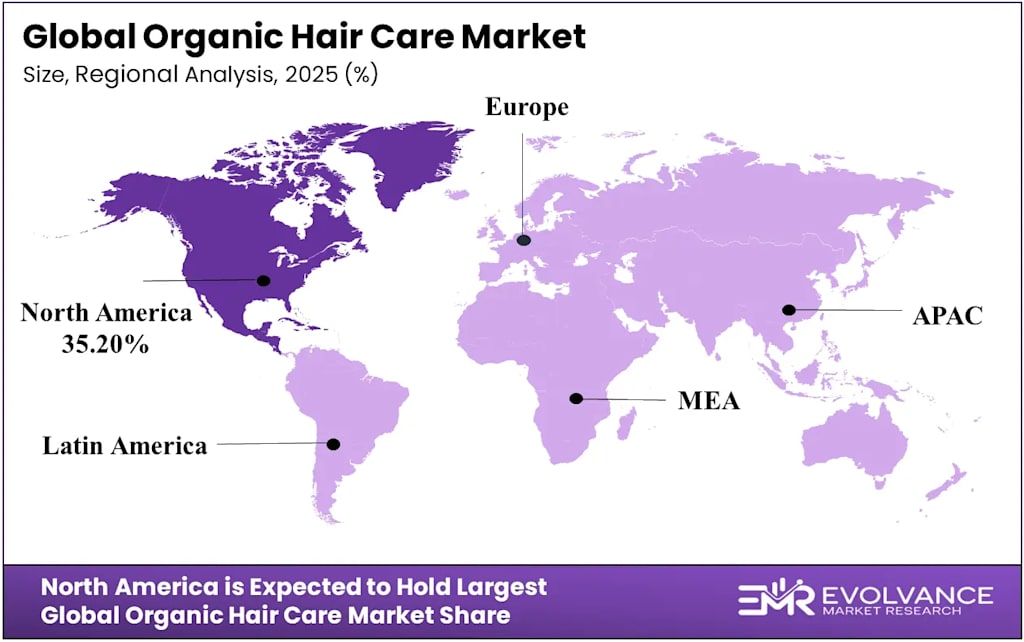
North America leads the global organic hair care market with a 35.20% revenue share valued at USD 7.31 billion in 2025 — and the reason is both regulatory and cultural. American consumers have become acutely ingredient-aware, driven by a wellness culture that extends the same scrutiny applied to food labels to personal care products. The MoCRA compliance requirements effective July 2024 — which mandate facility registration, adverse event reporting, and safety substantiation for personal care brands — are simultaneously raising standards and accelerating consolidation toward certified compliant operators.
Europe follows with strong organic certification infrastructure built around ECOCERT and COSMOS standards that give European consumers a credible verification framework for evaluating organic claims. The EU's Green Claims Directive, currently moving through the legislative process, will tighten the legal definition of environmental and natural claims across personal care — a development that will advantage genuinely certified brands and penalize those relying on vague "natural" positioning without certification backing.
Asia Pacific is the growth region to watch — where rising middle-class disposable income, growing ingredient awareness among younger urban consumers, and an existing cultural affinity for herbal and botanical hair care traditions are creating conditions for rapid organic category expansion across India, South Korea, and Southeast Asia.
Organic Hair Care Market Trends: The Greenwashing Problem
Here is the number that every organic hair care brand should be thinking about: 35% of consumers distrust brand environmental claims, according to EuroConsumers 2024 research. In a market whose entire value proposition is built on what goes into the product and what does not, consumer skepticism about ingredient claims is not a peripheral concern. It is the central challenge.
The greenwashing problem in organic hair care is real and documented. Forty-eight percent of cosmetic importers showed FDA non-compliance in 2024 according to Registrar Corp — a figure that confirms certification gaps are widespread and that the gap between what is labeled "natural" and what is genuinely certified creates both brand risk and competitive opportunity simultaneously.
Brands that have invested in third-party certification — USDA Organic, ECOCERT, GMP standards — and built transparent ingredient sourcing narratives are turning the industry's credibility problem into a competitive moat. When a consumer has been burned by a "natural" product that turned out to contain a long list of synthetic additives, the value of verifiable certification rises dramatically. Certification is not just a compliance box. In this market, it is the product.
Organic Hair Care Market Segments: Shampoo Leads but Waterless Is the Future
Shampoo commands a 36.80% share of the organic hair care market — the largest of any product type — driven by daily use frequency and the powerful consumer narrative around sulfate-free reformulation. The story is simple and compelling: traditional shampoos strip natural oils from the scalp, disrupt the scalp microbiome, and cause the kind of chronic scalp dryness and irritation that sends people looking for alternatives. Certified organic sulfate-free shampoos address that concern with a formulation story that is easy to understand and easy to believe.
Anti-dandruff is the leading scalp concern driving organic purchases — capturing a remarkable 50% of the scalp concern segment. This is a consumer group that has tried zinc pyrithione-based medicated shampoos, found them effective but harsh, and is now actively seeking certified natural alternatives that address dandruff without the drying, chemical-heavy formulations that conventional anti-dandruff products rely on. Brands that can credibly bridge clinical efficacy and organic certification in the anti-dandruff space hold a structural pricing advantage.
Dry hair types account for 35% of organic hair care revenue — reflecting strong alignment between moisture-deficient hair needs and the oil-rich botanical formulations that organic products deliver particularly well. Women represent 71.4% of end-use revenue, while gender-neutral and men's organic positioning is emerging as a secondary growth category with younger male consumers who have adopted ingredient-conscious grooming standards.
The most interesting emerging format is waterless hair care — shampoo bars, concentrated powder formulations, and solid conditioners. These formats reduce packaging waste, eliminate the water that makes up 70-80% of conventional liquid formulations, and deliver more active ingredients per unit weight. They align perfectly with the environmental values that drive organic hair care purchase decisions — and they are growing faster than any other format in the category.
Organic Hair Care Distribution: Online Is Where Discovery Happens
Offline channels retain a 70.08% revenue share — pharmacies, specialty stores, and supermarkets remain the primary trial and repurchase channels where organic hair care brands build volume. But online is where organic hair care discovery happens — and discovery drives the trial that becomes repurchase.
The organic hair care consumer is highly research-oriented. They read ingredient lists, cross-reference certifications, watch application tutorials, and read peer reviews before committing to a premium-priced product they have never tried. That research behavior makes content-led digital strategy the single most effective customer acquisition channel in this market. Brands that invest in ingredient education, certification transparency, and authentic user results convert at higher rates and retain customers longer than those relying purely on aesthetic brand positioning.
Key Players in the Organic Hair Care Market
Avalon Organics and Jason Natural Products anchor the mass-market certified organic tier with broad supermarket and pharmacy distribution. Briogeo has built a strong premium position through ingredient transparency and textured hair expertise. Rahua — founded on Amazonian ungurahua oil — represents the luxury end of certified organic positioning, with a supply chain story that delivers genuine differentiation at prestige price points.
L'Oréal's acquisition of organic and natural hair care brands signals that multinationals are treating certified organic as a strategic growth category rather than a niche. The acquisition wave is likely to intensify as the organic hair care market approaches USD 57 billion — at that scale, no major personal care company can afford to be absent from certified organic positioning.
The consumers who read ingredient labels are not going back. The USD 57 billion market they are building reflects choices being made one bottle at a time — and those choices are compounding.
About the Creator
Suge kun
Research Analyst passionate about data & market insights. I turn complex information into clear, actionable strategies. Detail-driven & results-focused — helping businesses make smarter decisions. — Suge Kun
Enjoyed the story? Support the Creator.
Subscribe for free to receive all their stories in your feed.
Comments
There are no comments for this story
Be the first to respond and start the conversation.