
Organic Food and Beverages Market: Clean Label Trends, Healthy Consumption & Growth Outlook
The organic food and beverages market is growing due to rising consumer preference for natural and chemical-free products worldwide.

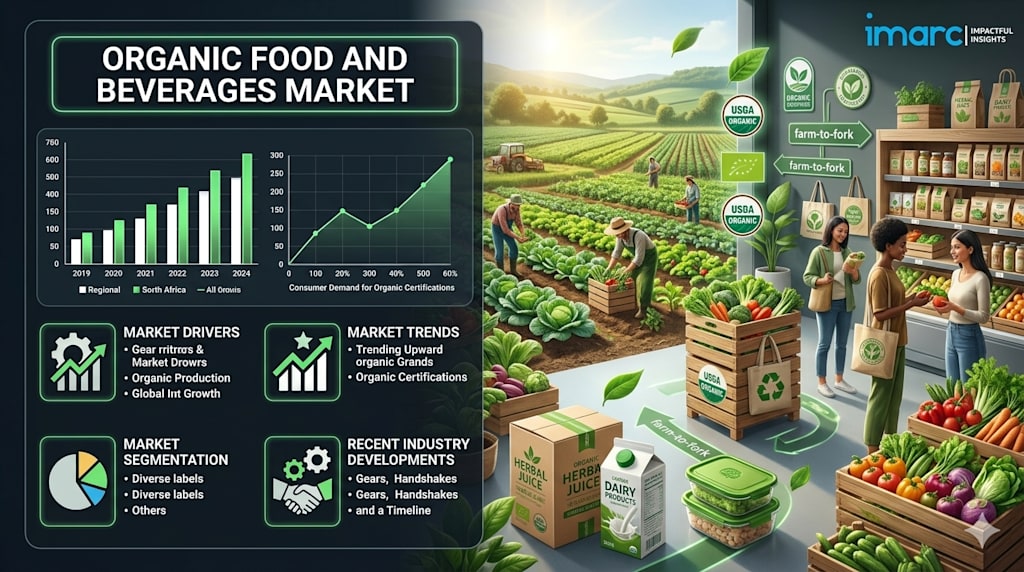
According to IMARC Group's latest research publication, the global organic food and beverages market size was valued at USD 371.1 Billion in 2025. Looking forward, IMARC Group estimates the market to reach USD 1,017.9 Billion by 2034, exhibiting a growth rate (CAGR) of 11.51% during 2026-2034.
How AI is Reshaping the Future of the Organic Food and Beverages Market
- Smart Supply Chain and Traceability: AI-powered blockchain tools track organic produce from farm to shelf, ensuring authenticity, reducing fraud, and giving consumers verified transparency across complex multi-tier supply networks.
- Precision Demand Forecasting: Machine learning analyzes purchasing behavior and seasonal trends to help organic brands optimize stock levels, cut spoilage, and align procurement with real-time consumer demand signals.
- Personalized Consumer Engagement: AI-driven platforms tailor product recommendations based on dietary preferences, purchase history, and health goals, deepening brand loyalty among health-conscious organic consumers.

Organic Food and Beverages Industry Overview
The global organic food and beverages sector is witnessing strong momentum as health awareness reshapes everyday consumer choices. North America leads the charge, commanding a 45.8% market share, backed by robust retail infrastructure and a well-informed consumer base. In the United States alone, which accounts for 90% of the North American share, rising e-commerce adoption is making organic products more accessible than ever, with US retail e-commerce representing 16.2% of total retail sales in Q1 2025.
Organic Food and Beverages Market Trends and Drivers
People are actively rethinking what goes on their plate. Concerns around pesticide residues, synthetic additives, and GMOs are pushing more consumers toward certified organic options. Chronic health conditions like obesity and diabetes are further accelerating this shift, with buyers connecting diet quality to long-term wellness. Brands are responding with purpose-driven innovations.
Organic is no longer a niche purchase. Major supermarkets are expanding shelf space for certified products, and online marketplaces are bringing organic goods to consumers in smaller cities and remote regions who previously had limited access. Mother Dairy's partnership with Bharat Organics to distribute organic staples like Atta and Jaggery across 300-plus Safal stores in Delhi NCR is a strong example of how established distribution networks are being leveraged to democratize organic access.
The plant-based food movement and organic demand are converging in a big way. As more consumers adopt vegetarian, vegan, or flexitarian lifestyles, they are increasingly seeking organic plant milks, meat alternatives, and snacks that align with both their ethical values and health goals.
Leading Companies Operating in the Global Organic Food and Beverages Industry
- Amy's Kitchen Inc.
- Belvoir Fruit Farms Ltd.
- Danone S.A.
- Dole Food Company, Inc.
- Eden Foods Inc.
- General Mills Inc.
- Organic Valley
- SunOpta Inc.
- The Hain Celestial Group Inc.
- The Kroger Company
- United Natural Foods Inc.
Organic Food and Beverages Market Report Segmentation
By Product Type:
- Organic Food
- Organic Fruit and Vegetables
- Organic Meat, Fish and Poultry
- Organic Dairy Products
- Organic Frozen and Processed Foods
- Others
- Organic Beverages
- Fruit and Vegetable Juices
- Dairy
- Coffee
- Tea
- Others
Organic food holds the largest market share, driven by strong demand for chemical-free fruits, vegetables, dairy, and meat products as consumers increasingly associate organic certification with superior quality, nutrition, and environmental responsibility.
By Distribution Channel:
- Offline
- Online
Offline channels dominate with a 75.6% market share, owing to well-developed retail infrastructure and the strong consumer preference for physically inspecting organic products before purchase.
Regional Insights:
- North America (United States, Canada)
- Asia Pacific (China, Japan, India, South Korea, Australia, Indonesia, Others)
- Europe (Germany, France, United Kingdom, Italy, Spain, Russia, Others)
- Latin America (Brazil, Mexico, Others)
- Middle East and Africa
North America leads the global organic food and beverages market with a 45.8% share, driven by high health awareness, strong retail networks, and supportive government policies promoting organic farming and sustainable food systems.
Recent News and Developments in the Organic Food and Beverages Market
- May 2025: Tata Consumer announced plans to expand its Organic India portfolio with specialized teas and inexpensive functional beverages targeting a broader consumer base, alongside the expansion of its Ching's Secret brand with Korean noodles.
- April 2025: Walmart launched Glen Powell's organic food line, featuring condiments free from high-fructose corn syrup, artificial colors, and additives, including classic ketchup, mayonnaise, mustard, and innovative variants like Hot Honey Ketchup.
Note: If you require specific details, data, or insights that are not currently included in the scope of this report, we are happy to accommodate your request. As part of our customization service, we will gather and provide the additional information you need, tailored to your specific requirements.
About the Creator
sujeet. imarcgroup
With 2 years of hands-on experience at IMARC Group, I have conducted in-depth market research and analysis across diverse industries including technology, healthcare, agriculture, and consumer goods.
Enjoyed the story? Support the Creator.
Subscribe for free to receive all their stories in your feed.
Comments
There are no comments for this story
Be the first to respond and start the conversation.