
Organ-on-Chip Market Outlook: Advanced Biomedical Research and Growth Opportunities
The Organ-on-Chip Market is experiencing rapid growth driven by increasing demand for advanced in vitro models in drug discovery and biomedical research.

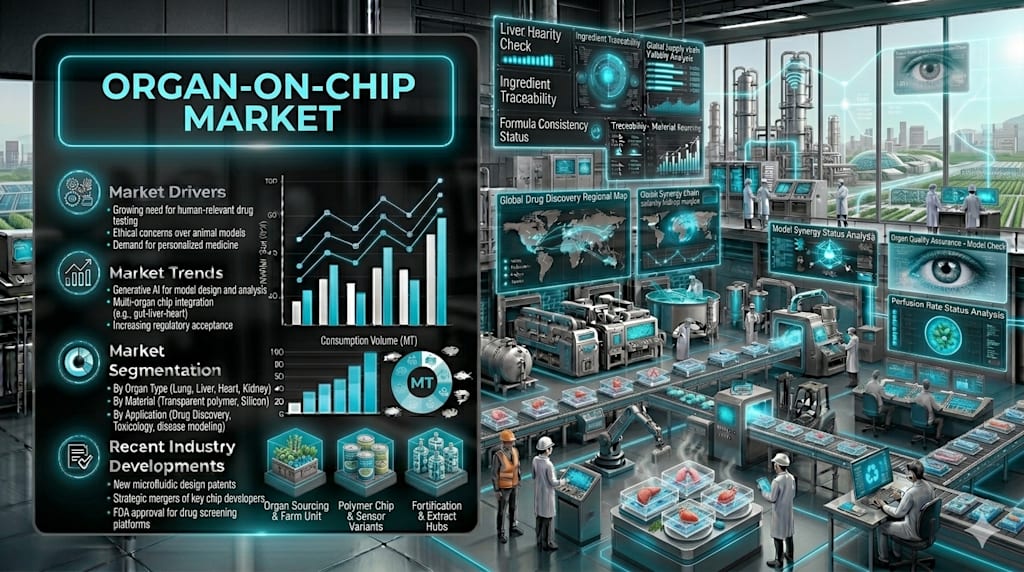
According to IMARC Group's latest research publication, The global organ-on-chip market size reached USD 98.2 Million in 2025. Looking forward, IMARC Group expects the market to reach USD 727.9 Million by 2034, exhibiting a growth rate (CAGR) of 24.19% during 2026-2034.
How AI is Reshaping the Future of Organ-on-Chip Market
- AI-Driven Predictive Modeling for Drug Discovery: AI and machine learning are significantly enhancing the predictive accuracy of organ-on-chip platforms by analyzing complex biological datasets generated during preclinical testing. With more than 80% of drug candidates failing in clinical trials, where 60% fail due to lack of efficacy and 30% due to toxicity, AI-powered organ-on-chip models are closing this critical gap by simulating human-specific drug responses that conventional animal models cannot replicate.
- AI-Enhanced Microfluidics and 3D Bioprinting Integration: The convergence of AI with microfluidics and 3D bioprinting is dramatically improving the functional accuracy of organ-on-chip systems. AI algorithms are now used to automatically optimize parameters such as fluid flow rates, temperature gradients, and cell-matrix interactions within the chips, enabling the creation of multi-organ platforms that better replicate human pharmacokinetics and pharmacodynamics.
- Real-Time AI Monitoring and Quality Control: AI-powered imaging and sensor analytics are being embedded into organ-on-chip platforms to provide continuous, real-time monitoring of cell behavior, tissue integrity, and fluid dynamics. Companies like Emulate, Inc. launched the AVA Emulation System in June 2025, a self-contained instrument capable of culturing, incubating, and imaging up to 96 independent organ-chip samples simultaneously, reportedly cutting consumable costs fourfold and reducing in-lab labor by half. This represents a major leap in throughput and scalability for pharmaceutical clients seeking high-volume preclinical screening.
Organ-on-Chip Industry Overview
The organ-on-chip industry is advancing rapidly on the strength of regulatory reform, institutional investment, and global academic-industry collaboration. The Netherlands, a key European hub, committed to a 124 million Euro Dutch National Growth Fund project for animal-free biomedical innovation, with MIMETAS serving as a core stakeholder. Queen Mary University of London, in February 2025, opened one of Europe's largest organ-on-chip facilities, funded by the National Centre for the Replacement, Refinement and Reduction of Animals in Research (NC3Rs), specifically designed to advance drug testing and train the next generation of biomedical scientists. China, in November 2024, released its first national guidelines for organ-on-chip technology, signaling its ambition to lead globally in this biotech segment and standardize chip manufacturing across its domestic pharmaceutical ecosystem.
Organ-on-Chip Market Trends and Drivers
The primary driver of the organ-on-chip market is the escalating demand for more accurate, cost-effective, and ethical alternatives to animal testing in pharmaceutical drug development. Currently, only 1 in 1,000 potential drugs progresses to clinical trials following preclinical testing in the United States, and of those, 90% fail during the clinical phase. This structural inefficiency, which can push the cost of developing a single approved drug past USD 2.5 billion, is pushing pharmaceutical companies to adopt organ-on-chip platforms as an intermediate testing layer. Drug discovery represents the largest application segment, driven by the platform's ability to shorten development timelines and generate more human-relevant safety and efficacy data.
Regulatory momentum is providing a structural tailwind across all major markets. The FDA's April 2025 roadmap for reducing animal testing by 2030 and the ISTAND Pilot Program's ongoing acceptance of chip-generated biological data are reducing barriers to commercial adoption. Pharmaceutical and biotechnology companies, which held 55.49% of end-user share in 2026, are revising internal R&D protocols in response to the FDA's October 2025 decision to phase out mandatory animal studies for monoclonal antibodies. In parallel, Contract Research Organizations are emerging as a high-growth end-user segment, with a projected growth rate of 35.07% through 2031, as pharma sponsors without in-house infrastructure increasingly outsource microphysiological testing services.
Technological advancements in 3D bioprinting, AI integration, and automated chip fabrication are lowering production costs and improving scalability. LCD 3D printing and automated thermoplastic processes have reduced per-device expenses substantially, enabling mass manufacture of high-resolution chips for mainstream pharmaceutical use. Academic institutions are also scaling up their role in the ecosystem; over 80 inter-organizational partnerships have been established in the organ-on-chip domain since 2017, with more than 60% of these being intracontinental agreements. Europe's regulatory push, including the EU ban on animal testing in cosmetics, is accelerating adoption in the cosmetics industry segment, which is expected to grow at approximately 27% through the coming years. AI integration, cited by 65% of active researchers, combined with microfluidic innovation adopted by 50% of developers, is collectively positioning organ-on-chip technology as the definitive next-generation platform for preclinical research.
Leading Companies Operating in the Global Organ-on-Chip Industry
- Allevi Inc.
- Altis Biosystems
- AxoSim
- BiomimX S.r.l.
- Elveflow
- Emulate Inc.
- InSphero
- MIMETAS
- Nortis Inc.
- TARA Biosystems Inc.
- TissUse GmbH
Organ-on-Chip Market Report Segmentation
By Offering:
- Products
- Services
- By Type:
- Liver
- Heart
- Lung
- Kidney
- Others
Lung holds the largest share of the industry, accounting for 34.12% of 2025 revenue, driven by extensive application in respiratory research and inhalation toxicity testing.
By Application:
- Physiological Model Development
- Drug Discovery
- Toxicology Research
Drug discovery represents the leading market segment, accounting for 45% of total application share in 2024, as the platform enables early-stage screening of drug candidates with significantly higher human relevance than traditional models.
By End Use:
- Pharmaceutical and Biotechnology Companies
- Academic and Research Institutes
- Cosmetics Industry
- Others
Pharmaceutical and biotechnology companies exhibit clear dominance in the market, holding over 73% of end-user share in 2024, driven by their integration of organ-chip platforms into core R&D workflows.
Regional Insights:
- North America (United States, Canada)
- Asia Pacific (China, Japan, India, South Korea, Australia, Indonesia, Others)
- Europe (Germany, France, United Kingdom, Italy, Spain, Russia, Others)
- Latin America (Brazil, Mexico, Others)
- Middle East and Africa
North America exhibits clear dominance, generating 43.80% of global market revenue in 2025, supported by the FDA's proactive regulatory stance, deep venture capital pools, and strong university-pharma collaboration infrastructure. Asia-Pacific is the fastest-growing region, with China, Japan, and India all scaling public R&D investments and enacting domestic regulatory guidance for chip-based data submissions.
Recent News and Developments in the Organ-on-Chip Market
- June 2025: Emulate, Inc. commercially launched the AVA Emulation System, a self-contained instrument that simultaneously cultures, incubates, and images up to 96 independent organ-chip samples in a single run, cutting consumable costs fourfold compared to existing solutions and reducing in-lab labor by 50%.
- June 2025: Hesperos, Inc. entered into a strategic partnership with biopharmaceutical company Psilera to accelerate the preclinical development of PSIL-006, Psilera's lead neuroplastogen compound targeting frontotemporal dementia, using Hesperos's human-on-a-chip neurology models.
- February 2025: Queen Mary University of London officially opened one of Europe's largest and most advanced organ-on-chip research facilities, funded through the NC3Rs, with the explicit goal of advancing animal-free drug testing and training the next generation of biomedical scientists.
- January 2025: CN Bio signed a distribution agreement with Japan-based Primetech for market expansion of its PhysioMimix OOC Systems across Japan, continuing the company's Asia-Pacific distribution strategy.
- November 2024: China released its first national guidelines for organ-on-chip technology, a regulatory milestone aimed at standardizing chip manufacturing and positioning China as a global leader in the biotech segment.
- November 2024: InSphero entered into a distribution agreement with South Korea-based Chayon for regional distribution of its Akura Plate Technology and Akura Organ-on-Chip Platforms, strengthening its Asia-Pacific commercial presence.
- September 2024: Emulate, Inc. launched the Chip-R1 Rigid Chip, specifically designed for ADME and toxicology testing with a minimally drug-absorbing profile, addressing a key technical challenge in organ-chip drug screening applications.
- April 2024: CN Bio Innovations raised USD 21 million in a Series B funding round led by Bayland Capital, with USD 10 million contributed by Bayland Capital and USD 5.5 million from CN Innovations Holdings Ltd., earmarked for product development and portfolio expansion.
- January 2024: CN Bio entered into a strategic partnership with Altis Biosystems to develop an advanced human Gut/Liver in vitro model, combining their respective organ-specific expertise to deliver next-generation ADME prediction capabilities through CN Bio's Contract Research Services.
Note: If you require specific details, data, or insights that are not currently included in the scope of this report, we are happy to accommodate your request. As part of our customization service, we will gather and provide the additional information you need, tailored to your specific requirements. Please let us know your exact needs, and we will ensure the report is updated accordingly to meet your expectations.
About the Creator
Olivia Smith
Olivia Smits is a Research and Marketing Analyst who specializes in market research, trend analysis, and consumer insights. I help businesses make smarter marketing and strategy decisions by turning data into clear, actionable insights.
Enjoyed the story? Support the Creator.
Subscribe for free to receive all their stories in your feed.
Comments
There are no comments for this story
Be the first to respond and start the conversation.