
Open Source Is Quietly Reshaping the World
Some of the most important technologies of our time are not being built behind closed doors. They are being built in public.
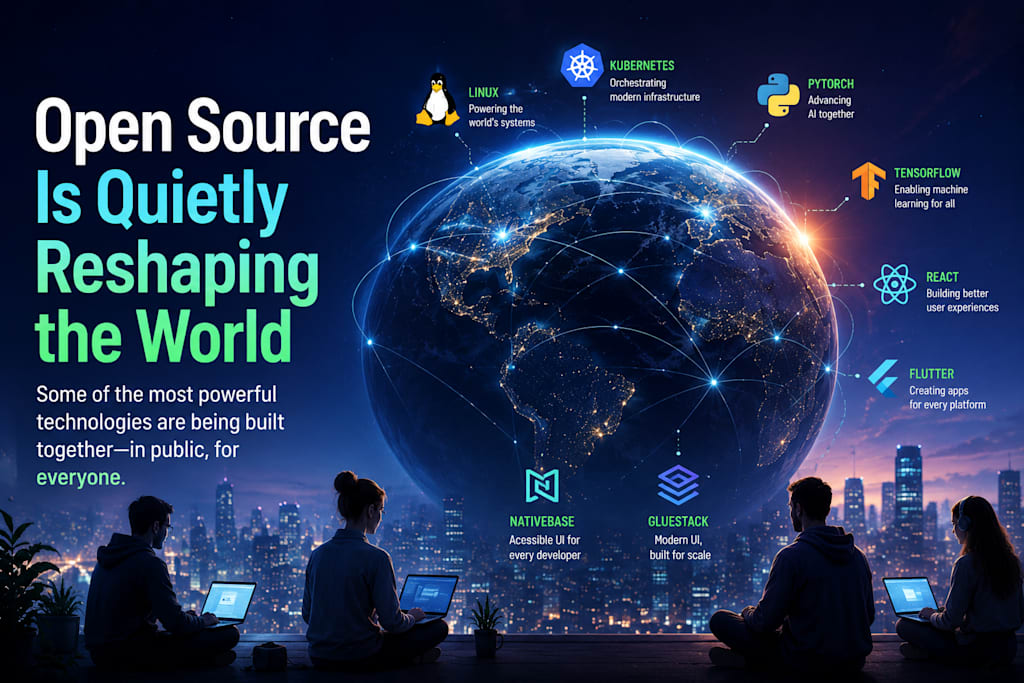
When people talk about technological innovation, the spotlight usually falls on artificial intelligence, cloud computing, robotics, or the latest breakthrough product. Headlines often celebrate billion-dollar companies and visionary founders. Yet many of the technologies powering those innovations have a different origin story.
They were built by communities.
Open source software has become one of the most influential forces in the digital age, even though most people rarely think about it. Every day, billions of people interact with technology that depends on open source projects. From the applications on our phones to the cloud infrastructure supporting global businesses, open collaboration has become a foundational part of modern computing.
What makes this remarkable is not just the technology itself. It is the way that technology is created. Developers from different countries, backgrounds, and industries contribute to shared projects, often without ever meeting one another. Together, they build tools that power products used by millions of people around the world.
In many ways, open source represents a different vision of innovation. Instead of knowledge being locked away, it is shared. Instead of progress being controlled by a single organization, it becomes a collective effort.
The Invisible Foundation Beneath Modern Technology
Most people have heard of artificial intelligence. Fewer people realize how much of the modern digital world depends on open source software.
The internet itself relies heavily on technologies developed through open collaboration. Much of the world's infrastructure runs on Linux, one of the most successful open source projects ever created. Platforms built on Kubernetes help organizations manage applications at global scale. Artificial intelligence research has accelerated through frameworks such as PyTorch and TensorFlow, allowing developers and researchers to experiment with machine learning without needing access to proprietary systems.
Even the apps people use every day often rely on open source technologies. React transformed how developers build user interfaces. Flutter made it easier to create experiences across multiple platforms from a single codebase.
The impact of open source extends far beyond code repositories. It has become the infrastructure layer beneath much of modern innovation.
Why AI Is Making Open Source More Important
Artificial intelligence is advancing at an extraordinary pace.
Every week seems to bring a new model, framework, or capability. Companies are racing to integrate AI into products, automate workflows, and create entirely new digital experiences.
In this environment, open source plays a critical role.
Without it, access to advanced technology could become concentrated among a small number of organizations with massive resources. Open source creates opportunities for startups, independent developers, researchers, and students to participate in innovation regardless of their size.
Many of the tools driving AI experimentation today are openly available. Developers can study them, improve them, and build on top of them. This accelerates learning and allows ideas to spread much faster than they would in closed ecosystems.
Some of the most exciting developments in technology often emerge when people are free to experiment. Open source creates an environment where that experimentation can happen at a global scale.
Communities Are Becoming Innovation Engines
One of the most fascinating aspects of open source is that it challenges traditional assumptions about how technology should be built.
For decades, innovation was associated with centralized organizations. Companies hired teams, managed projects internally, and controlled development behind closed doors.
Open source communities operate differently.
Contributors may live on different continents. They may work for different companies or no company at all. Some contribute professionally, while others participate because they are passionate about solving a particular problem.
Despite these differences, they often create technologies that rival or exceed commercial alternatives.
Projects such as NativeBase and Gluestack demonstrate how community-driven development can influence modern application development. These tools have helped developers create scalable user interfaces and component systems while benefiting from contributions and feedback from a broader ecosystem.
Their success reflects a larger trend. Increasingly, innovation is becoming something communities create together rather than something delivered from the top down.
The Sustainability Question
Open source has transformed software development, but it faces challenges of its own.
Many projects that support critical infrastructure are maintained by relatively small groups of contributors. As reliance on these technologies grows, so does the responsibility carried by maintainers.
Questions about sustainability are becoming increasingly important.
How can projects secure long-term support?
How can communities continue growing without sacrificing quality?
How do organizations contribute back to ecosystems they depend upon?
The answers will help determine how open source evolves over the coming decade.
What is clear is that businesses are becoming more aware of their role in supporting open ecosystems. Contributions now go beyond code. Documentation, funding, mentorship, education, and community engagement all play important roles in maintaining healthy projects.
A Different Vision of the Future
Perhaps the most remarkable thing about open source is that it offers an alternative model for technological progress.
It demonstrates that innovation does not always require secrecy.
It shows that collaboration can be as powerful as competition.
And it proves that people working together across borders can build technologies that shape industries and influence billions of lives.
As artificial intelligence, cloud computing, and digital infrastructure continue evolving, the role of open source is likely to become even more significant. The technologies attracting attention tomorrow may appear revolutionary on the surface, but many will still be built on foundations created by global communities working together in public.
The next major technological breakthrough might come from a startup, a research lab, or a multinational corporation.
There is also a good chance it will emerge from an open source community where thousands of contributors share ideas, solve problems, and build something larger than any one organization could create alone.
That possibility may be one of the most powerful ideas in technology today.
About the Creator
Enjoyed the story? Support the Creator.
Subscribe for free to receive all their stories in your feed.
Comments
There are no comments for this story
Be the first to respond and start the conversation.