
Online Grocery Market: Demand Drivers, Home Delivery Services & Future Growth Prospects
The online grocery market is growing due to rising internet penetration and increasing demand for convenient shopping solutions worldwide.

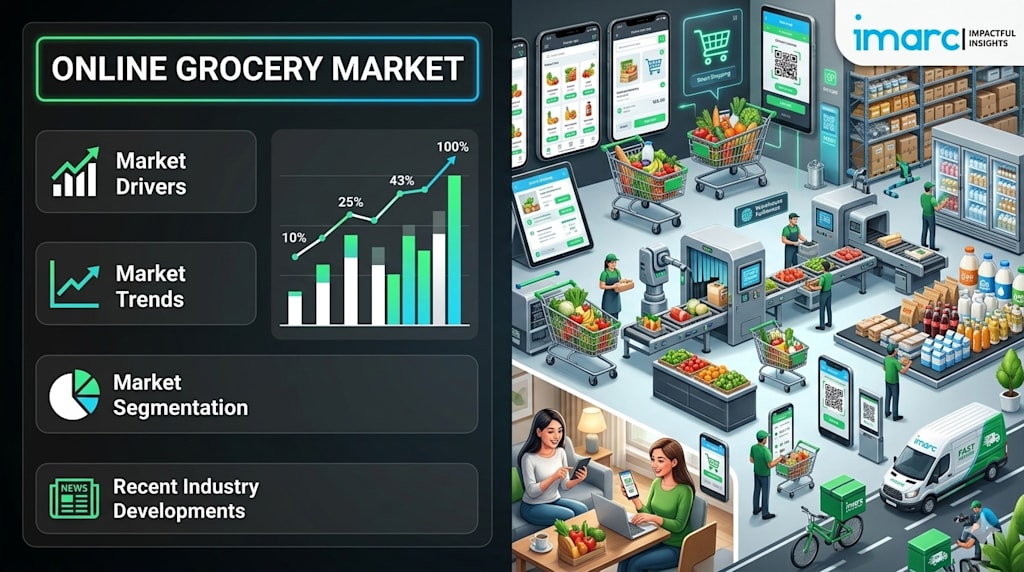
According to IMARC Group's latest research publication, global online grocery market size was valued at USD 909.6 Billion in 2025. Looking forward, IMARC Group estimates the market to reach USD 7,644.8 Billion by 2034, exhibiting a growth rate (CAGR) of 25.88% from 2026-2034.
How AI is Reshaping the Future of Online Grocery Market
- AI-Powered Personalized Shopping and Intelligent Product Recommendations: Artificial intelligence transforms the online grocery experience by analyzing purchase history, browsing behavior, dietary preferences, and seasonal patterns to deliver hyper-personalized product recommendations that anticipate customer needs before they articulate them.
- Predictive Inventory Management and Automated Demand Forecasting: AI-powered forecasting revolutionizes inventory management by analyzing historical sales data, weather patterns, local events, holiday calendars, and real-time market trends to predict demand with precision that significantly reduces stockouts while minimizing food waste from overstocking perishable products.
- Voice Commerce and Conversational Shopping Assistants: Voice-activated shopping through smart speakers, mobile assistants, and in-app chatbots is transforming how consumers build shopping lists and complete routine grocery purchases, with voice commerce projected to reach USD 164 billion globally as consumers embrace conversational interfaces for hands-free shopping convenience.
Online Grocery Industry Overview
The online grocery sector experiences remarkable expansion driven by smartphone ubiquity, convenience expectations, and last-mile delivery innovation. Asia Pacific dominates with 58.3% market share, fueled by dense urban populations and mobile-first commerce adoption. North America maintains substantial presence with 82.50% US market share regionally, while Europe advances through omnichannel integration and sustainability focus.
Online Grocery Market Trends & Drivers
Smartphone penetration and mobile app sophistication drive unprecedented online grocery adoption, with over 90% of Americans accessing internet and approximately 90% owning smartphones creating infrastructure for mobile-first shopping behaviors transforming grocery purchasing patterns.
Consumer lifestyle changes and convenience prioritization fundamentally drive market expansion as busy professionals, dual-income families, and individuals with demanding schedules seek time-saving alternatives eliminating physical store visits, traffic navigation, parking searches, and checkout queues.
AI integration and technological advancement transform operational efficiency while enhancing customer experience, with 86% of grocery C-suite executives recognizing AI as necessary for future competitive success and 80% of retail executives expecting AI-powered automation adoption.
Leading Companies Operating in the Global Online Grocery Industry:
- Amazon.com, Inc.
- Carrefour
- Costco Wholesale Corporation
- Edeka Group
- HappyFresh
- Koninklijke Ahold Delhaize N.V.
- Reliance Retail Limited (Reliance Industries Limited)
- Safeway Inc. (Albertsons Companies, Inc.)
- Schwan's Home Delivery
- ShopFoodEx
- Tesco PLC
- The Kroger Co.
- Walmart Inc.
- Wm Morrison Supermarkets Limited
Online Grocery Market Report Segmentation:
By Product Type:
- Vegetables and Fruits
- Dairy Products
- Staples and Cooking Essentials
- Snacks
- Meat and Seafood
- Others
Staples and cooking essentials lead the market with around 28.9% share.
By Business Model:
- Pure Marketplace
- Hybrid Marketplace
- Others
Pure marketplace dominates the segment, acting as facilitator connecting multiple sellers with buyers without maintaining inventory.
By Platform:
- Web-Based
- App-Based
App-based platforms drive substantial growth requiring users to download applications on smartphones or tablets, offering convenience and speed particularly for repeat purchases and regular users.
By Purchase Type:
- One-Time
- Subscription
Subscription leads the market with around 58.0% share, gaining traction particularly for staple items and regularly used products where consumers subscribe to receive predetermined products at scheduled intervals such as weekly or monthly.
Regional Insights:
- North America (United States, Canada)
- Asia Pacific (China, Japan, India, South Korea, Australia, Indonesia, Others)
- Europe (Germany, France, United Kingdom, Italy, Spain, Russia, Others)
- Latin America (Brazil, Mexico, Others)
- Middle East and Africa
Asia Pacific dominates with over 58.3% market share, driven by large population, increasing smartphone penetration reaching 78%, and expanding middle class projected to reach 3.8 billion people, creating substantial online grocery buying base.
Recent News and Developments in Online Grocery Market
- October 2025: Amazon introduced Amazon Grocery private-label brand featuring over 1,000 food products with numerous items priced below USD 5 to attract cost-sensitive shoppers.
- October 2025: Indonesian e-commerce leader Blibli introduced BlibliFresh online grocery service emphasizing freshness, quick delivery, and dependability.
Note: If you require specific details, data, or insights that are not currently included in the scope of this report, we are happy to accommodate your request. As part of our customization service, we will gather and provide the additional information you need, tailored to your specific requirements. Please let us know your exact needs, and we will ensure the report is updated accordingly to meet your expectations.
About the Creator
sujeet. imarcgroup
With 2 years of hands-on experience at IMARC Group, I have conducted in-depth market research and analysis across diverse industries including technology, healthcare, agriculture, and consumer goods.
Enjoyed the story? Support the Creator.
Subscribe for free to receive all their stories in your feed.
Comments
There are no comments for this story
Be the first to respond and start the conversation.