
On-Orbit Satellite Servicing Market: A $7B Shift in Space Economics
Satellites no longer have to die when they run out of fuel — and that changes everything.
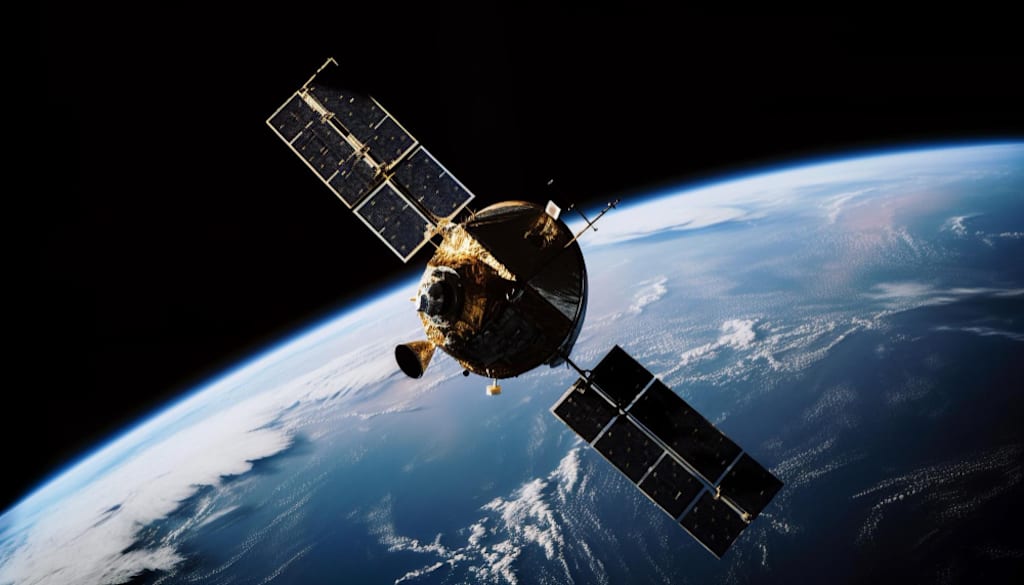
The Quiet Revolution Happening 400 Miles Above Your Head
There are roughly 8,000 active satellites orbiting Earth right now. Most of them will die alone. Not from collision or solar flares, but from something embarrassingly mundane: running out of fuel. For decades, the answer to a dead satellite was a shrug and a write-off — insurance claims filed, replacement missions funded, billions of dollars of functioning hardware left to drift. That era is ending faster than most people realize.
The On-Orbit Satellite Servicing Market Size is currently valued at $2.9 billion in 2025 and is projected to reach $7.2 billion by 2035, growing at a compound annual rate of 9.6%. A detailed breakdown of these projections and the forces driving them is available in this on-orbit satellite servicing industry overview. The numbers alone don't capture how genuinely strange and consequential this shift is — we are, without much fanfare, building the infrastructure to repair machines in orbit the way you'd bring a car into a shop.
The Problem Nobody Wanted to Admit Was Solvable
For a long time, "satellite servicing" was the kind of idea that got nodded at in aerospace conferences and then quietly shelved. The engineering challenges are formidable. Autonomous rendezvous with a tumbling object traveling at 17,000 miles per hour, in a vacuum, with communication delays — it reads like a list of conditions designed to make success impossible.
But Northrop Grumman proved otherwise. In 2020, its Mission Extension Vehicle-1 docked with Intelsat 901, a communications satellite that had been in service since 2001 and was nearly out of propellant. The MEV-1 essentially became the satellite's new engine, extending its operational life by five years. That single mission rewrote the assumptions of an entire industry. Intelsat 901 had been scheduled for decommissioning. Instead, it kept broadcasting. The financial case for servicing — rather than replacing — a $300 million asset became very hard to ignore.
Who's Actually Betting Real Money on This
The Northrop Grumman mission was a proof of concept. What's happened since is the arrival of serious capital. Astroscale, a Japanese-British company, completed its ELSA-d debris removal demonstration in 2022, showing that magnetic capture systems could reliably grab and release a client satellite in orbit. The company has since secured contracts with JAXA, the Japan Aerospace Exploration Agency, for actual debris removal missions — not demonstrations, real operations.
In the United States, DARPA's Robotic Servicing of Geosynchronous Satellites (RSGS) program has been quietly building toward a servicer that can repair solar arrays and replace electronics on satellites that were never designed to be touched after launch. The program represents a bet that the Pentagon's own satellite fleet — much of it aging and expensive to replace — needs a maintenance pathway that doesn't require a new rocket every time something goes wrong.
The On-Orbit Satellite Servicing Market Growth story also has a commercial dimension that gets less attention: satellite operators are renegotiating the economics of their entire business. A GEO communications satellite that might have been written off after 15 years can now realistically serve 25 or 30 with refueling and component replacement. That changes how banks finance satellite ventures, how insurers price policies, and how operators plan constellation architecture.
The Part That Should Make You Uncomfortable
Here's where the optimistic narrative gets complicated. The same technologies that enable satellite servicing — precision rendezvous, docking, robotic manipulation — are exactly the capabilities needed to disable someone else's satellite. The line between a servicing vehicle and a proximity weapon is thin, largely a matter of software and intent. The U.S. Space Force has been explicit about this concern in its public posture documents.
No international treaty currently governs on-orbit servicing in any meaningful way. The Outer Space Treaty of 1967 was written when servicing satellites was science fiction. What counts as an "inspection" versus a "hostile approach" remains undefined. As more nations and commercial actors develop these capabilities — China's Shijian-21 satellite, which reportedly repositioned a defunct satellite in 2021, raised significant alarm in Western intelligence circles — the absence of rules becomes increasingly uncomfortable.
What Comes Next Is More Ambitious Than Most People Know
The near-term roadmap for on-orbit servicing extends well beyond refueling. Companies like ClearSpace, backed by the European Space Agency, are targeting active debris removal at scale. Rocket Lab has discussed in-space manufacturing platforms. NASA's On-orbit Servicing, Assembly, and Manufacturing 1 (OSAM-1) program, though delayed and over budget, is attempting to demonstrate robotic refueling of satellites that were never built with servicing in mind — a far harder problem than refueling purpose-built vehicles.
The decade ahead will likely see the first permanent in-space service depots, orbiting fuel stations that reduce the cost of station-keeping across entire satellite fleets. Whether that future arrives in 2030 or 2040 depends on regulatory clarity that doesn't yet exist, funding commitments that keep shifting, and the willingness of satellite operators to retrofit future vehicles with standard docking interfaces — something the industry has so far resisted because standardization means ceding design autonomy. The engineering is nearly ready. The business and political frameworks are not. That gap is where the next decade's biggest arguments will happen.
About the Creator
Mark K. Belton
I’m Mark K. Belton, 26 years old, currently working as a Digital Marketing Intern. I have a strong interest in digital marketing and have been developing my skills in SEO, social media marketing, content creation, and online campaign
Enjoyed the story? Support the Creator.
Subscribe for free to receive all their stories in your feed.
Comments
There are no comments for this story
Be the first to respond and start the conversation.