
Offshore Wind Energy Market: Demand Drivers, Decarbonization Goals & Future Growth Prospects
The offshore wind energy market is growing due to rising demand for clean and sustainable power generation worldwide.

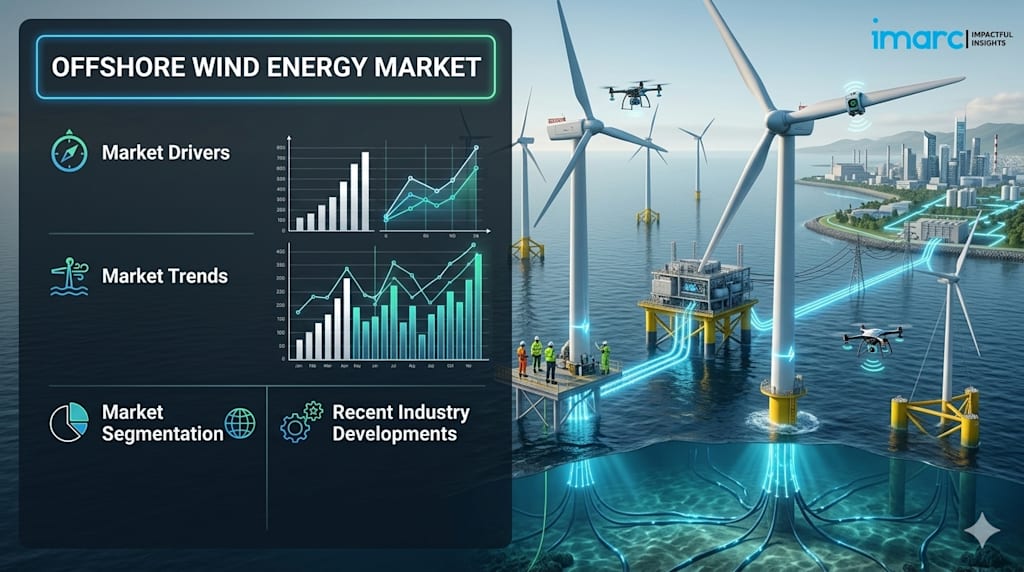
According to IMARC Group's latest research publication, global offshore wind energy market size reached USD 16.4 Billion in 2025. Looking forward, IMARC Group expects the market to reach USD 46.4 Billion by 2034, exhibiting a growth rate (CAGR) of 11.89% during 2026-2034.
How AI is Reshaping the Future of Offshore Wind Energy Market
- Predictive Maintenance and Downtime Reduction: AI-powered platforms continuously monitor turbine performance data, detecting early signs of mechanical wear or failure before costly breakdowns occur. Operators using these systems report measurable reductions in unplanned downtime, keeping turbines generating at peak capacity for longer periods.
- Wind Farm Layout and Energy Yield Optimization: Machine learning algorithms analyze wind flow patterns, wake effects, and seabed conditions to optimize turbine positioning and operational angles. Companies like Shoreline Wind use agent-based AI simulation to support over 455 GW of projects, improving energy capture while reducing structural fatigue across entire farm layouts.
- Intelligent Installation and O&M Scheduling: AI integrates weather forecasts, crew availability, vessel logistics, and spare parts inventory to identify optimal installation and maintenance windows. This reduces costly weather-related delays and streamlines offshore logistics, cutting overall operational expenditure for developers managing large-scale projects.
Offshore Wind Energy Industry Overview:
Offshore wind energy is rapidly scaling up as a cornerstone of the global clean energy transition, with total installed capacity surpassing 92 GW worldwide and powering over 73 million households. Europe leads in deployment, while Asia-Pacific is catching up fast, driven by China's aggressive provincial targets and Japan's floating wind ambitions.
Offshore Wind Energy Market Trends & Drivers
The global energy security agenda is one of the most powerful forces behind offshore wind expansion right now. With geopolitical tensions disrupting oil and gas supply chains, governments across Europe and Asia are accelerating coastal wind programs as a reliable domestic energy alternative. S
Turbine technology is advancing fast, enabling developers to extract more power from fewer installations. Equinor's Empire Wind 1 project off Long Island will deploy 54 Vestas V236-15 MW turbines delivering 810 MW — enough to power over 500,000 New York homes.
Floating offshore wind is emerging as the next frontier, opening up deep-water territories previously out of reach for fixed-foundation projects. The U.S. Department of Energy and its national laboratories have invested over USD 950 million into the Floating Offshore Wind Shot initiative to cut costs and accelerate commercialization.
Leading Companies Operating in the Global Offshore Wind Energy Industry:
- ON SE
- Électricité de France S.A.
- Equinor ASA
- General Electric Company
- Nordex SE
- Northland Power Inc.
- Ørsted A/S
- Siemens Gamesa Renewable Energy S.A. (Siemens Energy AG)
- Suzlon Energy Limited
- Vestas Wind Systems A/S
- Xinjiang Goldwind Science & Technology Co. Ltd.
Offshore Wind Energy Market Report Segmentation:
By Component:
- Turbine
- Substructure
- Electrical Infrastructure
- Others
Turbine accounts for the largest share, driven by the high unit cost and technological complexity of next-generation offshore wind turbine generators.
By Foundation Type:
- Fixed Foundation
- Floating Foundation
Based on the foundation type, the market has been segmented into fixed foundation and floating foundation.
By Capacity:
- Less Than 5 MW
- Greater than or Equal to 5 MW
Greater than or equal to 5 MW capacity segment currently exhibits clear dominance.
By Location:
- Shallow Water
- Transitional Water
- Deep Water
Shallow water currently holds the largest share due to established fixed-foundation technology.
Regional Insights:
- North America (United States, Canada)
- Asia Pacific (China, Japan, India, South Korea, Australia, Indonesia, Others)
- Europe (Germany, France, United Kingdom, Italy, Spain, Russia, Others)
- Latin America (Brazil, Mexico, Others)
- Middle East and Africa
Europe exhibits clear dominance in the offshore wind energy market, backed by decades of project experience.
Recent News and Developments in Offshore Wind Energy Market
- March 2026: Ørsted received a U.S. District Court ruling allowing it to resume construction on the Revolution Wind project after a federal stop-work order was challenged in court.
- March 2026: Equinor, through its subsidiary Rio Energy, acquired the 230 MW Esquina do Vento wind project in Brazil from Vestas and signed a turbine supply agreement for 51 V163-4.5 MW turbines, with a 30-year Active Output Management service deal.
Note: If you require specific details, data, or insights that are not currently included in the scope of this report, we are happy to accommodate your request. As part of our customization service, we will gather and provide the additional information you need, tailored to your specific requirements. Please let us know your exact needs, and we will ensure the report is updated accordingly to meet your expectations.
About the Creator
sujeet. imarcgroup
With 2 years of hands-on experience at IMARC Group, I have conducted in-depth market research and analysis across diverse industries including technology, healthcare, agriculture, and consumer goods.
Enjoyed the story? Support the Creator.
Subscribe for free to receive all their stories in your feed.
Comments
There are no comments for this story
Be the first to respond and start the conversation.