
Nvidia: The Accidental King Who Built the Brain of AI in a Fast-Food Diner 👑🧠🍔
The story of how the quest for better graphics gave birth to the world’s most powerful digital brains. ⚡️🤖

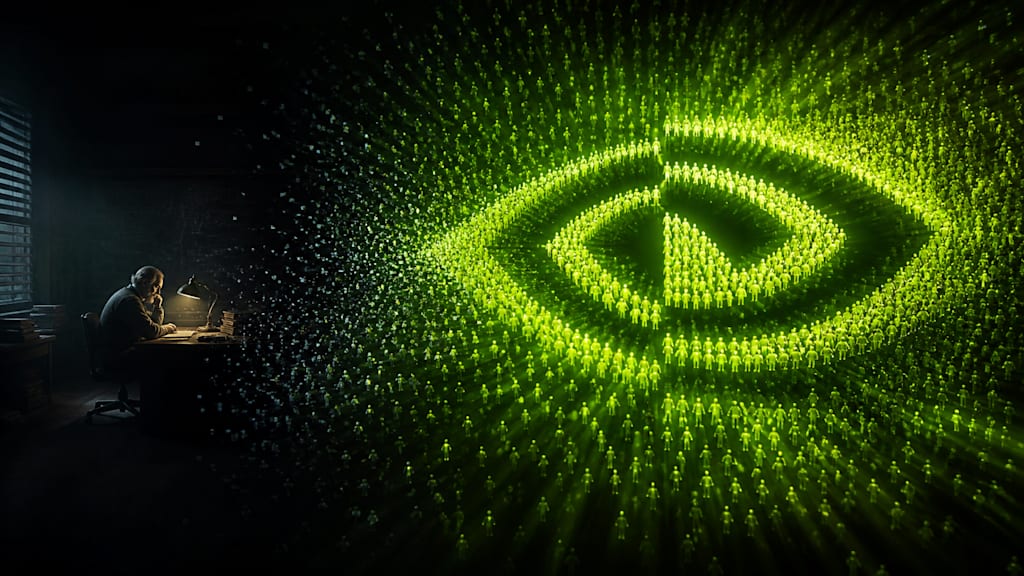
Imagine the year 1993. Three engineers are sitting in a Denny’s diner off a highway in California. They are drinking cheap coffee and dreaming of a world where computer games don’t look like a pile of blurry pixels ☕️🎮. They aren’t planning to save humanity or build artificial intelligence. They just want the monsters in the game Doom to move more smoothly 👾.
This is how the story of Nvidia begins—a company that, by accident, became the most important corporation on the planet 🌍.
The Professor vs. The Army of Preschoolers 👨🏫⚔️👦
To understand the Nvidia phenomenon, we need to understand the difference between a computer’s "brain" (the CPU) and a graphics card (the GPU).
Imagine you have a very difficult math problem to solve. A Central Processing Unit (CPU) is like a brilliant professor 👨🏫. He is incredibly smart, but he is only one person. He solves problems one by one, very quickly, but strictly in order 🎓.
On the other hand, an Nvidia Graphics Processing Unit (GPU) is not one professor, but an army of ten thousand preschoolers 🧒👦👧. Each of them can only do simple addition and multiplication, but they can all do it at the exact same second ⚡️.
Why does this matter? Because generating an image in a game requires calculating the color of millions of tiny dots (pixels) on the screen in a fraction of a second 🖼️. Each dot is a simple calculation. An army of preschoolers can do this instantly, while the brilliant professor would still be struggling with the first hundred ⏳.
The Great Gamble: A Road to Nowhere That Became a Highway 🎲🛣️
In 2006, Nvidia’s CEO, Jensen Huang (the man who always wears his famous black leather jacket 🧥), made a decision that almost drove the company into bankruptcy. He created CUDA.
This was a system that allowed programmers to use graphics cards for tasks other than gaming—such as weather simulations or drug research 🧬. Investors were furious. "Why build a highway for scientists if nobody has cars to drive on it?" they asked 💸. Nvidia spent billions of dollars developing technology that—at the time—it seemed nobody needed.
For years, CUDA was like a powerful rocket engine mounted on a regular bicycle 🚀🚲. Until the year 2012.
The "Big Bang" Moment 💥✨
In 2012, researchers working on artificial intelligence discovered something incredible. It turned out that training neural networks (teaching a computer to recognize faces or language) requires the exact same thing as generating graphics in video games: billions of dead-simple calculations performed all at once 🤖.
Artificial intelligence needed "muscles." When researchers looked at the market, Nvidia was the only company that had been building those muscles for a decade and—more importantly—had the ready-made software (CUDA) to control them 🦾.
Nvidia didn’t have to chase the AI revolution. The AI revolution fell straight into Nvidia’s arms 🤗.
The Shovel Seller in a Gold Rush ⛏️💰
There is an old business rule: during a gold rush, the people who make the most money aren't the ones digging for gold, but the ones selling the shovels 🛠️.
Today, every major company—from Google to Microsoft to the creators of ChatGPT—is desperately looking for "shovels" from Nvidia. Their latest chips are so powerful and rare that companies bid for them like works of art 🖼️, and countries like Saudi Arabia buy them by the thousands to build their own digital empires 🏰.
Nvidia became the "accidental king" because for 30 years they were obsessively focused on one thing: making video game pictures look better 🎨. It turned out that the math behind a beautiful sunset in a video game was the same key that opens the door to creating digital intelligence 🔑.
Conclusion: What does Jensen Huang teach us? 🧥💡
Nvidia’s story is proof that being absolutely the best in one niche field can suddenly make you the ruler of the future 🏆. The company from the Denny’s diner didn’t change its strategy—the world changed in a way that perfectly matched what Nvidia had been doing all along.
Today, Nvidia is worth trillions of dollars 💰📈, and it all started with the simple desire to make monsters in games look a little bit better 👹✨.
About the Creator
Piotr Nowak
Pole in Italy ✈️ | AI | Crypto | Online Earning | Book writer | Every read supports my work on Vocal
Enjoyed the story? Support the Creator.
Subscribe for free to receive all their stories in your feed.
Comments
There are no comments for this story
Be the first to respond and start the conversation.