
Not Every AI Task Needs a Chatbot: Meet the "Decision Model"
Jev from TypeSafe AI skips text generation entirely and answers structured questions faster and cheaper than a typical LLM. Here is what it does well, where it falls short, and why competitors are already copying the idea.

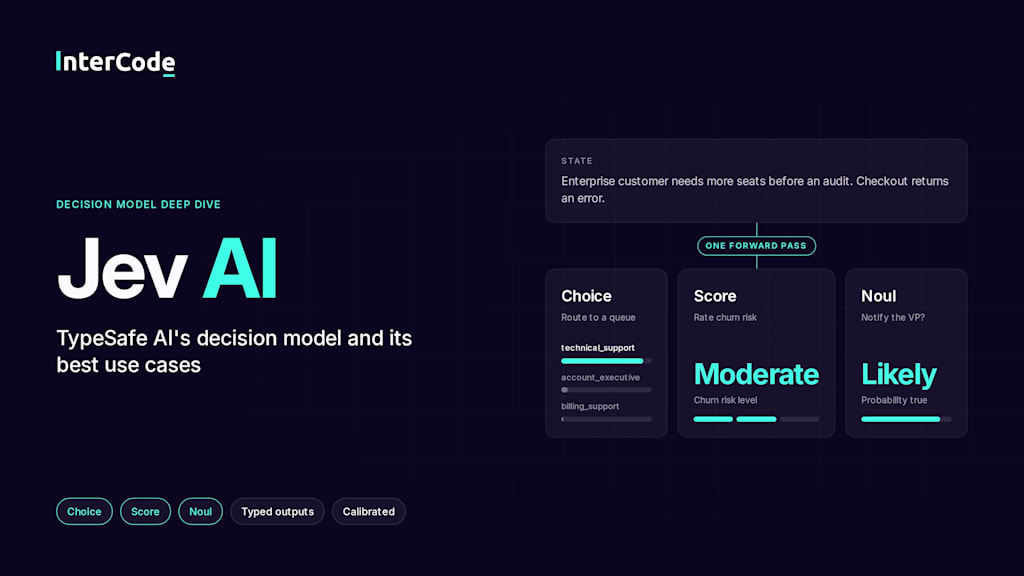
A lot of AI features in production today are doing very simple jobs with very heavy tools. Sorting a support ticket into the right queue. Scoring a sales lead. Checking whether an automated action is safe to run. These are all "pick one option and tell me how sure you are" problems, yet most teams still solve them by calling a full large language model.
In September 2026, TypeSafe AI released Jev, a model built for exactly this gap. It cannot write an email or chat with a customer. It does one thing: it takes a structured question and returns a structured answer, along with a confidence score.
What Makes It Different
A standard LLM builds its answer one token at a time. Even a tiny reply like a category label means running through the model over and over until the answer is complete. That sequential process is where most of the delay and cost comes from.
Jev reads the input once and produces the final answer in a single pass. There is no text to generate, so there is no malformed output to fix and no invented fields to catch. Responses typically arrive in 70 to 500 milliseconds, compared with several seconds for a generative model doing the same task.
The price of that speed is flexibility. Jev cannot write free text, handle multi-step reasoning, or do math.
How You Ask It Questions
Every request is built from three simple question types:
Choice: pick one label from a list, such as which team should handle a ticket.
Score: rate something on an ordered scale, such as how urgent an issue is.
Noul: answer yes or no with a probability, such as whether an action looks destructive.
Each answer comes back with a calibrated confidence number. That lets your software decide when to act automatically and when to hand the case to a person or a more capable model.
Is It Really That Much Cheaper?
TypeSafe advertises savings of 40 to 400 times compared with standard LLMs. That figure holds when the comparison is a top-tier reasoning model. Against the small, inexpensive models most teams already use for basic classification, the real saving is closer to five times. Still meaningful at high volume, just less dramatic than the headline.
Where It Makes Sense
The best fits are places where you are paying LLM prices for what is really a multiple-choice question:
Routing requests before an expensive step, so a costly agent only runs when it is actually needed.
Safety checks that block or flag risky actions, like deleting or changing production data, before they execute.
Support triage, where one pass can route a ticket, rate its urgency, and flag escalation risk.
Lead scoring, where company size, buyer authority, and urgency are scored separately and then combined by your own business rules.
Filtering retrieved documents in a search-based AI system, so irrelevant material never reaches your main model.
For example, imagine a customer message saying they want to upgrade from 50 to 250 seats but checkout keeps failing. Jev can decide which queue should get it and how worried you should be about losing that customer in one quick response, with a confidence figure on each answer.
Where It Falls Short
Jev has clear, documented blind spots:
It is unreliable at math and number comparisons, so keep calculations in your own code.
It struggles to count items in a list, so it is better to ask about each item individually.
It reads dates as plain text and cannot reason about which came first.
It only sees what is explicitly written. Anything implied but unstated gets missed.
Like any model that reads untrusted text, it can be steered by instructions hidden inside the input, so that data still needs to be sanitized.
In short, it is a fast and narrow decision-maker, not a reasoning engine. It works best when it sits inside application code that handles everything it cannot.
A Category That Is Already Crowded
Within about three weeks of Jev's launch, rivals appeared. Cloudflare released two open-weight models, Clef and Clef-flash, with a compatible interface and added image support. Clef-flash reportedly answers in around 39 milliseconds on Cloudflare's network. An open-source option called Laya can run locally without a GPU, with claimed latencies as low as 9 milliseconds. OpenAI has also previewed its own decision-focused API, though it was not widely available at the time of writing.
None of these numbers have been independently verified yet, so treat any benchmark, including the vendors' own, as a starting point for your own testing.
The Takeaway
If part of your product burns LLM calls on routing, scoring, or yes-or-no gates, decision models deserve a look. They will not replace your main model, but they can act as a much cheaper and faster front line for the decisions that never needed one. Teams exploring how to fit this kind of component into a larger AI agent architecture will want to test it on real traffic before committing.
About the Creator
InterCode
InterCode is an AI-first B2B software development boutique for SMBs, focused on agentic engineering. We build AI agents, SaaS, cloud & DevOps solutions. Our team consists of CCAR-F Claude Certified Architects by Anthropic. intercode.com
Enjoyed the story? Support the Creator.
Subscribe for free to receive all their stories in your feed.
Comments
There are no comments for this story
Be the first to respond and start the conversation.