
North America’s Processed Meat Market Is Reinventing Itself Through Convenience, Protein Trends, and Premium Innovation
From high-protein meat snacks to gourmet deli products, the processed meat industry across North America is entering a new era shaped by changing consumer lifestyles, evolving food preferences, and rising demand for convenience.

The North American processed meat industry is undergoing a major transformation. Once viewed as a traditional food category centered around bacon, hot dogs, and deli slices, the market is now evolving into a highly innovative sector driven by premiumization, health-conscious reformulation, protein-focused nutrition, and convenience-based lifestyles.
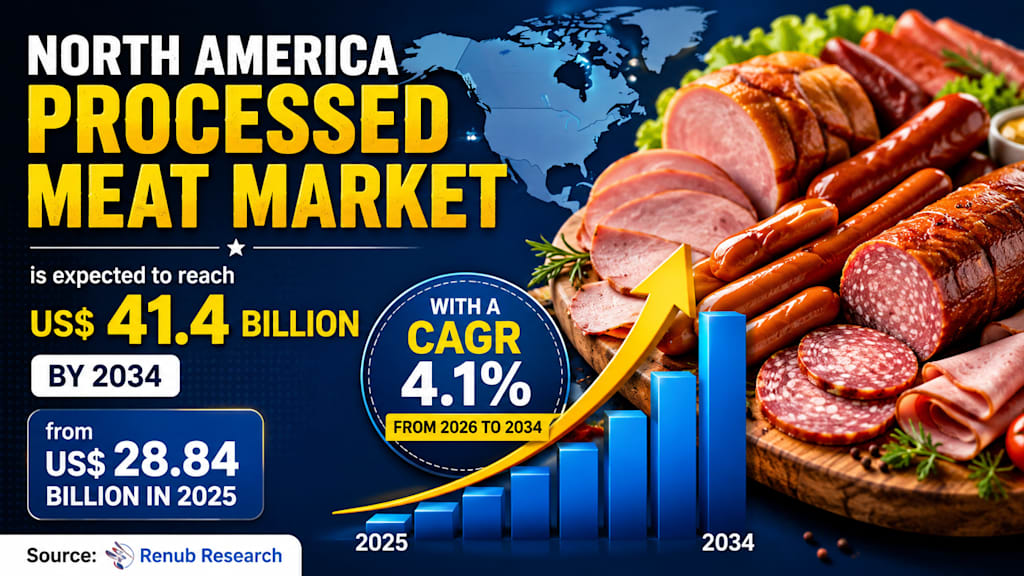
According to Renub Research, the North America Processed Meat Market is expected to grow from US$ 28.84 Billion in 2025 to US$ 41.4 Billion by 2034, expanding at a CAGR of 4.1% between 2026 and 2034. This projected growth reflects not only increasing demand for processed meat products but also the industry’s remarkable ability to adapt to modern consumer expectations.
Consumers today are living busier lives than ever before. As a result, they are actively searching for food products that combine convenience, taste, portability, and nutritional value. Processed meat products fit perfectly into this lifestyle shift.
From ready-to-eat deli meats and frozen meat products to protein-packed jerky and gourmet sausages, processed meat has become deeply integrated into everyday consumption habits across the United States, Canada, and Mexico.
However, the industry’s growth story is no longer just about convenience. It is increasingly about innovation.
Food manufacturers are now competing on cleaner labels, healthier ingredients, unique flavor experiences, premium packaging, and functional nutrition. Consumers want products that are fast and flavorful, but they also expect transparency, quality sourcing, and nutritional benefits.
This balancing act between convenience and health is reshaping the future of processed meat across North America.
Convenience Remains the Industry’s Biggest Strength
One of the primary reasons behind the continued expansion of the processed meat market is convenience.
Modern lifestyles leave many consumers with limited time for cooking and meal preparation. Working professionals, students, parents, and fitness-focused individuals are all looking for foods that save time while still delivering taste and protein-rich nutrition.
Processed meat products fulfill this need exceptionally well.
Products such as sausages, deli meats, bacon, frozen chicken products, smoked meats, and ready-to-cook beef items reduce meal preparation time while remaining versatile and satisfying.
Portable meat snacks have become especially popular among consumers with active schedules. Jerky, meat sticks, and snack packs are increasingly replacing traditional snack foods because they are perceived as more filling and protein-dense.
This trend has accelerated rapidly due to the growth of:
- On-the-go eating habits
- Gym and fitness culture
- High-protein diets
- Meal-prep lifestyles
- Convenience-focused grocery shopping
Retailers have responded by significantly expanding processed meat offerings.
Today’s grocery stores feature a wider selection of products than ever before, including:
- Organic sausages
- Low-sodium deli meats
- Gourmet jerky
- Antibiotic-free meat snacks
- Smoked specialty products
- Keto-friendly protein packs
- Ready-to-cook marinated meats
- Online grocery platforms and food delivery services have further increased accessibility. Consumers can now purchase premium processed meat products instantly through digital retail channels, helping brands expand their reach beyond traditional supermarkets.
High-Protein Diets Are Fueling Massive Demand
Protein has become one of the most influential trends in the North American food industry.
Consumers increasingly associate high-protein eating with fitness, energy, muscle recovery, weight management, and healthier lifestyles.
As a result, processed meat manufacturers are aggressively expanding their protein-focused product lines.
Jerky, turkey sticks, beef sticks, chicken snacks, and high-protein snack packs have emerged as some of the fastest-growing categories within the industry.
Unlike older processed snack products that were often criticized for artificial ingredients and excessive sodium, today’s protein snacks are being positioned as cleaner, healthier, and more functional food choices.
Manufacturers are focusing on:
- All-natural ingredients
- Reduced sugar content
- Minimal preservatives
- Cleaner labels
- Higher protein density
- Portion-controlled packaging
One strong example came in May 2025 when New Primal launched Rotisserie-Seasoned Chicken Sticks made with all-natural ingredients. The launch highlighted growing consumer demand for portable protein snacks that align with cleaner eating habits.
The growing popularity of keto diets and low-carb lifestyles has also strengthened demand for processed meat snacks.
Consumers are increasingly choosing meat-based snacks because they offer satiety and protein without the high sugar levels found in many traditional packaged snacks.
This shift is fundamentally changing how processed meat companies position their products.
Processed meat is no longer marketed solely as indulgent comfort food. It is increasingly being promoted as a practical nutritional solution for modern lifestyles.

Premiumization Is Transforming Consumer Expectations
Another major trend reshaping the North American processed meat market is premiumization.
Consumers today are willing to spend more money on products that offer:
- Better ingredients
- Gourmet flavors
- Ethical sourcing
- Artisanal preparation methods
- Premium packaging
- Unique culinary experiences
This shift has created strong demand for higher-end processed meat products.
Craft sausages, smoked specialty meats, dry-aged deli products, truffle-infused jerky, and globally inspired flavor combinations are rapidly gaining popularity.
Food culture and social media have significantly contributed to this trend.
Consumers are now more adventurous with flavor exploration due to exposure to online cooking videos, food influencers, grilling culture, and restaurant-inspired recipes.
As a result, processed meat companies are introducing products featuring:
- Black garlic
- Truffle seasoning
- Korean-inspired marinades
- Smoky barbecue blends
- Spicy chili infusions
- International spice profiles
In September 2025, meat snack company Carnal expanded its portfolio with Beef Sticks and Umami Cut Beef Jerky made using aged soy, fermented black garlic, and spring black truffles. The launch demonstrated how processed meat brands are increasingly targeting premium consumers seeking elevated flavor experiences.
Celebrity partnerships are also becoming part of the industry’s growth strategy.
The collaboration between YouTube creator MrBeast and Jack Link’s introduced a new line of meat snacks including Turkey Mini Sticks, Original Beef Mini Sticks, and Zero Sugar Beef Mini Sticks.
These partnerships help brands connect with younger consumers while making processed meat products feel more modern and culturally relevant.
Retail Expansion and Infrastructure Improvements Are Supporting Growth
The expansion of retail infrastructure across North America has strengthened processed meat distribution significantly.
Supermarkets, hypermarkets, convenience stores, warehouse clubs, and online retail channels continue increasing product visibility and accessibility.
At the same time, improvements in cold-chain logistics and refrigeration technology are helping companies maintain product quality across longer distribution networks.
This is particularly important because processed meat products rely heavily on controlled temperature management for freshness and safety.
Major industry players are also investing heavily in production expansion.
In August 2024, Cargill acquired two case-ready meat plants from Infinity Meat Solutions in Rhode Island and Pennsylvania. These facilities can produce up to 2 million pounds of beef and pork weekly, helping strengthen supply capabilities across U.S. grocery retail networks.
Automation is becoming another critical factor in market growth.
Modern meat processing facilities now use advanced systems for:
- Packaging automation
- Digital inventory management
- Precision refrigeration
- Product tracking
- Quality consistency
These technologies help companies reduce waste, improve operational efficiency, and manage labor shortages more effectively.
The United States Continues to Dominate the Market
The United States represents the largest share of the North America processed meat market.
American consumers have historically embraced processed meat products because of their convenience, affordability, and flavor diversity.
Products such as bacon, hot dogs, deli meats, frozen meat items, sausages, and jerky continue seeing strong demand across households and foodservice channels.
The country’s advanced cold-chain infrastructure and massive grocery retail network further support market growth.
At the same time, premiumization trends are becoming increasingly visible in the U.S. market.
Consumers are showing stronger interest in:
- Clean-label meats
- Grass-fed products
- Hormone-free options
- Antibiotic-free products
- Protein-focused snack formats
The popularity of sports nutrition and fitness culture has also strengthened demand for portable meat snacks.
Protein-based processed meat products are now common in gyms, airports, convenience stores, and vending machines.
Despite rising competition from plant-based alternatives, traditional processed meat products continue maintaining strong consumer loyalty due to familiarity, taste, and convenience.
Canada’s Market Is Being Shaped by Health-Conscious Innovation
Canada’s processed meat industry is growing steadily as consumers seek convenient yet healthier food options.
Canadian shoppers increasingly prefer products with:
- Reduced sodium
- Cleaner labels
- Fewer preservatives
- Sustainable sourcing claims
Manufacturers are responding by reformulating products while introducing premium deli meats, smoked products, and artisanal sausages.
Canada also benefits from a stable domestic livestock industry that supports reliable supply chains for processors.
However, consumer expectations around sustainability and animal welfare are becoming increasingly influential.
Brands are under growing pressure to improve transparency regarding sourcing practices and manufacturing standards.
This trend is likely to shape the future direction of the Canadian processed meat industry over the coming decade.
Mexico Is Emerging as a High-Growth Market
Mexico is rapidly becoming one of the most promising growth markets for processed meat in North America.
Urbanization, rising disposable incomes, and expanding supermarket networks are changing food consumption patterns across the country.
Consumers are increasingly purchasing convenient packaged food products including:
- Ham
- Sausages
- Chorizo
- Canned meats
- Ready-to-cook meat products
The growth of fast-food chains and food delivery services has further accelerated processed meat demand.
Traditional meat products remain deeply popular, but younger consumers are increasingly exploring newer processed food categories.
Manufacturers are investing in better packaging technologies and shelf-life solutions to support growth in urban retail environments.
Although affordability remains an important factor for many Mexican consumers, long-term market potential remains highly positive.
Health Concerns Continue Creating Industry Challenges
Despite strong growth projections, the processed meat industry continues facing significant challenges.
Health concerns remain one of the biggest issues.
Over the years, studies linking processed meat consumption with health risks have influenced public perception.
Consumers are increasingly concerned about:
- Sodium levels
- Preservatives
- Nitrates
- Artificial additives
- Highly processed ingredients
Younger demographics are especially drawn toward fresh foods and minimally processed diets.
As a result, manufacturers are under pressure to reformulate products while maintaining taste, shelf life, texture, and food safety.
Developing cleaner-label processed meat products often requires expensive research and technological upgrades.
This creates a difficult balancing act for manufacturers attempting to satisfy both health-conscious consumers and traditional buyers.
Supply Chain Volatility Remains a Serious Risk
Supply-chain instability continues creating operational challenges across the industry.
The processed meat sector depends heavily on livestock production, refrigeration systems, transportation networks, packaging materials, and labor availability.
Any disruption in these areas can affect pricing and profitability.
Rising costs related to:
- Animal feed
- Transportation
- Packaging
- Energy
- Refrigeration
- Labor
have placed significant pressure on meat processors.
Disease outbreaks affecting livestock populations can also disrupt supply chains and increase raw material costs.
At the same time, stricter food safety regulations and environmental standards are increasing compliance expenses.
To manage these risks, companies are investing more heavily in automation, diversified sourcing strategies, and operational resilience.
Key Market Segments
By Meat Type
- Poultry
- Beef
- Pork
- Others
By Processing Type
- Frozen
- Chilled
- Canned
By Distribution Channel
- Hypermarkets and Supermarkets
- Convenience Stores
- Online Retail Stores
- Others
Major Companies Operating in the Market
Several major companies continue shaping the competitive landscape of the North America processed meat industry through acquisitions, innovation, and aggressive retail expansion.
Leading players include:
- Hormel Foods
- Tyson Foods
- Conagra Brands Inc.
- General Mills
- The Kraft Heinz Company
- Cargill, Incorporated
- Pilgrim’s Pride Corp
These companies are investing heavily in:
- Premium branding
- Product diversification
- Automation technologies
- Cleaner-label innovation
- Sustainable sourcing initiatives
The growing importance of transparency and health-conscious consumption is expected to influence future corporate strategies across the industry.
The Future of Processed Meat Will Depend on Adaptation
The North America processed meat market is clearly evolving beyond its traditional identity.
What was once driven mainly by convenience and affordability is now increasingly influenced by:
- Nutritional awareness
- Premium experiences
- Sustainability concerns
- Flavor innovation
- Functional nutrition
- Lifestyle branding
Companies that successfully adapt to these changes are likely to dominate future market growth.
Innovation will remain critical.
Brands that focus on cleaner ingredients, advanced processing methods, gourmet flavor development, and convenient packaging formats are expected to outperform competitors.
Convenience, however, will remain the category’s core strength.
Consumers still value foods that save time while fitting modern lifestyles.
As long as processed meat products continue delivering convenience alongside evolving consumer expectations, the market is expected to remain highly resilient.
The projected increase from US$ 28.84 Billion in 2025 to US$ 41.4 Billion by 2034 demonstrates that the industry still possesses strong long-term momentum despite growing competition from alternative proteins.
Final Thoughts
The North America processed meat market is entering one of the most transformative periods in its history.
Convenience remains central to consumer demand, but today’s shoppers also expect healthier ingredients, premium flavor experiences, sustainable sourcing, and functional nutrition.
This combination of evolving expectations is pushing food manufacturers to innovate faster than ever before.
From gourmet jerky and protein snack sticks to cleaner-label deli meats and advanced processing facilities, the industry is rapidly modernizing.
While challenges related to health concerns and supply-chain volatility remain important, the market’s adaptability continues supporting long-term growth potential.
As lifestyles evolve across the United States, Canada, and Mexico, processed meat products are expected to remain a major part of North America’s food culture for years to come.
About the Creator
Enjoyed the story? Support the Creator.
Subscribe for free to receive all their stories in your feed.
Comments
There are no comments for this story
Be the first to respond and start the conversation.