
North America Drone Market Set to Reach US$ 26.90 Billion by 2033 as Commercial Adoption Accelerates Across Industries
Rising investments in AI-powered UAVs, smart city integration, logistics automation, and defense modernization are reshaping the future of the North American drone ecosystem

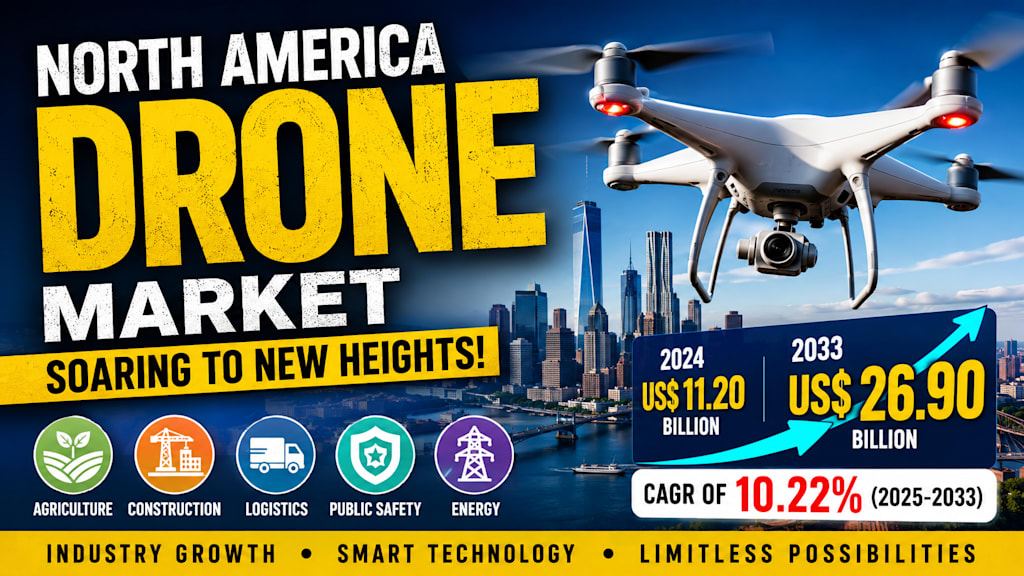
The North American drone market is entering a new era of rapid transformation. Once viewed primarily as military tools or hobbyist gadgets, drones are now becoming critical assets across industries ranging from agriculture and construction to logistics, infrastructure, entertainment, and public safety. According to Renub Research, the North America Drone Market is projected to grow from US$ 11.20 billion in 2024 to US$ 26.90 billion by 2033, expanding at a CAGR of 10.22% from 2025 to 2033.
This remarkable growth reflects how drones are increasingly moving into mainstream commercial operations. Companies are embracing unmanned aerial vehicles (UAVs) to reduce operational costs, improve efficiency, collect real-time data, and automate repetitive tasks. Governments are also investing heavily in drone infrastructure, airspace modernization, and regulatory frameworks that encourage innovation while maintaining safety standards.
North America — led by the United States — has become one of the world’s most advanced drone ecosystems. The region benefits from strong technological infrastructure, robust venture capital activity, military spending, and a rapidly evolving regulatory environment that supports commercial deployment.
Drones Are Becoming Essential Business Tools
Across industries, drones are no longer experimental technologies. They are practical business tools delivering measurable value every day.
In agriculture, drones are helping farmers monitor crops, identify irrigation problems, analyze soil health, and optimize pesticide spraying. Precision farming powered by aerial data allows producers to increase yields while reducing waste and labor expenses.
Construction companies are deploying drones for site mapping, progress tracking, structural inspections, and safety monitoring. Instead of manually surveying large job sites, project managers can now obtain high-resolution aerial imagery within minutes.
Energy companies are also increasing drone usage for inspecting power lines, pipelines, solar farms, and wind turbines. Traditional inspection methods often involve dangerous manual work or expensive helicopters. Drones significantly improve safety while lowering operational costs.
The logistics sector is perhaps one of the most exciting growth areas. Major companies are investing in autonomous delivery drones capable of handling last-mile delivery operations in urban and rural environments. Faster deliveries, reduced traffic congestion, and lower transportation expenses are driving enormous interest in drone logistics.
Law enforcement agencies and emergency responders are also leveraging drones for surveillance, disaster response, crowd monitoring, and search-and-rescue missions. UAVs provide rapid situational awareness during emergencies, allowing authorities to respond more effectively.
These expanding applications are becoming major catalysts for sustained market growth throughout North America.
FAA Regulations Are Encouraging Commercial Expansion
One of the biggest reasons for North America’s leadership in drone innovation is its evolving regulatory environment.
The Federal Aviation Administration (FAA) has introduced several frameworks that support commercial drone operations while prioritizing safety. As of December 2023, more than 1.47 million drones were registered in the United States, reflecting the technology’s massive adoption across both recreational and professional sectors.
The FAA has also granted permissions for Beyond Visual Line of Sight (BVLOS) operations to several organizations. BVLOS technology allows drones to operate beyond the pilot’s direct line of sight, opening enormous opportunities for long-distance inspections, delivery services, and autonomous industrial applications.
This regulatory flexibility is critical because many advanced drone use cases depend on autonomous or semi-autonomous operations. Without supportive aviation policies, commercial drone deployment would remain heavily restricted.
Canada is also building a favorable regulatory environment through Transport Canada, which continues updating drone laws to encourage innovation while ensuring operational safety. Meanwhile, Mexico is gradually aligning its drone policies with international aviation standards to support broader adoption across industries.
Artificial Intelligence Is Making Drones Smarter
Artificial intelligence is becoming one of the most transformative forces in the drone industry.
Modern drones are no longer simple flying cameras. AI-powered drones can now analyze visual data, detect anomalies, recognize objects, automate flight paths, and deliver predictive insights in real time.
In agriculture, AI-enabled drones can identify crop diseases before they spread extensively. In construction, machine learning algorithms can compare site progress against project timelines automatically. In public safety, intelligent drones can recognize suspicious activities or identify missing persons during rescue operations.
Cloud computing and IoT integration are amplifying these capabilities even further. Drones can transmit real-time aerial data to centralized systems where AI models generate actionable recommendations instantly.
This combination of AI, automation, and aerial mobility is turning drones into powerful data intelligence platforms rather than simple flying devices.
Smart Cities Are Fueling Drone Integration
As North American cities become smarter and more connected, drones are emerging as valuable infrastructure management tools.
Urban planners are increasingly integrating drones into smart city ecosystems for traffic monitoring, environmental analysis, emergency management, and infrastructure maintenance.
Drones equipped with IoT connectivity can gather live data from roads, bridges, construction zones, and public spaces. This information can then feed into centralized city management systems powered by artificial intelligence.
For example, drones can assist with monitoring air quality, detecting road damage, managing traffic congestion, and inspecting public infrastructure without disrupting daily operations.
Emergency response is another major area where drones are adding value. During natural disasters or accidents, UAVs provide real-time aerial visibility that helps first responders coordinate rescue efforts more efficiently.
As cities continue investing in digitization and urban intelligence platforms, drone integration is expected to accelerate substantially throughout the next decade.
Drone-as-a-Service Is Lowering Adoption Barriers
A particularly important trend reshaping the market is the rise of Drone-as-a-Service (DaaS).
Many small and medium-sized businesses want drone capabilities but cannot justify the upfront investment in hardware, software, training, insurance, and maintenance. DaaS providers solve this challenge by offering drone operations as subscription-based or on-demand services.
Companies can now access aerial inspections, mapping services, surveys, and analytics without purchasing drones themselves.
This business model is especially attractive in industries like construction, mining, insurance, and agriculture, where drone usage may be periodic rather than continuous.
DaaS is making drone technology far more accessible and scalable across North America, contributing significantly to market expansion.
Battery Limitations Still Challenge the Industry
Despite rapid innovation, several technological barriers continue to limit drone scalability.
Battery life remains one of the industry’s most significant challenges. Most commercial drones can operate for only 20 to 45 minutes before requiring recharging or battery replacement. This limitation restricts operational range and efficiency for large-scale industrial tasks.
Payload capacity is another obstacle. Advanced applications such as LiDAR mapping, cargo transport, and industrial inspections often require heavier equipment that many drones cannot currently support efficiently.
Weather sensitivity also impacts reliability. Strong winds, rain, and extreme temperatures can compromise flight safety and operational stability.
These limitations highlight the importance of ongoing innovation in battery technology, lightweight materials, and propulsion systems. Companies investing in longer flight endurance and higher payload capabilities are expected to gain strong competitive advantages in the coming years.
The United States Continues to Dominate the Market
The United States remains the clear leader in the North American drone industry.
The country benefits from extensive military investments, advanced aerospace infrastructure, strong startup ecosystems, and aggressive commercial adoption across industries.
American technology firms and defense contractors are investing heavily in next-generation drone systems, AI integration, autonomous navigation, and delivery infrastructure.
At the same time, concerns around national security and foreign drone manufacturers are influencing regulatory discussions. Policymakers are increasingly evaluating cybersecurity risks associated with imported drone technologies, particularly from Chinese manufacturers.
Nevertheless, the U.S. market continues to expand rapidly due to increasing enterprise demand and government support for innovation.
Canada and Mexico Are Emerging Growth Engines
Canada’s drone market is witnessing strong momentum thanks to growing adoption across agriculture, logistics, construction, and infrastructure monitoring.
The country’s supportive regulatory environment and emphasis on innovation are helping accelerate commercial deployment. Canadian firms are particularly active in remote inspection technologies and environmental monitoring applications.
Meanwhile, Mexico’s drone market is gaining traction across precision agriculture, energy infrastructure, law enforcement, and entertainment industries.
As drone regulations improve and investments rise, Mexico is expected to become an increasingly important contributor to regional market growth over the next decade.
Recent Developments from Major Drone Industry Companies
1. Intel Corporation Expands AI-Driven Drone Analytics
Intel continues investing in AI-powered drone technologies focused on industrial inspections, aerial data processing, and autonomous flight optimization.
2. Alphabet Inc. Accelerates Drone Delivery Expansion
Alphabet’s drone delivery initiatives are expanding in North America, with increased testing for autonomous last-mile logistics services.
3. Boeing Company Advances Military UAV Programs
Boeing is strengthening its unmanned defense systems portfolio through next-generation autonomous aerial vehicle development.
4. Teledyne FLIR LLC Launches Advanced Thermal Imaging Drones
The company introduced enhanced thermal imaging solutions for industrial inspections, defense surveillance, and emergency response applications.
5. AeroVironment Inc. Expands Tactical Drone Capabilities
AeroVironment continues enhancing tactical UAV systems for defense, surveillance, and intelligence operations.
6. Drone Delivery Canada Strengthens Commercial Delivery Network
The company expanded commercial drone logistics projects targeting healthcare, remote communities, and cargo transport.
7. UVify Inc. Develops High-Speed Autonomous Drone Platforms
UVify is focusing on autonomous swarm technology and advanced drone performance systems.
8. 3D Robotics Inc. Enhances Enterprise Mapping Solutions
3D Robotics continues improving aerial mapping and construction site monitoring platforms.
9. DJI Official Website Introduces Longer-Endurance Commercial Drones
DJI remains highly influential in the North American commercial drone ecosystem through upgraded battery technologies and imaging capabilities.
10. Amazon Prime Air Continues Autonomous Delivery Testing
Amazon is scaling drone-based delivery programs to reduce shipping times and improve logistics efficiency.
Final Thoughts
The North American drone industry is moving far beyond its early experimental stage. Drones are now becoming core operational tools across countless industries, enabling automation, data intelligence, efficiency improvements, and entirely new business models.
From smart agriculture and infrastructure monitoring to AI-driven logistics and urban management, drones are reshaping how businesses and governments operate.
Although challenges such as battery limitations, cybersecurity risks, regulatory complexity, and airspace integration remain important, the pace of technological advancement continues to accelerate.
With supportive regulations, strong private investment, and expanding enterprise demand, North America is expected to remain one of the global leaders in drone innovation throughout the next decade.
As the market approaches US$ 26.90 billion by 2033, drones are no longer just futuristic concepts — they are rapidly becoming essential infrastructure for the digital economy.
Intel | Data Center Solutions, IoT, and PC Innovation
About the Creator
Enjoyed the story? Support the Creator.
Subscribe for free to receive all their stories in your feed.
Comments
There are no comments for this story
Be the first to respond and start the conversation.