
Non-Lethal Weapons Market Trends: Crowd Control Innovation, Defense Demand & Forecast to 2034
How law enforcement modernization, portable incapacitation devices, and urban security concerns are transforming the global non-lethal weapons market outlook.

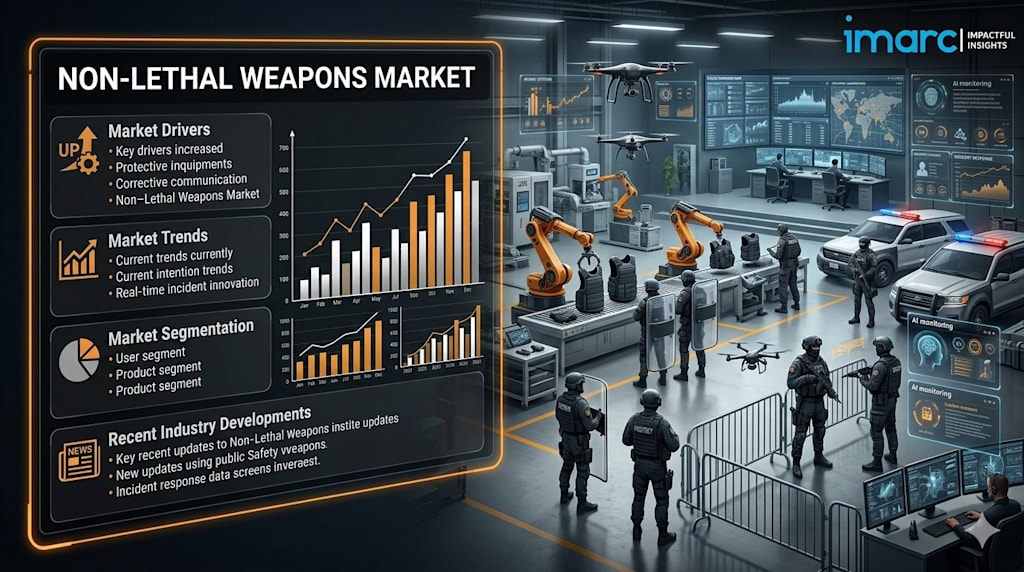
Rising civil unrest, escalating geopolitical tensions, growing terrorism threats, and increasing emphasis on humane crowd control solutions are driving non-lethal weapons demand, supported by strong defense investments, ongoing technological advancements in directed-energy and electroshock systems, and expanding procurement by law enforcement and military agencies worldwide. According to IMARC Group's latest data, The global non-lethal weapons market size was valued at USD 9.5 Billion in 2025. Looking forward, IMARC Group estimates the market to reach USD 15.3 Billion by 2034, exhibiting a CAGR of 5.27% during 2026-2034.North America currently dominates the market, holding a significant market share of over 37.6% in 2024.
The non-lethal weapons market represents a critical and rapidly evolving segment within global defense and public security, with demand driven by the need to manage threats, control crowds, and conduct peacekeeping operations without causing permanent harm or fatalities. Gases and sprays lead the product type segment with approximately 28.7% of market share, valued for their versatility, rapid deployment capability, and wide applicability across riot control and personal security scenarios.
Non-Lethal Weapons Market Growth Drivers:
Increasing Need to Control Crowd and Civil Unrest
The rising frequency of protests, civil disturbances, and large-scale public gatherings globally is creating sustained and urgent demand for effective non-lethal crowd control solutions. Law enforcement agencies require tools that can de-escalate volatile situations while minimizing casualties and avoiding the human rights implications associated with lethal force. Research published in the British Medical Journal analyzing 1,984 individuals struck by crowd-control weapons found that 53 died from their injuries and 300 suffered permanent disabilities, underscoring the critical importance of continued technological refinement in non-lethal weapon design.
Ongoing Technological Advancements in Non-Lethal Systems
The continuous development of advanced non-lethal technologies is significantly expanding the operational capabilities available to defense and law enforcement personnel. Modern product lines include laser interdiction systems, long-range acoustic devices, flash-bang grenades, directed-energy weapons, and electroshock tools. The TASER X26P employs trilogy log systems alongside charge metering to deliver precisely calibrated electric charges, while LRAD Corporation's acoustic hailing devices deploy electromagnetic sound waves for riot control. In April 2023, China introduced the CS/LW21 handheld electromagnetic launcher, capable of firing coin-shaped projectiles using electromagnetic force for riot management applications.
Growing Terrorism and Security Concerns
The intensifying global threat of terrorism is compelling governments and security agencies to expand investment in non-lethal technologies as a complement to conventional defense capabilities. According to the 2023 Global Terrorism Index produced by the Institute for Economics and Peace, more than 90% of terrorist attacks and 98% of terrorism-related deaths occurred in active conflict zones, with terrorism-related fatalities increasing by 22% to 8,352, the highest level recorded since 2017. In May 2024, the United States Air Force Security Forces Center partnered with the Joint Intermediate Force Capabilities Office to evaluate and deploy advanced non-lethal weapon technologies for counter-terrorism and force protection applications. In May 2023, the Republic of Singapore Navy equipped its Sentinel-class patrol vessels with Sitep Italia's multirole acoustic stabilized system, demonstrating the growing integration of non-lethal solutions within naval security operations globally.
Non-Lethal Weapons Market Trends:
Dominance of Chemical Technologies and Gases and Sprays
Chemical-based non-lethal technologies, including tear gas, pepper spray, and related chemical agents, continue to lead the market by technology segment due to their versatility, rapid deployment characteristics, and widespread acceptance across law enforcement and military applications. Their ability to quickly incapacitate individuals or disperse crowds with minimal long-term harm, combined with compliance with international ethical and legal standards, makes them the preferred technology category across global procurement programs. Gases and sprays as a product segment mirror this dominance, commanding approximately 28.7% of market share through their affordability, ease of use, and applicability across a broad range of security scenarios from riot management to personal protection deployments.
Law Enforcement Agencies as the Primary End-User Segment
Law enforcement agencies account for approximately 64.4% of non-lethal weapons market share by end user, driven by sustained global investment in de-escalation capabilities and crowd management protocols. The United States Law Enforcement De-escalation Training Act of 2022 allocated USD 34 million for the Department of Justice to develop de-escalation curricula, with an additional USD 90 million earmarked to incentivize local police departments to participate in structured programs. Studies associated with these initiatives found that de-escalation tactics correlated with a 28% reduction in use-of-force incidents, a 26% decline in citizen injuries, and a 36% reduction in officer injuries, reinforcing the operational case for pairing de-escalation protocols with effective non-lethal weapon deployment across policing environments worldwide.
Strong Regional Procurement Growth Across Asia Pacific and Europe
Beyond North America's dominant position, significant regional growth is emerging across Asia Pacific and Europe. Japan's Ministry of Defense allocated approximately JPY 5.8 billion (around USD 42 million) for non-lethal technologies, representing a 15% increase over the prior measured period. India's total defense budget for the current fiscal year reached approximately USD 83 billion, with meaningful allocations directed toward modernization and self-reliance initiatives encompassing non-lethal capability development. In Germany's North Rhine-Westphalia, police deployed Tasers 631 times in the first half of a recent measurement period, reflecting growing institutional integration of electroshock devices within European law enforcement frameworks. The European Commission has committed EUR 7.3 Billion for defense technology funding across a multi-year program period, with approximately EUR 1.1 Billion designated for a recent annual cycle, supporting continued investment in ethical, advanced non-lethal systems across member states.
Recent News and Developments in Non-Lethal Weapons Market
March 2025: Axon Enterprise announced the launch of an upgraded TASER 10 model with extended range and enhanced precision targeting capabilities, specifically developed for law enforcement agencies seeking greater standoff distance and improved de-escalation outcomes in high-risk encounter scenarios.
January 2025: Byrna Technologies expanded its distribution network across Europe and Latin America following the announcement that cumulative sales of its personal security launcher had exceeded 500,000 units globally, targeting both institutional law enforcement clients and personal protection markets.
November 2024: Byrna Technologies confirmed the milestone of selling over 500,000 units of its Byrna SD personal security device, a CO2-powered handheld less-lethal launcher, reinforcing strong consumer and security market demand for accessible non-lethal personal protection solutions.
August 2024: Rheinmetall announced the development of a new generation of rubber projectile munitions and irritant agent delivery systems aligned with updated NATO non-lethal weapons standards, designed for European law enforcement and military peacekeeping deployments.
May 2024: The United States Air Force Security Forces Center announced a partnership with the Joint Intermediate Force Capabilities Office to field advanced non-lethal technologies including directed-energy vehicle-stopping devices and next-generation diversionary grenades across security forces units.
February 2024: Combined Systems introduced an updated line of chemical crowd-control munitions incorporating improved dispersal mechanisms and reduced residue formulations, developed in response to international law enforcement procurement requirements for more operationally precise riot control agents.
Note: If you require specific details, data, or insights that are not currently included in the scope of this report, we are happy to accommodate your request. As part of our customization service, we will gather and provide the additional information you need, tailored to your specific requirements. Please let us know your exact needs, and we will ensure the report is updated accordingly to meet your expectations.
About the Creator
Suhaira Yusuf
I specialize in Consumer Insights, focusing on transforming detailed market data into strategic business solutions that accelerate growth and improve customer engagement.
Enjoyed the story? Support the Creator.
Subscribe for free to receive all their stories in your feed.
Comments
There are no comments for this story
Be the first to respond and start the conversation.