
Non-Invasive Prenatal Testing Market Growth: How Advanced Genetic Screening Is Transforming Prenatal Healthcare
Rising maternal age, genomic innovation, and growing awareness of fetal health are accelerating global demand for non-invasive prenatal testing

The future of prenatal healthcare is becoming increasingly precise, safer, and more accessible thanks to rapid advancements in genetic testing technologies. Among the most significant innovations reshaping maternal and fetal healthcare is Non-Invasive Prenatal Testing (NIPT), a screening method that enables healthcare professionals to detect chromosomal abnormalities early in pregnancy using a simple maternal blood sample.
As awareness of prenatal health continues to grow and more women choose to delay pregnancy, demand for accurate and low-risk genetic screening solutions is rising worldwide. NIPT has emerged as a preferred option because it provides highly reliable results while eliminating many of the risks associated with traditional invasive procedures.
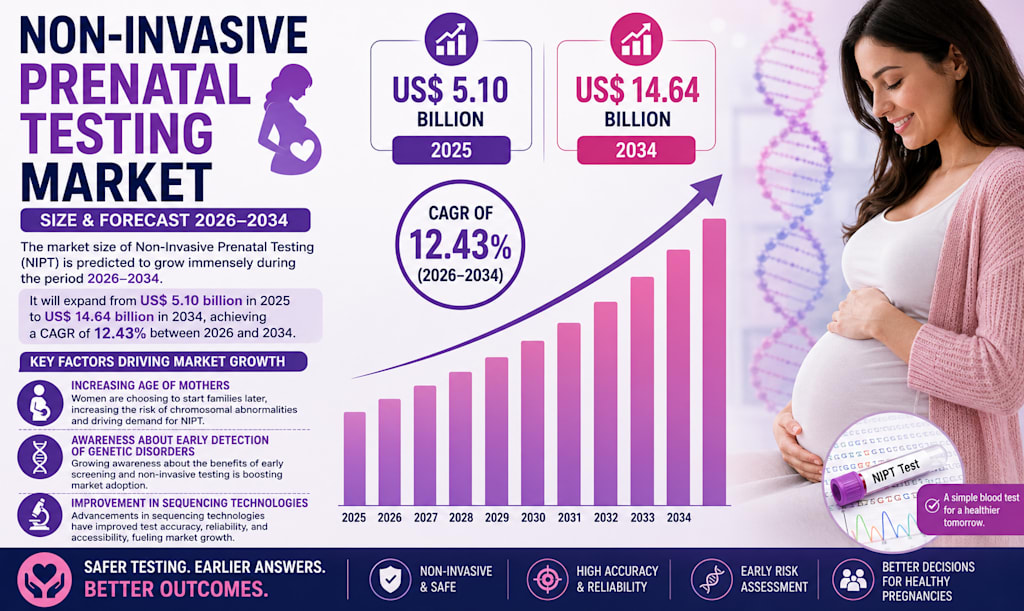
According to Renub Research, the global Non-Invasive Prenatal Testing (NIPT) Market is projected to expand from US$ 5.10 billion in 2025 to US$ 14.64 billion by 2034, growing at a CAGR of 12.43% between 2026 and 2034. Increasing maternal age, growing awareness of genetic disorders, technological advancements in sequencing, and expanding prenatal screening programs are among the major factors driving this growth.
As healthcare systems increasingly prioritize preventive medicine and personalized healthcare, NIPT is positioned to become one of the most important diagnostic tools in modern prenatal care.
Understanding Non-Invasive Prenatal Testing
Non-Invasive Prenatal Testing, commonly known as NIPT, is a prenatal screening technique that analyzes fragments of fetal DNA circulating within the mother's bloodstream.
The test is typically performed after the 10th week of pregnancy and helps identify chromosomal abnormalities that may affect fetal development.
NIPT is commonly used to screen for:
- Down Syndrome (Trisomy 21)
- Edwards Syndrome (Trisomy 18)
- Patau Syndrome (Trisomy 13)
- Sex chromosome abnormalities
- Certain microdeletion syndromes
Unlike invasive procedures such as amniocentesis or chorionic villus sampling (CVS), NIPT requires only a blood sample from the expectant mother, significantly reducing the risk of pregnancy complications.
Its high accuracy, convenience, and safety have made it one of the fastest-growing segments within prenatal diagnostics.
Rising Maternal Age Is Driving Demand
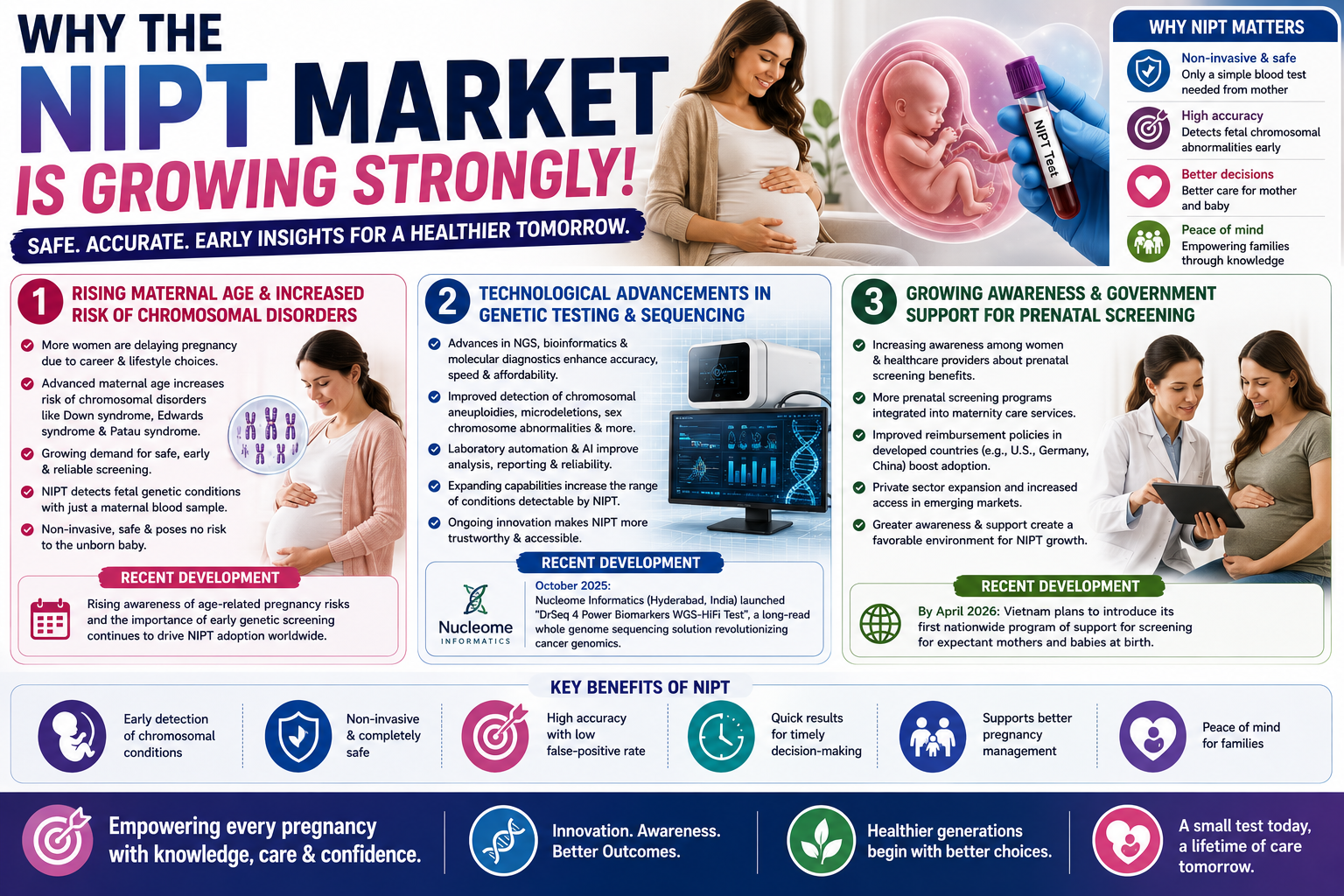
One of the strongest factors contributing to the expansion of the NIPT market is the increasing average age of pregnant women worldwide.
Many women today are choosing to delay childbirth due to:
- Career development
- Higher education
- Financial planning
- Lifestyle preferences
- Personal circumstances
While delayed parenthood offers numerous social and economic benefits, it is also associated with a higher risk of chromosomal abnormalities during pregnancy.
Medical research has consistently shown that pregnancies among older women face elevated risks of conditions such as:
- Down Syndrome
- Edwards Syndrome
- Patau Syndrome
As a result, expectant parents and healthcare providers are increasingly seeking safe methods to assess fetal health at earlier stages of pregnancy.
NIPT offers an ideal solution because it provides highly accurate genetic information without exposing the fetus to procedural risks.
The growing number of pregnancies among women aged 35 and older is expected to remain one of the primary drivers of market growth throughout the forecast period.
Genomic Technology Is Revolutionizing Prenatal Diagnostics
Technological innovation continues to play a central role in the evolution of the NIPT market.
Advances in several fields have significantly improved testing capabilities:
- Next-Generation Sequencing (NGS)
- Bioinformatics
- Molecular diagnostics
- Laboratory automation
- Artificial intelligence
These innovations have made NIPT:
- More accurate
- Faster
- More affordable
- More widely available
Modern testing platforms can now identify a broader range of genetic abnormalities than earlier generations of prenatal screening technologies.
In addition to common chromosomal conditions, many advanced NIPT solutions can now detect:
- Microdeletion syndromes
- Sex chromosome abnormalities
- Rare genetic disorders
- Additional fetal genomic variations
Artificial intelligence is also helping laboratories process genetic information more efficiently, reducing turnaround times and improving reporting accuracy.
A notable example of ongoing innovation occurred in October 2025 when Hyderabad-based Nucleome Informatics launched its DrSeq 4 Power Biomarkers WGS-HiFi Test, leveraging long-read whole genome sequencing technology to advance genomic diagnostics.
As sequencing costs continue declining and analytical capabilities improve, NIPT adoption is expected to accelerate across both developed and emerging healthcare markets.
Growing Awareness of Prenatal Health Is Expanding Adoption
Another major factor fueling growth is increasing awareness of prenatal health and preventive care.
Healthcare providers, public health organizations, and governments are actively promoting prenatal screening as part of comprehensive maternity care programs.
Today's expectant parents have greater access to information than ever before. This has increased interest in advanced screening methods that can provide early insights into fetal development and potential health risks.
Several countries have integrated prenatal screening into routine maternal healthcare pathways, helping improve access and encouraging broader adoption.
Key drivers include:
- Improved healthcare education
- Greater awareness of genetic disorders
- Expansion of maternity care services
- Increased availability of genetic counseling
- Growth of private healthcare offerings
Developed markets such as the United States, Germany, and China have expanded reimbursement policies for prenatal screening, while emerging economies are witnessing growing private-sector investment in genetic testing services.
A particularly notable initiative is Vietnam's planned nationwide screening support program for expectant mothers and newborns, scheduled for implementation by April 2026.
These efforts are helping create favorable conditions for long-term market expansion.
NIPT Services Are Becoming Increasingly Popular
While diagnostic instruments remain essential, service-based NIPT solutions are experiencing particularly strong growth.
Many healthcare providers prefer outsourcing prenatal genetic testing rather than establishing costly in-house laboratories.
Specialized testing service providers typically offer:
- Sample collection
- Genetic analysis
- Interpretation of results
- Genetic counseling
- Clinical reporting
This model enables hospitals and clinics to access advanced genomic testing without substantial infrastructure investments.
Patients also benefit from increased convenience, shorter waiting times, and broader access to expert genetic services.
The growing popularity of telemedicine has further expanded accessibility by allowing healthcare professionals to communicate results and counseling services remotely.
As healthcare systems continue modernizing, demand for outsourced NIPT services is expected to increase significantly.
Diagnostic Laboratories Play a Critical Role
Diagnostic laboratories have become the backbone of the global NIPT ecosystem.
These specialized facilities utilize advanced technologies such as:
- Next-generation sequencing platforms
- Molecular diagnostics systems
- Automated sample processing tools
- Bioinformatics software
Their primary function is to analyze fetal DNA accurately and efficiently while ensuring high-quality clinical results.
Many healthcare providers now outsource testing to specialized laboratories because they offer:
- Greater efficiency
- Lower operational costs
- Faster turnaround times
- Higher testing volumes
- Advanced technical expertise
As demand for prenatal genetic screening rises, investments in diagnostic laboratory infrastructure are expected to grow correspondingly.
Edwards Syndrome Screening Represents a Key Growth Area
Among the various applications of NIPT, screening for Edwards Syndrome (Trisomy 18) remains an important market segment.
Edwards Syndrome is a serious chromosomal condition associated with:
- Severe developmental abnormalities
- Organ defects
- High fetal mortality rates
- Significant healthcare challenges
Early detection allows healthcare providers and families to make informed decisions regarding pregnancy management and care planning.
NIPT offers a highly accurate and non-invasive method for identifying the condition while avoiding the risks associated with invasive diagnostic procedures.
Growing awareness among high-risk pregnancies and older mothers is expected to continue supporting demand for Edwards Syndrome screening services.
Challenges Facing the NIPT Market
Despite its impressive growth potential, the NIPT industry faces several important challenges.
High Testing Costs
One of the most significant barriers remains affordability.
NIPT requires sophisticated equipment, highly trained personnel, and advanced laboratory infrastructure. Consequently, testing costs can be substantially higher than traditional prenatal screening methods.
In many developing countries, NIPT is not fully covered by public healthcare programs or insurance plans, limiting access for lower-income populations.
Limited Healthcare Infrastructure
Access to specialized genetic testing facilities remains uneven across regions.
Rural and underserved communities often face challenges accessing advanced prenatal diagnostics, particularly in emerging markets.
Ethical and Regulatory Concerns
NIPT raises important ethical considerations regarding genetic information and reproductive decision-making.
Concerns include:
- Gender selection misuse
- Genetic discrimination
- Informed consent
- Counseling requirements
- Data privacy
Regulatory frameworks vary widely across countries, creating additional complexity for companies seeking global market expansion.
Successfully addressing these challenges will be critical for ensuring equitable and responsible adoption of NIPT technologies.
Regional Markets Driving Growth
United States
The United States remains one of the largest NIPT markets due to advanced healthcare infrastructure, high awareness levels, and widespread adoption of prenatal screening. According to data cited in the report, Trisomy 18 affects approximately one in every 2,000 to 6,000 live births in the United States, while Down Syndrome occurs in roughly one in every 707 births.
Germany
Germany's strong healthcare system, favorable reimbursement environment, and emphasis on preventive care continue driving adoption. Expanding genetic testing services and technological innovation are expected to support further market growth.
China
China represents one of the fastest-growing markets due to rising healthcare awareness, delayed pregnancies, and government efforts to improve maternal health services. In June 2024, BGI Genomics reported collaboration with more than 160 hospitals globally to provide NIPT services.
Saudi Arabia
Saudi Arabia is witnessing steady growth due to investments in healthcare modernization, maternal health programs, and precision medicine initiatives. In July 2025, King Faisal Specialist Hospital & Research Center partnered with the Rady Children's Institute for Genomic Medicine to advance genome-based newborn screening capabilities.
Final Thoughts
Non-Invasive Prenatal Testing is rapidly transforming prenatal healthcare by offering safer, earlier, and more accurate genetic screening solutions for expectant families.
With the market projected to grow from US$ 5.10 billion in 2025 to US$ 14.64 billion by 2034, NIPT is becoming an increasingly important component of modern maternity care.
The combination of rising maternal age, growing awareness of fetal health, advancements in genomic technologies, and expanding healthcare infrastructure will continue driving adoption worldwide.
Although challenges related to affordability, accessibility, and ethical considerations remain, ongoing innovation and policy support are creating a strong foundation for future growth.
As healthcare moves toward greater personalization and preventive care, NIPT stands out as one of the most impactful diagnostic advancements in maternal and fetal medicine, helping families make informed decisions and improving pregnancy outcomes around the world.
About the Creator
Enjoyed the story? Support the Creator.
Subscribe for free to receive all their stories in your feed.
Comments
There are no comments for this story
Be the first to respond and start the conversation.