

At 9:14 AM on a Tuesday, Walter Pennick was the least important person on Beech Avenue. By 9:40 AM he was the most important person for approximately four miles in every direction.
Walter was deadheading the dahlias in his front garden (which he did every Tuesday regardless of whether they needed it) when Priya from number 12 came out of her house holding her phone at arm's length as if it had bitten her.
"Is yours working?" she called across the hedge.
Walter straightened up slowly due to his back having opinions. "Is my what working?"
"Your phone."
Walter thought about this. "I expect so. I haven't asked it to do anything."
Priya pressed the side button. She shook it. She held it up towards the sky (which Walter had seen young people do before) as if signal fell like rain and you only had to catch it. The screen remained black. It wasn't the dull black of a dead battery. It was the flat, stubborn black of an object that had quietly decided to stop being useful.
Then Dev from 14 came out holding his. Then the Okafor twins (who were 17 and had never in Walter's knowledge been seen outside before noon). Then Mrs Haverstock from the corner, still in her dressing gown, jabbing at her screen with one finger like she was trying to wake up a sleeping cat.
Within ten minutes, the entire Avenue was standing on the pavement staring at the slabs of glass in their hands waiting for them to come back to life.
They didn't.
The first person to need Walter was a delivery driver.
He had parked his van at a terrible angle with the door open and was walking up and down the pavement asking anyone if they knew where 42 Ashgrove Road was. His entire route lived on his phone. Forty-one parcels in the back and not a clue where any of them went.
"Ashgrove," said Walter. "Left at the Co-op, right at the church that is flats now, second on the left. Forty-two has a green door. Bad-tempered dog, but he is all noise."
The driver looked at him like he had pulled a coin from behind his ear.
"How do you know that?"
"I've lived here fifty-one years," said Walter. "I've walked past it."
The driver wrote it on his hand in biro. Then he asked about Fairfield Close, Parsons Lane, and the new estate behind the garden centre. By the time he drove off his entire forearm was a map.
At 10:30 AM, Walter turned on the radio.
It was a real radio; battery-powered, the size of a shoebox, and it sat on the kitchen windowsill, where Margaret had put it in 1986. By 11:00 AM, nine of his neighbours were squeezed into his front room listening to it, because Walter was the only person on the Avenue who owned one, and nobody could get the news on their phones for obvious reasons.
The BBC newsreader sounded like she had had a very long morning. Every smartphone in the world had stopped working at the same moment. Nobody knew why. Engineers were "investigating." Landlines were working. Cars were working. Laptops and computers were working, technically, except that nobody could log into anything, because every bank, every email account, and every work system wanted to send a six-digit code to the phone that no longer existed.
"Oh God," said Dev putting his head in his hands. "My bank app. My boarding passes. My bus ticket. My gym."
"My photos," said one of the Okafor twins very quietly and the other twin put an arm around her.
Mrs Haverstock said, "Well I can't see what all the fuss is about," and then a moment later: "Hang on. How am I supposed to pay for anything?"
Walter went to the kitchen and came back with the biscuit tin. Inside, beneath a layer of custard creams was £340 in notes and coins because Walter had never trusted the cash machine at the Co-op and he had been right not to.
"I'll lend it out," he said. "Pay me back when the world turns on again."
Nine people looked at the biscuit tin and then at him with something close to awe.
The afternoon continued in much the same way. Walter became a sort of lending library for the twentieth century.
Priya needed to collect her son from school but did not know the school's landline number. Walter had a Yellow Pages from 2009 under the stairs. The number had not changed.
Dev had a job interview in town at 3:00 PM and no idea how to get there without the little blue dot. Walter drew him a map on the back of an electricity bill: the bus stop, the number 17 bus, the stop after the big roundabout, the building with the clock on it. Dev studied it as if it were scripture then folded it into his breast pocket.
The twins wanted to know what time it was. Walter lent them his spare wristwatch with the cracked strap. They took turns wearing it and checked it (out of habit) every forty seconds or so just as they used to check their phones. After a while they stopped checking. After a while longer they asked him to teach them a card game and he taught them rummy. The girl twin won four hands in a row and shouted so loudly that Mrs Haverstock knocked on the wall.
Then Mrs Haverstock came round herself because it turned out her daughter's number lived only in her phone and she could not remember a single digit of it. Walter had his address book. Margaret's handwriting was all through it; slanting and blue; and right there under H was Haverstock, Linda (daughter of Joan at no. 1) with a number beside it from a Christmas card swap in 2004.
Mrs Haverstock called her daughter from Walter's landline and cried a bit, while Walter went and put the kettle on so she could do so in private.
By evening something strange had happened to Beech Avenue.
Nobody went inside.
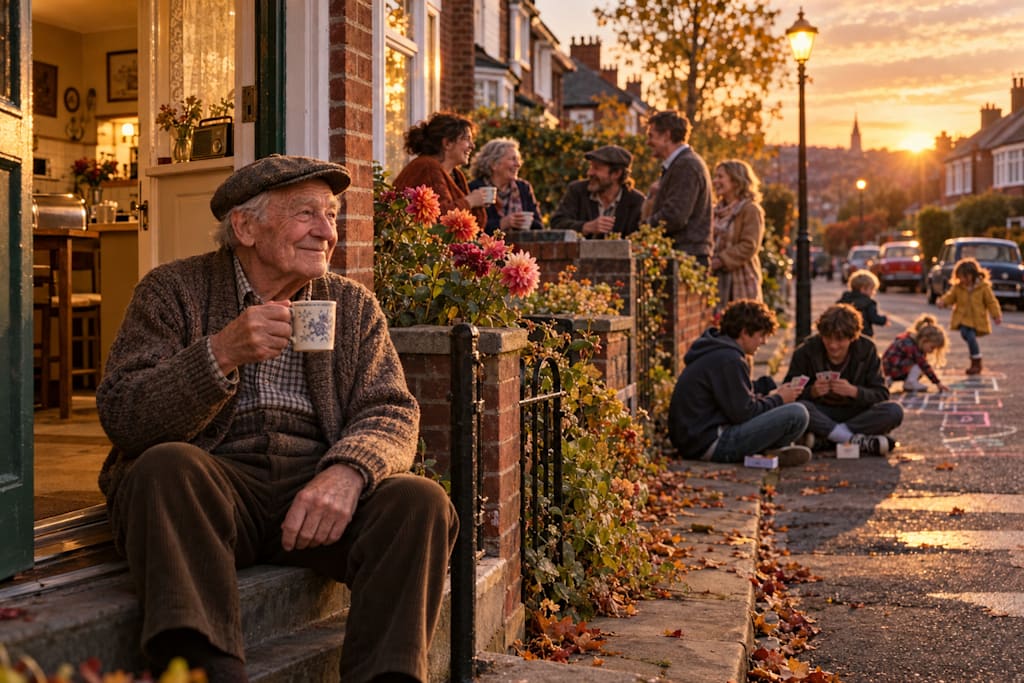
There was nothing to go inside for. No scrolling; no streaming on the sofa; no forty-minute spiral through videos of strangers' kitchens. Instead people sat on garden walls and talked. Dev came back from his interview at 6:00 PM (he thought it went well; they had been so impressed he had found the place at all) and he and Mrs Haverstock discovered they both loved old jazz records. The twins played rummy on the pavement under the streetlight. Priya's little boy and two other children Walter had never seen before chalked a hopscotch grid outside number nine and played until full dark.
Walter sat on his front step with a cup of tea and watched all of this.
In fifty-one years he had never seen the Avenue like this. He had lived here long enough to watch it fill with young families and empty again; and in the last ten years since phones arrived properly, people had stopped looking up. They would nod at him on their way to their cars; thumbs already moving. He had become part of the scenery; like the postbox or the dahlias.
Tonight three separate people asked him how he was. One of them actually waited for an answer.
The phones remained dead on Wednesday; Thursday; Friday.
The world adjusted clumsily. Banks reopened their counters and queues went round blocks. Shops put up handwritten signs: CASH ONLY SORRY. Someone on the radio said that map sales had increased eleven thousand percent; Walter laughed aloud, alone in his kitchen. Teenagers across the country rediscovered payphones, which was a problem, since most of them had been converted into tiny libraries or defibrillator boxes.
On Beech Avenue, the knocking on Walter's door never really stopped. Could he wake Dev at 6:00 AM with a knock because Dev didn't own an alarm clock? Did he know how to post a letter? Was a stamp still a stamp? Where did the stamp go? Did he know any recipes that didn't come from TikTok? (He knew forty; Margaret taught him mostly). Would he mind awfully keeping eye on the kids for hour?
He didn't mind; didn't mind any of it.
On Saturday morning, the radio announced that engineers had found the fault and phones would start switching back on by lunchtime.
Walter listened to the announcement, while standing at the kitchen counter. Then he turned the radio off, and in the quietness, he opened the bread bin.
Underneath a half-loaf, wrapped in a tea towel, was a phone.
It was a Nokia, grey and chunky, roughly the size and weight of a bar of soap. It had real buttons, a snake game, and had never once been called smart.
And working perfectly whole time.
There one message on it from Tuesday 9:32 AM, from his daughter in Canada: "Dad, the news says all phones gone down. I can still text you on this old thing so I guess yours is fine too. Are you OK? Love you xx"
Walter replied the same day "Fine. Very busy. Love you too, Dad." Since then, the two began texting most evenings, slowly pressing each key three times to get the right letter. It was the most they had talked in about a year.
He hadn't lied to anyone. When Priya had asked on Tuesday morning whether his phone was working, he told the honest truth, that he expected so. She just hadn't asked a second time. Nobody had. They assumed that old Walter, if he had a phone, would be as lost as they were.
Although, he could have told them. Thought about it Tuesday night, while on the front step, having tea. But then the girl twin won another hand of rummy, and when Dev came over to ask about number 17, it seemed such a shame to spoil it.
At ten past twelve, a cheer went up street. Then another. Walter looked out of his kitchen window, and saw the whole Avenue standing on the pavement again, exactly as Tuesday, but now staring down at bright glowing screens.
He wrapped the Nokia back in the tea towel, and put it in the bread bin, next to the crusts.
Then, he filled the kettle, sat down at the kitchen table, and waited to see whether anyone would still knock.
At twenty past, someone did. It was Priya, her phone in her back pocket.
"I know I don't need anything," she said, a bit embarrassed "I just thought you might fancy a cup of tea."
"Kettle's on," said Walter.
About the Creator
Daisy Fernsby
I’ve spent years writing about the natural world, and I still get a thrill from a fact that changes how someone sees an animal. History pulls at me just as hard, especially the Tudor and medieval world with all its scandal and consequence.
Enjoyed the story? Support the Creator.
Subscribe for free to receive all their stories in your feed. You could also become a paid subscriber, letting them know you appreciate their work.
Comments
There are no comments for this story
Be the first to respond and start the conversation.