
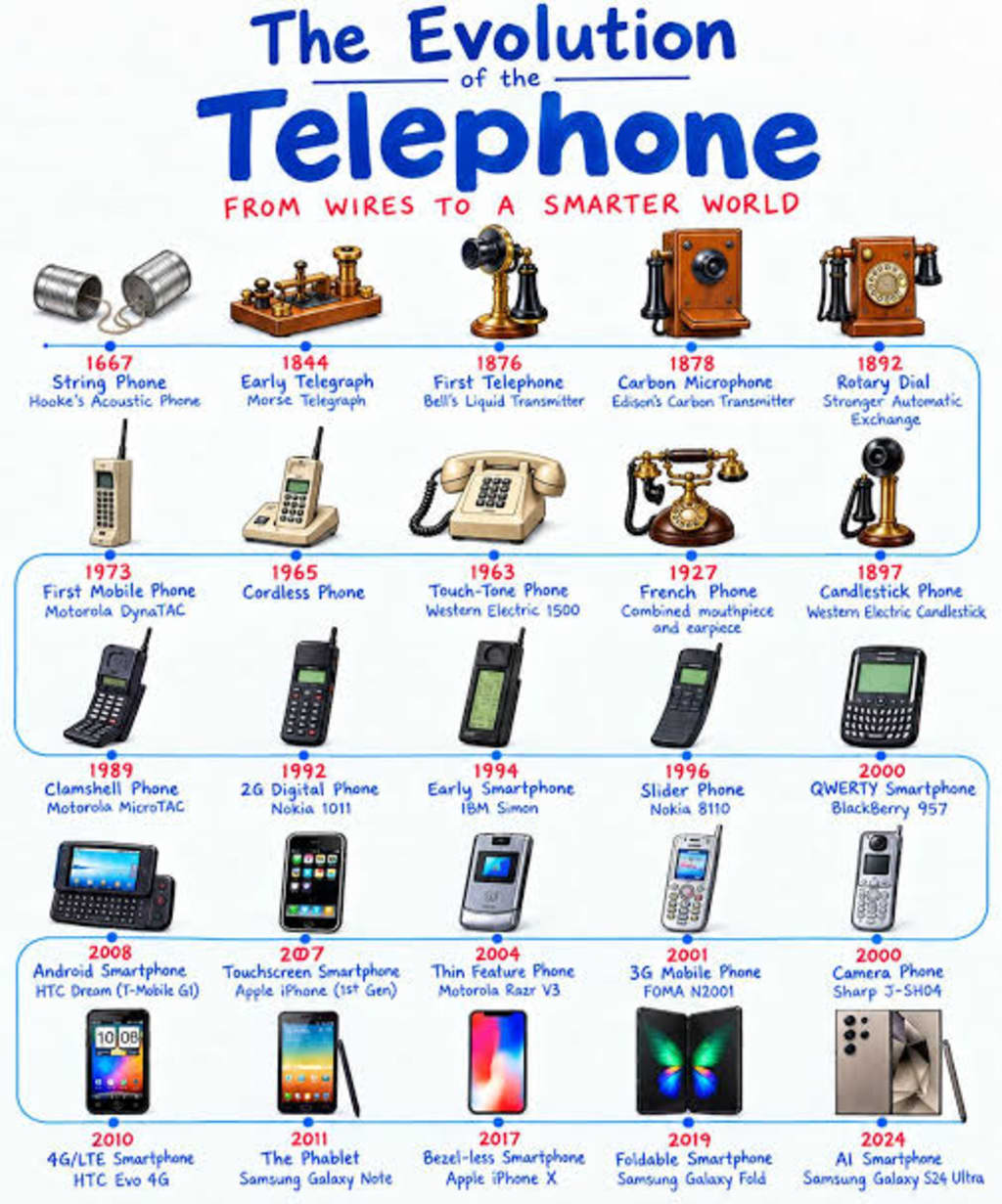
I was born in 1959.
This is important.
Not because I consider myself ancient, and certainly not because I intend to begin one of those speeches that starts with When I was your age...
But because I remember a world before smartphones.
I remember a world before cellphones.
I even remember a world when having a telephone in your own home was not something you automatically expected.
When I was young, if you needed to make a call while you were out, you found a public telephone. You put money into it. Later, families had one telephone at home, usually sitting in the hallway or living room like a piece of communal furniture. It had a rotary dial and a cord, and if someone was using it, everybody else waited.
Somehow, civilization survived.
So did we.
Many decades later, I was camping in Canada with my husband, our two adult children, our son's wife, several dogs, two campers, enough food to survive a small siege, and enough modern technology to communicate with the International Space Station.
Or so we thought.
We had chosen a campground well outside a larger town because we wanted exactly what people claim to want when they go camping: wilderness.
Trees.
Mountains.
Lakes.
Wildlife.
Silence.
Of course, modern people only want silence if they can interrupt it whenever they choose.
We knew cellphone reception would be terrible. That was why we had brought satellite equipment. No problem. We could disappear into the Canadian wilderness and still watch a movie in the evening, check the news, send messages and reassure everyone that we were enjoying getting away from it all.
Our son, whom I'll call Ted, decided to spend the afternoon fishing.
He took his fishing gear and, because this was Canada and not a city park in Cologne, protection in case he encountered a bear or cougar.
Before leaving, he showed us on the map where he intended to go.
Yes.
A map.
A real one.
Paper.
Folded.
Covered in lines and symbols.
I had insisted that both of my children learn to read maps when they were young. Not only ordinary road maps, but topographical maps as well.
They had complained, naturally.
Children are required by some ancient law to complain whenever parents teach them something useful.
"Why do I need this?"
"Because one day you might."
"We have GPS."
"And one day you might not."
That afternoon, my husband, our daughter Amy and I took the dogs for a long walk.
It was beautiful.
We passed other hikers, and occasionally we saw someone standing beside a trail holding a phone in the air.
One man stared at his screen, tapped it several times, shook it and held it toward the sky.
Amy laughed.
"Maybe he thinks God provides technical support."
We continued walking.
A little later, we passed a young couple. Both were staring furiously at their phones.
"No signal?" I asked.
"Nothing," the woman said.
"Welcome to the wilderness."
She didn't find that funny.
Neither did her boyfriend.
We thought nothing more about it.
Dead zones were normal here.
On the way back, Amy wanted to stop at the library in the small town near the campground. She wanted a few books and hoped to check something online while we were there.
The librarian stopped her before she reached the computer.
"Internet's down."
"Again?"
"Everything's down."
She sounded annoyed rather than worried.
We collected several books and left.
Across the street was a small store that sold electronics and repaired phones.
There was a crowd outside.
Not three people.
Not ten.
Half the town seemed to be standing there.
People held their phones like patients waiting outside an emergency room.
"Something must have happened to the network," Amy said.
"Apparently."
Back at the campground, Ted was already waiting.
"There's something wrong with my phone."
I looked at him.
"You caught any fish?"
"That's not the point."
"So no fish."
"Mom."
I took out my own phone.
NO SIGNAL.
"Mine too."
"See?"
"We're in the middle of nowhere."
"But it was working earlier."
"Then perhaps the satellite is having a bad day."
Ted stared at me with the expression adult children reserve for mothers who clearly fail to understand the seriousness of modern life.
"How am I supposed to know what's going on?"
"You could talk to us."
He did not appreciate that suggestion.
That evening things became stranger.
Our satellite connection didn't work.
The television didn't work.
The internet didn't work.
The radio produced mostly static.
Around the campground, people began walking from site to site asking the same questions.
"Do you have service?"
"Is your internet working?"
"Can you get online?"
"No."
"No."
"No."
By nine o'clock, people were behaving as though someone had removed oxygen from the atmosphere.
A teenager walked past our campsite holding his phone above his head.
Another camper drove slowly around the grounds searching for reception.
One woman announced that she needed to get onto Facebook because her sister would worry.
"Where does your sister live?" I asked.
"She's camping two sites over."
I stared at her.
"Have you considered walking over there?"
She stared back at me.
Apparently not.
We sat around the fire.
Amy opened one of her library books.
My daughter-in-law did the same.
I began reading.
My husband looked around at us.
"So this is what we're doing now?"
"Apparently."
Ted sighed.
"I need my GPS tomorrow."
"For what?"
"I wanted to drive up to the lake."
"There is a map in your truck."
He looked at me.
"The paper map."
"I know what you mean."
"Good. I bought it for you."
"Mom, nobody uses those anymore."
"You can."
"What if I get lost?"
I smiled.
"You can read a map."
There was a pause.
Then he groaned.
"Oh God."
"Exactly. All those terrible childhood lessons are coming back."
The next morning, nothing had changed.
No phones.
No internet.
No satellite connection.
Nothing.
By then people were nervous.
We decided to drive into the nearest larger town and find out what was happening.
That was when we discovered the first serious consequence.
Traffic.
Cars were everywhere.
People were trying to reach towns, stores, police stations, workplaces and relatives.
But without navigation systems, a remarkable number of them had apparently lost the ability to get there.
At one intersection, a driver stopped in the middle of the road.
Another leaned out of his window.
"Move!"
"I don't know where to go!"
"Then get off the road!"
"My GPS isn't working!"
"Nobody's GPS is working!"
The line stretched farther than we could see.
I reached behind my seat and pulled out the road map.
Ted groaned.
"Here she goes."
"Here she saves you an hour."
We opened it across the dashboard.
All of us knew how to read it.
There was the main highway.
There was the town.
There was the mountain.
And there, winding around the other side, was a smaller road.
"We turn around," I said. "Take this road here, cross over the ridge and come into town from the north."
"Are you sure?" Ted asked.
I looked at him.
"No. I randomly selected a blue line because I like the color."
Amy laughed.
We turned around.
Twenty minutes later, we were driving through almost empty country roads while hundreds of cars remained trapped on the highway.
The old paper map worked perfectly.
Imagine that.
Eventually we reached the outskirts of town, although not exactly where we had intended.
There was a police station.
"Good enough," I said.
I went inside.
The place was chaotic.
People stood at the desk demanding information.
One wanted to know how to reach Vancouver.
Another couldn't contact his wife.
Someone else wanted the police to fix his phone.
I waited until an officer finally looked at me.
"Can I help you?"
"I hope so. What exactly is happening? Is there a satellite problem? Phones aren't working. Internet isn't working. We can't get anything."
He studied me for a moment.
"Everything is down."
"Everything here?"
"Everything."
I waited.
He continued.
"Worldwide."
I laughed.
Not because it was funny.
Because sometimes the brain refuses to accept a sentence.
"Worldwide?"
"That's what we're being told."
"Every network?"
"Every smartphone."
"What happened?"
"We don't know yet."
"Cyberattack?"
"We don't know."
"Satellite failure?"
"We don't know."
"Solar event?"
He shook his head.
"We don't know."
I looked back through the glass doors at my family waiting outside.
"Can it be fixed?"
His expression changed.
That was the moment I stopped smiling.
"At the moment," he said, "they don't think so."
"What does that mean?"
"It means the devices aren't just disconnected. Something has rendered smartphones inoperable. All of them. Different manufacturers, different networks, different countries. They don't know how yet."
I looked at my phone.
A small black rectangle.
Yesterday it had been a telephone, camera, map, newspaper, library, bank, calendar, television, mailbox, address book and encyclopedia.
Today it was a paperweight.
The officer sighed.
"You wouldn't believe what's happening out there. People can't even find their way home."
"I believe it."
"We've had people asking us for directions all morning."
"That's not unusual."
"One guy had a map."
"Good."
"He couldn't read it."
I smiled.
The officer didn't.
"I'm serious. He showed it to me and asked which dot was the church."
"Which dot?"
"It wasn't even a road map."
"What was it?"
"A sewing pattern."
For several seconds I said nothing.
"A sewing pattern?"
"His wife had printed it. He found it in the car and thought it was a map."
I laughed so loudly that several people turned around.
"I'm sorry."
"No, you're not."
"No. I'm really not."
He pointed toward the paper map I had tucked under my arm.
"You can read that?"
"Of course."
"Topographical maps too?"
"Yes."
He looked genuinely impressed.
"My husband can. My children can. My daughter-in-law can."
"All of you?"
"Yes."
I turned toward the window and waved at them.
They waved back.
I couldn't resist.
I opened the door.
"Ted!"
"What?"
"Remember when you asked why you needed to learn how to read a map?"
He already knew what was coming.
"Don't say it."
The officer grinned.
"I told you so!"
"Mom!"
For the first time that morning, several people laughed.
But on our way back to the campground, I began noticing things I hadn't noticed before.
Gas stations had handwritten signs:
CASH ONLY.
Stores were calculating prices with calculators.
People stood outside banks.
A restaurant had put a board on the sidewalk:
NO CARD PAYMENTS.
At intersections, strangers were giving directions.
People were writing telephone numbers on pieces of paper, although nobody yet knew when telephones would work again.
Outside a grocery store, a young woman stood crying.
Not because she was hungry.
Because she didn't know her mother's number.
It had been stored in her phone.
For years.
She had never memorized it.
That stopped being funny.
Back at the campground, the atmosphere had changed.
People were talking.
Not messaging.
Talking.
Someone had found an old battery-powered radio.
Another camper had a stack of maps.
We spread them across a picnic table.
Within an hour, our campsite had become an unofficial information center.
"How do I get to the highway?"
"Which road goes south?"
"How far is the next town?"
"Can you show me where we are?"
I showed a teenage boy how to orient the map.
"Find north first."
"How?"
"Look around you."
He did.
I pointed toward the mountains.
"Now look at the map."
Slowly, his expression changed.
He understood.
It was a tiny thing.
But I saw something happen.
He wasn't following a blue line on a screen anymore.
He knew where he was.
That evening, the campground was strangely quiet.
No notification sounds.
No videos.
No glowing screens illuminating faces.
People sat outside.
Someone played a guitar.
Children ran between campsites.
A man borrowed one of Amy's books.
Ted sat beside the fire staring into the flames.
"You know what the weirdest thing is?" he said.
"What?"
"I keep reaching for it."
His dead phone lay beside him.
"I know."
"Even when I don't need it."
"I know."
"How long do you think this will last?"
I looked around the campground.
Nobody knew.
Perhaps the phones would come back tomorrow.
Perhaps next week.
Perhaps never.
The world beyond our forest would be struggling with problems far greater than navigation. Banking. Transportation. Hospitals. Businesses. Emergency systems. Governments.
Modern civilization had woven digital technology through almost everything.
Pull one thread hard enough and nobody knew how much would unravel.
But that night, in one small campground in Canada, something else was happening.
People were adapting.
Someone had already organized a board where campers could leave handwritten messages.
Someone else was planning a trip into town the next morning and taking requests for supplies.
The teenager I had taught to read the map was showing another boy how to find north.
Ted picked up the paper map again.
He unfolded it carefully.
"Where was that lake?"
I pointed.
"Here."
"And this line?"
"Elevation."
He nodded.
He remembered.
I smiled.
"What?"
"Nothing."
"You're doing the mother thing again."
"What mother thing?"
"The face that says you were right."
"I don't need a face for that."
He laughed.
Above us, the sky was spectacular.
Without glowing screens everywhere, people had begun looking up.
Thousands of stars stretched across the darkness.
For most of human history, people had crossed continents using stars, coastlines, mountains, rivers, compasses and maps.
Then, for a very short period of time, we had decided that a little machine should tell us where we were.
The machine had stopped.
The mountains hadn't.
The roads hadn't.
North hadn't moved.
And neither had we.
I folded the map and handed it to my son.
"Keep it."
He looked at it.
"I will."
Somewhere beyond the forest, billions of dead smartphones were lying on tables, in cars, in pockets and in people's hands.
For the first time in decades, nobody was scrolling.
And perhaps the strangest thing of all was what happened next.
We looked at each other.
About the Creator
Enjoyed the story? Support the Creator.
Subscribe for free to receive all their stories in your feed. You could also become a paid subscriber, letting them know you appreciate their work.
Comments
There are no comments for this story
Be the first to respond and start the conversation.