
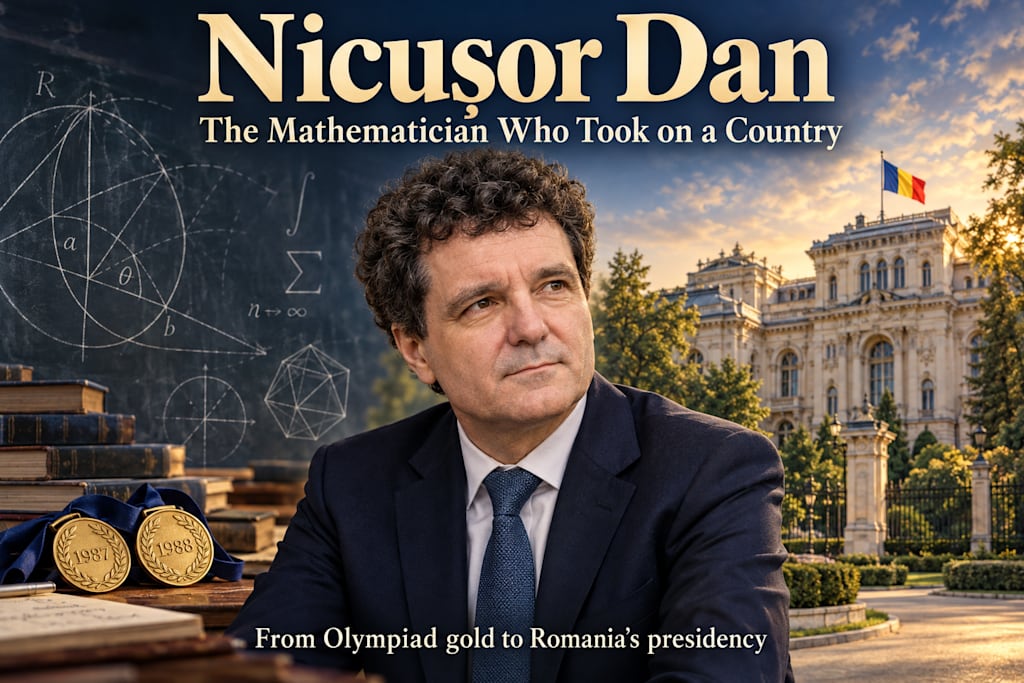
Nicușor Dan: The Mathematician Who Took on a Country
From international mathematics medals to Romania’s presidency, an unlikely political career tests the distance between solving problems and governing people
Introduction
Many politicians arrive in public life through law, business or a lifelong attachment to a political party. Nicușor Dan followed a less familiar route, beginning with exceptional mathematical ability and eventually becoming President of Romania.
His story connects international competitions, advanced research in France, campaigns to protect Bucharest and the difficult business of national leadership. It also raises an intriguing question: can the habits that help someone solve a mathematical problem help them govern a divided country?
There is no automatic connection between academic brilliance and political success. Nevertheless, Dan’s career offers an unusual example of someone taking an analytical education beyond the lecture room and into public life.
The Schoolboy with Exceptional Ability
Dan was born on 20 December 1969 in Făgăraș, a town in central Romania. While attending the local Radu Negru school, he developed the mathematical talent that would first bring him international recognition.
He won gold medals at the International Mathematical Olympiad in both 1987 and 1988, achieving perfect scores on both occasions. These were remarkable results in a competition designed to challenge some of the strongest school-age mathematicians in the world.
Olympiad questions require considerably more than familiarity with classroom methods. Competitors must identify hidden relationships, construct arguments and demonstrate why their answers work, often after an approach that initially looked promising has failed.
That training encourages persistence, but it also teaches an uncomfortable discipline: an answer cannot become correct simply because its author is confident. The reasoning must survive scrutiny, which is a useful principle far beyond mathematics.
From Romania to Research in France
Dan continued his mathematical education at the University of Bucharest before moving to France in 1992. His studies included the École Normale Supérieure and the universities of Paris XI and Paris XIII, placing him within a demanding academic environment.
In 1998, he completed his doctorate at Paris XIII, now known as Université Sorbonne Paris Nord. Its mathematics department records that he defended his thesis on 27 April under the supervision of Daniel Barsky and Christophe Soulé.
The thesis concerned Green currents and meromorphic continuation, subjects belonging to advanced mathematics rather than everyday calculation. His research profile at the Romanian Academy identifies Arakelov geometry as his field of interest, an area connecting arithmetic with geometry.
A useful way to appreciate this work is to think of mathematics as a search for relationships between different kinds of structure. Dan’s research belonged to that deeper world, where investigating shapes and functions can reveal information about questions involving numbers.
Choosing to Return Home
After completing his doctorate, Dan returned to Romania in 1998 and worked at the Institute of Mathematics of the Romanian Academy. He also helped establish the Bucharest Normal School in 2000, creating opportunities for advanced scientific education within his own country.
This decision gave his career a different direction from the familiar story of a gifted student permanently leaving for better prospects abroad. He brought experience gained in France back into Romanian academic life, although his interests increasingly extended beyond research.
Returning home did not immediately make him a politician. His route towards public office developed through civic activity, particularly the question of what was happening to the buildings, public spaces and neighbourhoods of Bucharest.
The Fight to Save Bucharest
Through the Save Bucharest Association, Dan challenged development decisions and campaigned to protect architectural heritage and green spaces. His public reputation grew from legal battles over planning and the conduct of local authorities.
This was a practical form of activism, involving documents, regulations and court proceedings. Protecting a historic building requires more than expressing affection for it, particularly when developers and officials have competing interests.
The relationship with mathematics is suggestive rather than provable. Both activities can demand close attention to a complicated argument, the discovery of weaknesses and the patience to keep working when progress is slow.
However, the outcomes differ considerably. A mathematical proof can settle a question within an agreed framework, while a planning dispute can continue through appeals, political pressure and disagreements over what a city should become.
From Activist to Mayor
Dan stood independently for the Bucharest mayoralty in 2012, beginning a transition from challenging decisions outside government to seeking responsibility within it. In 2015, he founded the Save Bucharest Union, which subsequently developed into the national Save Romania Union party.
He left that party in 2017 following internal disagreements. His eventual election as mayor in 2020, followed by re-election in 2024, established him as a politician with an electoral base beyond his original civic campaigns.
As mayor, he worked on infrastructure problems including the capital’s ageing district heating system. Such work is less glamorous than campaign speeches, but residents judge public administration partly through whether their essential services function reliably.
His progression illustrates how a reputation can develop through sustained attention to specific problems. It also shows the difficulty of moving from identifying failures to managing the institutions expected to repair them.
The Presidential Victory
On 18th May 2025, Dan won Romania’s presidential election against nationalist candidate George Simion. Running as an independent, he secured approximately 53.6 per cent of the vote and moved from the capital’s city hall to national leadership.
His political position emphasises Romania’s membership of the European Union and NATO, alongside institutional reform and opposition to corruption. His victory made the former mathematics competitor an especially unusual figure among European heads of state.
The appeal of that background is understandable, particularly when voters are frustrated by polished speeches and familiar party manoeuvres. Yet the presidency brings responsibilities that cannot be assessed through academic qualifications or personal reputation alone.
The Problems That Have No Perfect Score
By October 2026, Dan was confronting a prolonged struggle to establish a government. On 5 October, he nominated diplomat Luca Niculescu as prime minister, his fourth nomination attempt since the governing coalition collapsed in May.
The immediate challenge involved securing parliamentary support while Romania faced pressure over its public finances. This provides a sobering contrast with an Olympiad, where the rules are fixed and success can be measured against a definite solution.
Political leadership requires agreement among people who may reject each other’s objectives, distrust the institutions involved or disagree about who should bear the costs of reform. Even a sound proposal can fail if its supporters cannot build a majority.
Analytical ability can help a leader understand a problem, but governing also requires negotiation and communication. The mathematician must persuade people who are under no obligation to accept his premises.
Conclusion
Nicușor Dan’s journey from a talented Romanian schoolboy to the presidency is remarkable without requiring exaggerated claims about genius. His mathematical achievements were genuine, his research career was substantial and his civic work created a route into elected office.
His career also demonstrates that intellectual distinction cannot remove the difficulties of politics. The qualities that help produce a proof may support public service, but they must work alongside judgement, compromise and the ability to earn lasting trust.
Dan once faced problems with answers that could be established rigorously. He now faces the more uncertain challenge of helping a country decide which answers it is prepared to accept.
About the Creator
Alan Spencer
Have been an author and writer for over 20 years. Have been a journalist, editor, proofreader, and a designer and presenter of training courses. Have written over 100 articles, two books, and around 20 training courses.
Enjoyed the story? Support the Creator.
Subscribe for free to receive all their stories in your feed. You could also become a paid subscriber, letting them know you appreciate their work.
Comments
There are no comments for this story
Be the first to respond and start the conversation.