
Neurology Devices Market Set for Strong Growth as AI, Neurostimulation, and Aging Populations Transform Global Brain Care
Rising neurological disorders, technological innovation, and growing healthcare investments are accelerating the global neurology devices industry toward a US$ 22.61 billion valuation by 2033.

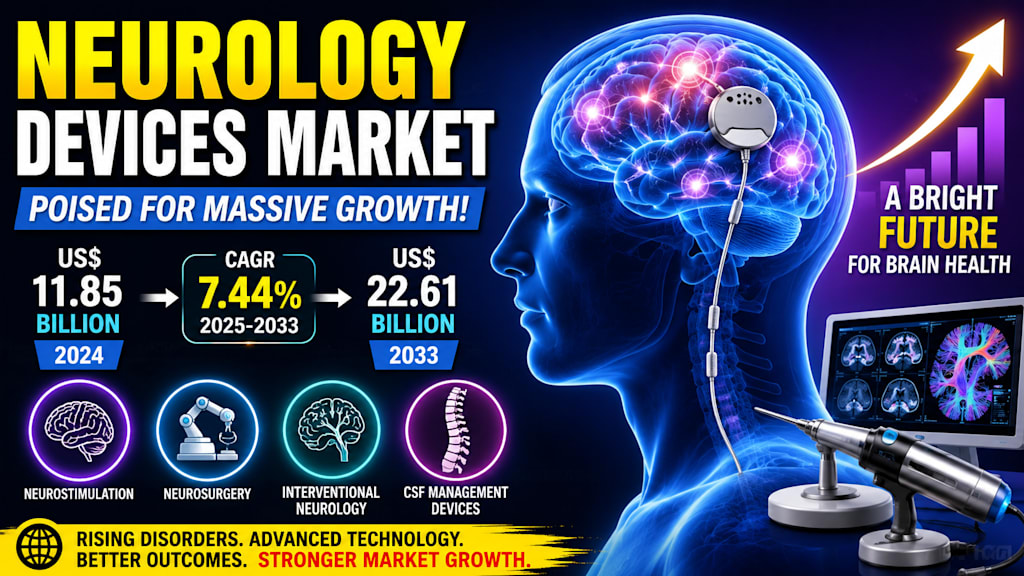
The global neurology devices market is entering a transformative era as healthcare systems worldwide increase their focus on neurological disorders, advanced brain monitoring technologies, and minimally invasive treatment solutions. According to Renub Research, the Global Neurology Devices Market is projected to rise from US$ 11.85 billion in 2024 to US$ 22.61 billion by 2033, growing at a CAGR of 7.44% during the forecast period from 2025 to 2033.
The growing burden of neurological diseases such as Alzheimer’s disease, Parkinson’s disease, epilepsy, dementia, stroke, and multiple sclerosis is becoming one of the strongest growth drivers for the market. Healthcare providers are increasingly adopting sophisticated neurology devices to improve diagnosis, treatment precision, patient monitoring, and long-term disease management.
Neurological disorders are no longer considered isolated healthcare concerns. They are rapidly becoming one of the most significant global public health challenges. According to international health estimates, nearly one billion people worldwide are affected by neurological conditions. This dramatic increase in patient volume is creating substantial demand for neurostimulation systems, neurosurgical equipment, interventional neurology tools, and advanced cerebrospinal fluid management devices.
One of the biggest reasons behind the market’s rapid expansion is technological advancement. Modern neurology devices are becoming more intelligent, connected, and minimally invasive. Artificial intelligence, robotic-assisted surgery, wearable monitoring systems, and brain-computer interfaces are reshaping neurological treatment across hospitals and specialty care centers.
Medical device companies are investing aggressively in digital healthcare ecosystems that allow physicians to remotely monitor patient progress in real time. Remote neurology care became especially important after the global rise of telemedicine and digital health adoption.
For example, Abbott introduced an upgraded version of its NeuroSphere myPath digital health application designed to help physicians closely monitor patients using spinal cord stimulation and dorsal root ganglion therapy systems. These digital tools improve communication between patients and physicians while helping clinicians optimize treatment outcomes more efficiently.
Another major growth catalyst is the rapidly expanding elderly population. Aging significantly increases the risk of neurological diseases, particularly Alzheimer’s disease, dementia, Parkinson’s disease, and stroke-related complications. As life expectancy rises globally, healthcare systems are preparing for a much larger neurological patient population.
The World Health Organization estimates that by 2050, approximately 426 million people worldwide will be aged 80 years or older. This demographic shift is expected to dramatically increase demand for neurology devices and specialized neurological care infrastructure.
The market is also benefiting from increased awareness regarding neurological health. Earlier diagnosis and improved screening programs are encouraging patients to seek treatment before neurological disorders become severe. Hospitals and ambulatory surgery centers are adopting advanced neuroimaging and neuro-monitoring systems to provide faster and more accurate diagnoses.
Neurostimulation technology is emerging as one of the most exciting segments within the industry. These devices use electrical impulses to treat chronic pain, epilepsy, movement disorders, and other neurological conditions. Deep brain stimulation and spinal cord stimulation therapies are gaining strong acceptance because they offer minimally invasive alternatives to traditional surgical treatments.
In April 2024, Medtronic received FDA approval for its Inceptiv closed-loop spinal cord stimulator. The device automatically adjusts stimulation levels in real time by sensing biological signals from the patient’s body. This next-generation technology represents a major breakthrough in personalized neurological treatment and demonstrates how intelligent automation is shaping the future of medical devices.
The neurosurgery devices segment is also witnessing rapid innovation. Robotic-assisted neurosurgical systems are helping surgeons perform highly precise operations with reduced complications and faster patient recovery times. Improved imaging technologies and navigation systems are making brain and spinal procedures safer and more efficient.
Interventional neurology is another growing area within the market. Minimally invasive procedures used to treat aneurysms, arteriovenous malformations, and stroke are becoming increasingly common. In the United States, aneurysm coiling procedures continue to gain momentum because they reduce surgical trauma and improve recovery outcomes.
According to data highlighted in the market analysis, approximately 6.8 million Americans are estimated to have a brain aneurysm, while more than 30,000 people experience ruptured brain aneurysms every year in the United States alone. Such alarming figures continue to increase demand for advanced neurological intervention technologies.
North America currently dominates the global neurology devices market due to its sophisticated healthcare infrastructure, high healthcare expenditure, and strong research capabilities. The United States remains the leading regional market because of rapid technological adoption and the presence of major medical device manufacturers.
American healthcare providers are increasingly integrating artificial intelligence into neurological diagnosis and treatment systems. AI-powered imaging analysis, predictive monitoring systems, and data-driven neurological care platforms are improving clinical efficiency and patient outcomes.
Europe also remains a significant contributor to global market growth. Countries such as the United Kingdom, Germany, and France are heavily investing in neurological research and healthcare innovation. Demand for wearable neuro-monitoring systems and minimally invasive neurological procedures is rising steadily across European healthcare facilities.
The United Kingdom’s neurology devices market is benefiting from government-supported healthcare research initiatives and growing awareness regarding neurological disorders among aging populations. Hospitals are increasingly adopting robotic-assisted neurosurgery systems and advanced neuroimaging equipment to improve treatment quality.
Meanwhile, the Asia-Pacific region is expected to emerge as one of the fastest-growing neurology devices markets during the forecast period. Countries such as China, India, Japan, and South Korea are experiencing rising rates of neurological disorders due to aging populations, changing lifestyles, and increasing healthcare accessibility.
India, in particular, presents strong growth opportunities for neurology device manufacturers. Rising healthcare investments, improving hospital infrastructure, and increasing awareness regarding neurological diseases are helping drive market expansion. However, affordability remains a major challenge in many developing economies.
Despite its impressive growth outlook, the global neurology devices market still faces several important obstacles. One of the biggest concerns is the high cost of neurological equipment and associated procedures. Advanced devices such as robotic surgical systems, neurostimulators, and sophisticated brain imaging platforms require significant financial investment.
Many healthcare facilities in developing countries struggle to adopt these technologies because of limited budgets and insufficient infrastructure. The cost burden also affects patients, especially in regions where insurance coverage and reimbursement policies remain weak.
Limited reimbursement frameworks continue to create barriers to widespread adoption. In several countries, advanced neurological treatments are either partially covered or not reimbursed at all. This creates financial pressure on both hospitals and patients, slowing the adoption of cutting-edge technologies.
Another challenge is the shortage of highly trained neurological specialists and technicians capable of operating advanced neurology systems. Emerging economies especially face workforce limitations that may slow market penetration in rural and underserved areas.
However, industry experts believe that continuous innovation, strategic collaborations, and increasing public-private investments will gradually address many of these barriers. Medical device manufacturers are increasingly partnering with research institutions and healthcare providers to develop affordable and accessible neurological technologies.
The future of the neurology devices market looks highly promising as digital healthcare, artificial intelligence, wearable devices, and precision medicine continue to evolve. The industry is expected to witness rapid innovation across neuro-monitoring, neurostimulation, and minimally invasive surgical technologies.
As neurological disorders become more prevalent globally, healthcare systems are prioritizing faster diagnosis, improved treatment accuracy, and long-term patient care. Neurology devices are therefore becoming essential components of modern healthcare infrastructure.
With growing investments, expanding research activities, and increasing demand for advanced neurological care, the neurology devices market is positioned to become one of the most dynamic sectors within the global medical technology industry over the next decade.
10 Recent Developments by Leading Companies
Medtronic received FDA approval in 2024 for its Inceptiv closed-loop spinal cord stimulator featuring real-time adaptive stimulation technology.
Abbott expanded its NeuroSphere myPath digital platform with advanced patient monitoring and remote therapy management capabilities.
Boston Scientific strengthened its neurostimulation portfolio through innovations in chronic pain management systems.
Stryker Corporation continued expanding robotic-assisted neurosurgery technologies for precision-based neurological procedures.
Johnson & Johnson invested in advanced neurological imaging and minimally invasive surgical systems.
B. Braun Melsungen AG increased its focus on cerebrospinal fluid management devices and neurosurgical solutions.
Smith & Nephew accelerated innovation in minimally invasive surgical tools for neurological interventions.
MicroPort Scientific Corporation expanded its presence in neurovascular intervention technologies across Asian markets.
Several leading manufacturers introduced AI-integrated diagnostic platforms to improve neurological disease detection accuracy.
Major medical device companies increased strategic partnerships with hospitals and research institutes to accelerate next-generation neurology device development.
Final Thoughts
The neurology devices market is rapidly evolving into one of the most innovation-driven sectors in global healthcare. Rising neurological disease prevalence, aging populations, digital healthcare integration, and minimally invasive treatment demand are reshaping the industry landscape.
Although challenges such as high device costs and reimbursement limitations remain, continuous technological progress and growing healthcare investments are expected to sustain long-term market expansion. Companies capable of delivering affordable, intelligent, and patient-centric neurological solutions are likely to emerge as major winners in the coming decade.
As brain health becomes an increasingly important healthcare priority worldwide, neurology devices will continue playing a critical role in improving diagnosis, treatment outcomes, and quality of life for millions of patients globally.
About the Creator
Enjoyed the story? Support the Creator.
Subscribe for free to receive all their stories in your feed.
Comments
There are no comments for this story
Be the first to respond and start the conversation.