
Netherlands Tactical Communication Market: How a Small NATO Nation Is Running One of Europe's Most Ambitious Military Modernization Programs
8,000 vehicles, 135 naval vessels, 170 aircraft — the Netherlands tactical communication market is growing at 8.9% annually and the USD 1.42 billion FOXTROT programme is just the beginning

The Netherlands is a country of 17 million people with a military budget that places it seventh among 32 NATO members by total defence spending. It is not a nation most people associate with cutting-edge military technology procurement. Yet right now, the Royal Netherlands Armed Forces are running one of the most technically ambitious tactical communication modernization programs in the entire NATO alliance — a program that is simultaneously retrofitting 8,000 military vehicles, 135 naval vessels, and 170 aircraft with next-generation encrypted radio systems under a single coordinated procurement framework.
That program is called FOXTROT. And it is the primary driver behind a defence technology market transformation that most civilian analysts have not yet noticed.
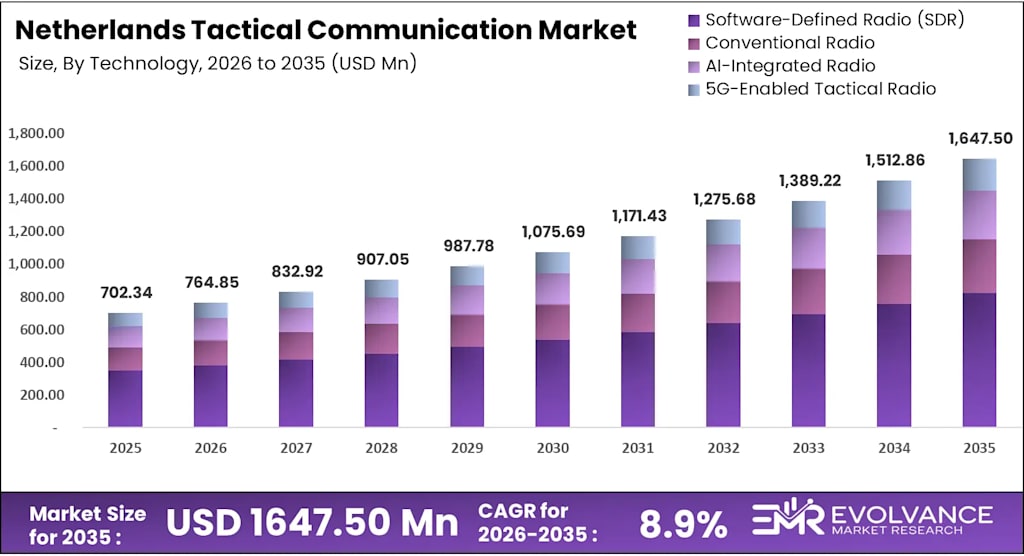
The Netherlands tactical communication market size was valued at USD 702.34 million in 2025 and is projected to reach USD 1,647.50 million by 2035, growing at a CAGR of 8.9%. The FOXTROT tactical digitization programme — valued between EUR 1 billion and EUR 2.5 billion — drives a sustained multi-year demand pull that gives vendors with multi-domain communication capabilities a structural advantage over single-platform suppliers. For defence contractors, procurement specialists, and strategic investors who need the complete analytical picture — covering radio types, platforms, frequency bands, technologies, security levels, and procurement pathways through 2035 — the full research is documented in the Netherlands tactical communication market report from Evolvance Market Research.
Netherlands Tactical Communication Market Size and Growth
The scale of Dutch defence investment is larger than most observers realize. PwC and Strategy analysis projects the Netherlands' cumulative defence equipment spend at approximately EUR 62 billion over 2025 to 2030 — with roughly EUR 41 billion addressable by manufacturers. The COMMIT directorate managing communication and IT systems held a 2024 budget of EUR 864.08 million, representing 4% of total Ministry of Defence spend. IT systems investment reached EUR 1.23 billion — 13% of the entire Defence Equipment Budget Fund.
The single largest contract on record in Dutch tactical communication history was the USD 1.42 billion Foreign Military Sale package approved by the US Defense Security Cooperation Agency for the FOXTROT programme. That package covers all five Dutch military radio types — manpack, handheld, vehicle-mounted, base station, and airborne — with encrypted, cyber-hardened Falcon IV Software-Defined Radio systems from L3Harris. The simultaneous five-domain requirement structure of the Dutch procurement distinguishes it from all comparable European NATO programmes and signals the Netherlands' ambition to achieve full joint communication interoperability across every operational domain simultaneously rather than sequentially.
Netherlands Tactical Communication Market Trends: Software-Defined Radio Leads
Software-Defined Radio dominates the technology segment — and the FOXTROT programme's selection of Falcon IV SDR across all five Dutch military radio types confirms SDR as the mandatory baseline for Dutch tactical communication procurement through the forecast period.
The strategic rationale for SDR is compelling. Traditional hardware-defined radios are fixed to specific frequency bands and waveforms at manufacture — any capability upgrade requires physical hardware replacement. Software-defined radios can be updated through software to support new waveforms, new frequency bands, and new encryption standards without hardware changes. In an operational environment where electronic warfare capabilities are evolving rapidly and NATO interoperability standards are continuously updated, the ability to upgrade radio capability through a software patch rather than a procurement cycle is a genuine strategic advantage.
AI-integrated radio is the technology segment showing the fastest growth trajectory through 2035. AI-driven spectrum management — which automatically identifies and avoids jammed frequencies, optimizes transmission power, and adapts waveform selection to current threat environments — is moving from experimental to operational deployment across NATO member procurement programs. The Netherlands, as one of NATO's most technically sophisticated defence procurement agencies, is positioned at the leading edge of AI radio adoption within the alliance.
5G-enabled tactical radio is the emerging technology category that will reshape the market most significantly in the second half of the forecast period. The integration of commercial 5G network architecture with military tactical radio systems enables data rates and latency performance that previous generation tactical networks could not achieve — enabling real-time ISR data sharing, autonomous system command and control, and joint all-domain operations concepts that depend on high-bandwidth, low-latency tactical connectivity.
Netherlands Tactical Communication Market Segments: Army Drives Volume
The Army leads the application segment — anchored by FOXTROT's approximately 8,000-vehicle modernization target, which represents the largest platform group by unit count in Dutch tactical procurement. Vehicle-mounted installation leads the By Installation Type segment for the same reason — the systematic SDR retrofit of the Dutch ground vehicle fleet is the single largest procurement action driving market volume through the first half of the forecast period.
Manpack radio leads the By Type segment, serving 3,500 dismounted personnel under the FOXTROT procurement framework. The combination of vehicle-mounted and manpack deployment creates a seamless ground force communication network where every soldier on foot and every vehicle in the fleet operates on the same encrypted SDR waveforms with full interoperability — a capability that the Netherlands' previous generation radio systems could not deliver.
VHF leads the By Frequency Band segment as the NATO STANAG-compliant baseline for all Dutch ground force procurement tenders. Multi-band capability — which allows a single radio to operate across VHF, UHF, HF, and SHF bands — is the emerging standard for higher-tier systems where operational flexibility across terrain types and mission profiles requires frequency agility that single-band radios cannot provide.
The Naval segment presents a different procurement profile — 135 vessels requiring integrated tactical communication systems that maintain interoperability with allied naval forces while managing the unique electromagnetic environment of maritime operations. The Royal Netherlands Navy's participation in NATO Standing Naval Forces and Combined Task Force operations creates specific interoperability requirements that drive procurement toward NATO-standardized systems with certified interoperability credentials.
Netherlands Tactical Communication Market Procurement: FMS Leads
Foreign Military Sale leads the By Procurement Pathway segment — representing the single largest Dutch tactical communication contract on record through the USD 1.42 billion DSCA package. FMS procurement through US defence channels gives the Netherlands access to the most advanced certified-export communication systems available while maintaining alignment with US and NATO alliance interoperability standards.
Direct Commercial Sale and NATO government-to-government procurement pathways serve the secondary and niche procurement requirements outside the FOXTROT framework. European defence industry participation — through companies like Thales Netherlands and Elbit Systems of America — competes for the portions of the procurement where European preference or industrial participation requirements create space outside the FMS framework.
Key Players in the Netherlands Tactical Communication Market
L3Harris holds the dominant position through the FOXTROT programme's selection of its Falcon IV SDR family — a contract that provides multi-year revenue certainty and positions L3Harris as the incumbent platform vendor for Dutch tactical communication through the forecast period. Maintaining that position requires continuous software capability upgrades and responsive in-country support infrastructure that competitors will find difficult to displace.
Thales Netherlands participates through its position in naval communication systems and its established relationship with the Dutch defence procurement community built over decades of programme delivery. Harris Corporation's integration into L3Harris has created a combined entity with the breadth of capability across ground, naval, and airborne communication domains that the Netherlands' simultaneous five-domain requirement demands.
FOXTROT is not the end of the Netherlands tactical communication story. It is the foundation on which AI-integrated, 5G-enabled joint communication capability will be built through the second half of this decade.
About the Creator
Suge kun
Research Analyst passionate about data & market insights. I turn complex information into clear, actionable strategies. Detail-driven & results-focused — helping businesses make smarter decisions. — Suge Kun
Enjoyed the story? Support the Creator.
Subscribe for free to receive all their stories in your feed.
Comments
There are no comments for this story
Be the first to respond and start the conversation.