
Natural Food Colors Market Expands as Clean Label Demand and Plant-Based Innovation Reshape the Global Food Industry
Rising health awareness, stricter regulations on synthetic additives, and growing demand for clean-label products are accelerating the adoption of natural food colors worldwide.

Market Overview
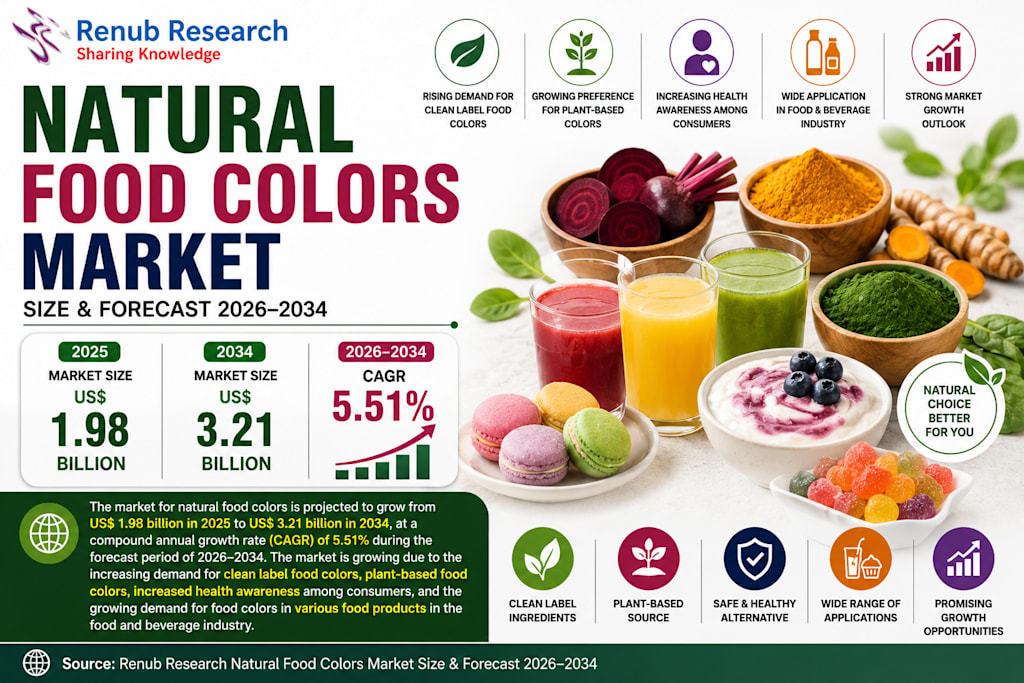
The global natural food colors market is witnessing strong growth as consumers increasingly demand healthier, safer, and more transparent food products. Food manufacturers worldwide are shifting away from artificial additives and embracing plant-based ingredients to align with changing consumer preferences and stricter food safety regulations. According to Renub Research, the natural food colors market is expected to grow from US$ 1.98 billion in 2025 to US$ 3.21 billion by 2034, registering a CAGR of 5.51% during 2026–2034.
Natural food colors are pigments derived from fruits, vegetables, plants, minerals, and microorganisms that are used to enhance or restore the appearance of food and beverages. Common natural coloring ingredients include carotenoids from carrots and tomatoes, anthocyanins from berries, chlorophyll from green plants, turmeric, paprika, beetroot extract, and spirulina. Unlike synthetic colors, natural food colors are widely recognized for their safety, plant-based origin, and environmentally friendly characteristics.
The growing awareness surrounding health and wellness is one of the biggest factors driving the industry forward. Consumers today are paying closer attention to ingredient labels and actively avoiding artificial colors due to concerns about long-term health effects. Clean-label products are becoming a major purchasing preference globally, especially among younger consumers and health-conscious families. This shift is encouraging food and beverage manufacturers to reformulate products using naturally sourced ingredients.
The market is also benefiting from the broader rise of organic, vegan, and plant-based food products. Natural food colors fit perfectly within these categories because they align with consumer expectations regarding sustainability, transparency, and ingredient purity. Food manufacturers are increasingly using natural colors across beverages, bakery products, confectionery, dairy products, processed foods, and meat alternatives to improve visual appeal while maintaining clean-label positioning.
Growth Drivers
One of the most powerful growth drivers in the natural food colors market is rising consumer demand for clean-label products. Modern consumers are becoming increasingly aware of the ingredients used in their food products and are actively seeking foods free from artificial additives and preservatives. According to data released in July 2024, nearly 75% of global consumers are willing to pay a premium for clean-label products, especially products free from artificial colors.
Consumers now associate natural ingredients with trust, quality, and safety. As awareness regarding the possible side effects of synthetic additives increases, food and beverage companies are reformulating products to include plant-based alternatives. This trend is especially visible in beverages, confectionery, dairy products, and premium packaged foods where visual appeal remains highly important. Manufacturers are therefore investing heavily in natural food coloring technologies to meet evolving consumer expectations.
Stringent government regulations regarding artificial food additives are also accelerating market growth. Regulatory authorities in North America and Europe have introduced stricter controls on synthetic food colors due to concerns regarding consumer health and safety. As a result, food manufacturers are increasingly switching toward approved natural alternatives.
According to the International Food Information Council (IFIC), more than 60% of consumers actively avoid artificial colors, while terms such as “natural” and “organic” strongly influence purchasing decisions. This changing consumer mindset is reshaping product development strategies across the global food and beverage industry. Companies are now prioritizing natural ingredient sourcing, sustainable production, and plant-based formulations to remain competitive in the market.
The expansion of the food and beverage industry itself is another important growth factor. Urbanization, changing lifestyles, increasing disposable income, and rising demand for packaged foods are boosting the need for visually attractive food products. Food colors play a critical role in product presentation, especially in categories such as bakery products, beverages, dairy, confectionery, snacks, and functional foods.
Natural food colors are also becoming increasingly important in the growing plant-based food industry. As vegan and meat-alternative products gain popularity, manufacturers require natural coloring solutions capable of creating visually appealing textures and appearances without relying on synthetic ingredients. This trend is significantly expanding the application range for natural food colors globally.
In February 2025, Oterra, a global leader in natural food colors, inaugurated a new blending and application center in Kochi, Kerala, India. The facility was designed to support increasing demand for natural food colors across India, Asia-Pacific, and the Middle East, highlighting the growing commercial importance of the industry.
Market Challenges
Despite strong growth potential, the natural food colors industry continues to face several important challenges. One of the biggest issues is product stability and shelf-life limitations. Natural food colors are often more sensitive to environmental factors such as heat, light, oxygen exposure, and pH changes compared to synthetic alternatives.
This instability can lead to fading, discoloration, or changes in texture during processing and storage, creating difficulties for food manufacturers trying to maintain consistent product appearance. To overcome these challenges, companies must invest in advanced extraction methods, stabilization technologies, and improved formulation systems, which increases production costs.
High production costs represent another major challenge for the market. Extracting natural pigments from fruits, vegetables, and plant sources is a complex process involving cultivation, harvesting, purification, and processing. Seasonal variations, climate conditions, and agricultural supply constraints can additionally impact raw material availability and pricing.
Natural colors also often require higher quantities to achieve the same intensity as synthetic alternatives, adding further cost pressure for manufacturers. Small and medium-sized food companies may find it difficult to absorb these additional expenses while maintaining competitive pricing. Although consumer demand for natural ingredients continues rising, balancing affordability with quality remains a major challenge within the industry.
Lycopene Natural Food Colors Market
The lycopene natural food colors segment is growing steadily because of increasing interest in plant-based and health-focused food ingredients. Lycopene, a red-colored carotenoid primarily derived from tomatoes and other red fruits, is widely used in beverages, sauces, dairy products, and processed foods.
In addition to its coloring properties, lycopene is associated with potential health benefits linked to antioxidant activity and chronic disease prevention. The clean-label movement is therefore encouraging manufacturers to use lycopene as a natural alternative to synthetic red dyes. Advances in extraction technologies are further improving its commercial viability across multiple food categories.
Carmine Natural Food Colors Market
Carmine continues to hold a significant position within the natural food colors industry due to its ability to produce stable and intense red shades. Derived from cochineal insects, carmine is commonly used in beverages, confectionery, dairy products, and cosmetics.
Its excellent stability under heat and light exposure makes it valuable for food applications requiring durable coloration. However, ethical concerns regarding insect-derived ingredients and increasing demand for vegan products present challenges for long-term market expansion within this segment.
Beverages Natural Food Colors Market
The beverage industry represents one of the fastest-growing application areas for natural food colors. Soft drinks, fruit juices, energy drinks, alcoholic beverages, and functional drinks increasingly rely on natural colors to improve product appearance while supporting clean-label claims.
Consumers are increasingly demanding beverages made with natural ingredients, encouraging beverage companies to replace synthetic additives with plant-based alternatives. Functional beverages containing antioxidants, vitamins, and wellness-focused ingredients are particularly driving demand for naturally sourced colors. However, maintaining color stability under varying pH conditions remains a technical challenge for beverage manufacturers.
Bakery & Confectionery Natural Food Colors Market
The bakery and confectionery segment is growing rapidly as manufacturers seek visually appealing products made with natural ingredients. Natural colors are widely used in cakes, pastries, candies, chocolates, and icings to improve product presentation and support premium branding strategies.
The popularity of artistic baked goods, customized desserts, and themed confectionery products is further boosting demand for vibrant and stable natural coloring agents. Manufacturers are also investing in heat-stable natural colors capable of withstanding baking temperatures without fading or degrading.
Natural Food Colors Meat Products Market
The use of natural food colors in meat products is expanding as manufacturers attempt to improve visual appeal while maintaining clean-label positioning. Natural colors such as beetroot extract and paprika are commonly used in sausages, deli meats, and cured products to preserve desirable red and pink shades.
Growing consumer preference for natural ingredients is encouraging meat processors to reduce reliance on synthetic additives. However, challenges related to color stability during storage, oxygen exposure, and heat processing remain significant for this application segment.
United States Natural Food Colors Market
The United States natural food colors market is growing rapidly because of strong consumer awareness regarding health and wellness. Consumers are increasingly shifting away from synthetic additives and demanding food products made with natural ingredients. The country’s large food and beverage industry, combined with strong regulatory oversight regarding artificial additives, is supporting market expansion.
In December 2024, Oterra opened a major innovation, collaboration, and production facility in Mount Pleasant, Wisconsin. The 155,000-square-foot center includes advanced innovation, manufacturing, and logistics capabilities designed to support growing demand for natural food colors across the United States market.
United Kingdom Natural Food Colors Market
The United Kingdom market continues growing steadily due to strong consumer demand for transparent and healthy food products. Strict regulations regarding artificial additives and the increasing popularity of vegan diets are encouraging manufacturers to adopt natural coloring solutions.
In July 2024, GNT announced plans to develop plant-based EXBERRY color solutions using advanced fermentation technologies in partnership with UK-based startup Plume Biotechnology. The initiative reflects growing industry focus on sustainability and innovation within natural food color production.
India Natural Food Colors Market
India’s natural food colors market is expanding significantly because of rising health awareness, urbanization, increasing disposable income, and strong growth within the processed food industry. Plant-derived ingredients such as turmeric, spinach, and beetroot are increasingly used in packaged food products across the country.
Government focus on food quality and safety standards is additionally supporting market growth. In February 2025, Oterra inaugurated a new blending and application center in Kerala to support increasing regional demand for natural food colors.
Saudi Arabia Natural Food Colors Market
Saudi Arabia’s natural food colors market is growing steadily due to changing lifestyles, increasing health awareness, and rising demand for clean-label food products. Urbanization and expansion of the food and beverage sector are boosting adoption of natural colors across beverages, confectionery, and processed food categories.
Government efforts to improve food safety standards are also encouraging food manufacturers to move toward natural ingredients despite challenges related to import dependency and pricing pressures.
Recent Developments Companies in Vocal Format
- Oterra opened a major innovation and production facility in Wisconsin to support rising demand for natural food colors.
- Oterra inaugurated a new blending and application center in Kerala, India, to expand regional supply capabilities.
- GNT partnered with Plume Biotechnology to develop fermentation-based EXBERRY natural color solutions.
- International Flavors & Fragrances Inc. continues expanding clean-label ingredient solutions across food categories.
- Symrise AG remains focused on plant-based color innovation and sustainable ingredient development.
- Chr Hansen Holding A/S continues investing in natural pigment technologies for clean-label applications.
- Ingredion Inc. is strengthening its portfolio of naturally sourced food ingredients and specialty starches.
- BASF SE remains active in carotenoid and nutritional ingredient development for food applications.
- Archer Daniels Midland continues supporting natural ingredient supply chains for food manufacturers globally.
- McCormick Company remains focused on natural flavor and coloring solutions aligned with consumer wellness trends.
Segment Outlook
The natural food colors market is segmented by ingredient into beta-carotene, lycopene, curcumin, anthocyanin, carmine, copper chlorophyllin, paprika, betanin, riboflavin, blue spirulina, caramel, annatto, and other natural pigments.
By application, the market serves bakery and confectionery, beverages, dairy and frozen products, meat products, oils and fats, fruits and vegetables, plant-based meat alternatives, and pet food industries. Beverages and bakery products remain among the fastest-growing application categories due to strong demand for clean-label and visually attractive food products.
Final Thoughts
The global natural food colors market is becoming a critical part of the broader clean-label and plant-based food movement. Rising health awareness, stricter regulations on artificial additives, and growing consumer demand for transparency are transforming ingredient sourcing strategies across the food and beverage industry. Renub Research’s projection of US$ 3.21 billion by 2034 highlights the strong long-term opportunity for companies focused on natural, sustainable, and innovative food coloring solutions. Businesses that successfully balance color performance, stability, affordability, and clean-label positioning are expected to lead the future of the natural food colors industry.
About the Creator
Enjoyed the story? Support the Creator.
Subscribe for free to receive all their stories in your feed.
Comments
There are no comments for this story
Be the first to respond and start the conversation.