
Most of the Threads in Neuralink's First Implant Pulled Back. Here's Why It Still Worked.
A coin-sized implant, 1,024 electrodes, and a chip that has to compress brain signals before they leave the skull. The hard part isn't reading thoughts. It's surviving inside a living brain.

Editorial note: I use AI tools to assist with research, drafting, fact-checking, and editing. The analysis, opinions, engineering interpretation, and final editorial decisions are my own.
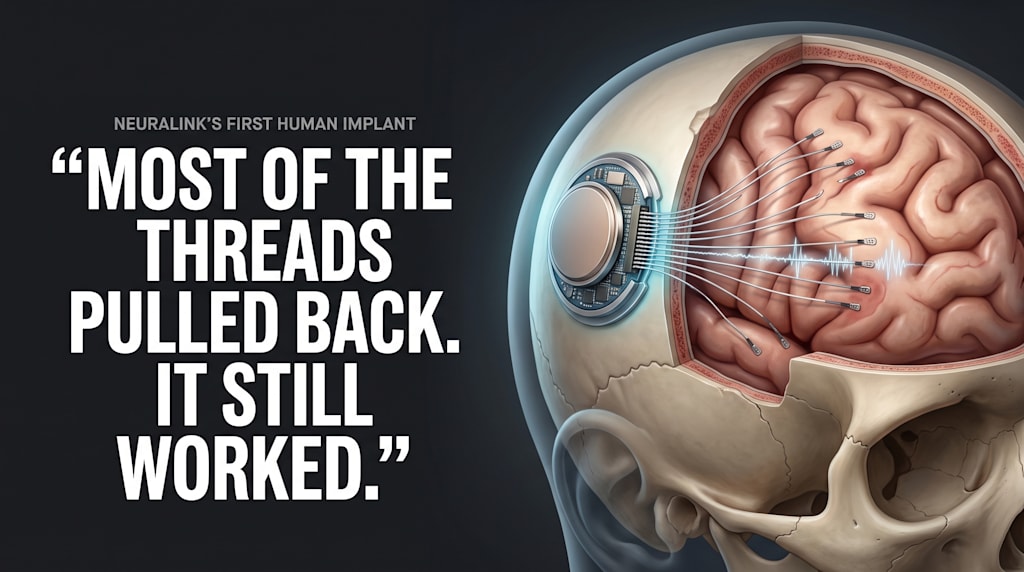
Within weeks of Neuralink's first human implant, many of the device's electrode threads had pulled back from the brain tissue they were placed in. Neuralink confirmed that "a number" of threads had retracted. The patient later put the figure at roughly 85 percent.
And the patient kept using it.
Noland Arbaugh, paralyzed from the shoulders down since a diving accident eight years earlier, had already moved a computer cursor with nothing but intent. When the threads retracted, his performance dropped. Neuralink changed the software that interprets his brain signals, and performance came back.
That sequence, hardware degrading while software compensates, says more about where brain-computer interfaces really stand than any launch event. It's also the part most coverage skips.
I've spent more than 20 years in PCB and electronics manufacturing. The headlines about Neuralink tend to be about mind-reading, Elon Musk, or the future of humanity. What I see is a hardware problem: electronics that have to capture tiny electrical signals, process them, and send them out wirelessly, all while sealed inside a skull and surrounded by tissue that is actively trying to reject them.
Here's what that hardware actually does, and where it's still struggling.
It doesn't read thoughts. It reads voltage.
A brain-computer interface, or BCI, doesn't decode thoughts in any mystical sense. It measures electricity.
Neurons communicate by moving ions across their membranes. When one fires, it produces a brief voltage spike called an action potential. It lasts about a millisecond and is on the order of 100 millivolts at the source, but it fades quickly with distance. A BCI's job is to detect those spikes, recognize patterns in them, and translate the patterns into a command, like moving a cursor to the left.
That sounds simple until you look at the distances involved. Neuralink's 2019 paper sets a design target of placing electrodes within about 60 microns of the neurons they're meant to record (Musk & Neuralink, Journal of Medical Internet Research, 2019). Sixty microns is about two-thirds the width of a human hair. Much farther than that, and the signal starts to disappear into noise.
Now multiply that by 1,024 electrodes, placed inside a living brain that moves with every heartbeat. If you picture a "brain chip" as something like a USB stick, this is where the picture breaks down. It's a precision signal-capture problem, at tolerances most fabrication shops would consider demanding, in a material that bleeds, shifts, and tries to wall off anything foreign.
The implant: a coin, and a lot of very thin wire
The N1 implant measures 23 mm × 8 mm, according to Neuralink's PRIME Study documentation (ClinicalTrials.gov, NCT06429735; PRIME Study brochure). It's about the size of a large coin and sits flush with the skull, so it can't be seen once it's in place.
The coin isn't where the sensing happens. That job belongs to the flexible threads that extend from it into the brain. Neuralink's 2019 paper puts thread width at 4 to 6 µm, roughly a tenth to a twenty-fifth the width of a human hair.
Arbaugh's implant used 64 threads with 16 electrodes on each. Several outlets, including TechTimes, have since reported that later patients received 128 thinner threads with 8 electrodes each, keeping the same 1,024 total. Neuralink hasn't published a peer-reviewed specification for that change, so treat it as reported rather than confirmed. The direction would make engineering sense, though. In principle, thinner threads could reduce mechanical disruption during insertion and potentially reduce the resulting tissue response.
Why does electrode count matter? It's a sampling problem. More electrodes record more neurons at once, which gives the decoding software more information about what the user intends. My read, and this is an engineering inference rather than a documented threshold, is that 1,024 channels give enough redundancy to capture population-level activity in the motor cortex, so losing a single thread doesn't collapse the whole signal. Arbaugh's case suggests the system can survive much larger losses than that, though not without help from the software.
The chip nobody talks about
Most Neuralink explainers spend paragraphs on the electrodes and a sentence on the chip. That's backward. The chip is where some of the most demanding electrical engineering happens.
The implant's custom chip, an application-specific integrated circuit or ASIC, amplifies the raw analog signals from the electrodes, converts them to digital data, and processes them before anything leaves the skull. Neuralink's 2019 paper describes it this way: "The on-chip ADC samples at 19.3 kHz with 10-bit resolution. Each analog pixel consumes 5.2 µW, and the whole ASIC consumes approximately 6 mW, including the clock drivers."
One caveat matters here. Those figures come from Neuralink's 2019 prototype-era publication, which described a different system from the one now implanted in patients (more on that below). No public source confirms these exact numbers for today's clinical N1. They may be the same. They may not. What they do show is the architecture Neuralink built its approach on.
Put 19.3 kHz in plain terms: 19,300 voltage readings per second, per channel, across every active electrode. That's far more raw data than a small wireless link can carry on a small battery. So the chip doesn't send raw data. It runs a spike-detection algorithm first and transmits what matters.
At Neuralink's 2019 launch event, engineer DJ Seo said that algorithm achieves more than 200× compression in around 900 nanoseconds. That's a company statement, not a peer-reviewed result, so it deserves some caution. But the broader point holds whatever the exact ratio turns out to be. Given the channel count, sampling rate, wireless bandwidth, and power budget, heavy compression inside the implant is unavoidable. You can't stream uncompressed broadband neural data out of a skull on a practical battery. Compression is what makes the device possible.
Power and heat: the constraints you can't negotiate
The 6 mW figure needs to be read precisely. It's the power draw of the ASIC itself, as described in the 2019 paper. It isn't the power budget of the whole implant, which also includes a battery, a wireless charging receiver, and radio electronics. Neuralink hasn't published a total power figure for the N1.
What is well established, across implantable neural devices generally, is that heat is a hard limit. Warming the tissue around an implant is a serious safety concern, and the neural-engineering literature discusses allowable temperature rise in very small margins. Neuralink hasn't disclosed the N1's specific thermal budget, but that general constraint is why every milliwatt inside the implant matters. In most electronics, power efficiency is about battery life. Here, it's about patient safety.
The robot, and why hands aren't enough
Threads 4 to 6 µm wide have to be placed into moving tissue, at speed, while avoiding blood vessels. At those widths, repeatable placement becomes a precision-automation problem as much as a surgical one. Neuralink's approach is therefore built around robotic insertion rather than manual placement.
Neuralink's R1 robot inserts each thread with a needle much thinner than a human hair, placing threads into a moving brain while avoiding blood vessels (New Atlas, reporting Neuralink's 2022 update). The newer version of the robot unveiled in 2026 uses a five-axis system and navigates in real time with cameras and OCT scanners (Interesting Engineering, April 2026). Damaging a vessel means bleeding, inflammation, and lost signal.
People with a manufacturing background, me included, instinctively compare this to PCB fabrication, where high-density interconnect (HDI) boards routinely involve features under 50 µm. The comparison is useful but incomplete. PCB fabrication happens in rigid, stable materials where every parameter is controlled. The R1 works in living tissue that pulses with each heartbeat, varies in stiffness from patient to patient and region to region, and has vasculature that can't be touched. The tolerances are similar. The environments aren't remotely alike. Biological variability, not the number on the spec sheet, is the real challenge.
The problem nobody has solved
Every foreign object placed in the brain triggers a response. Every one.
Reactive astrocytes and microglia, the brain's support and immune cells, recognize the threads and gradually encase the electrode tips. That encapsulation raises electrical impedance where electrode meets tissue, and signal quality degrades over time. This is glial scarring. Polikov, Tresco, and Reichert mapped the cellular process in a foundational 2005 paper in the Journal of Neuroscience Methods, and it's widely regarded across the field as one of the central long-term challenges for every implantable BCI, not just Neuralink's. The industry has been engineering around it ever since. No one has eliminated it.
Which brings us back to Arbaugh. In May 2024, Neuralink disclosed that "a number of the implant's connective threads retracted from the brain" in the weeks after surgery, reducing the signals the device could capture. The company didn't give a percentage (NBC News). The 85 percent estimate came from Arbaugh himself, in an interview with The Wall Street Journal (Popular Science).
It's also worth being careful about what retraction means. It describes where a thread physically ended up. It doesn't automatically mean every electrode on that thread went dead, and the public record doesn't map one to the other. What is documented is that Neuralink adjusted its decoding algorithm and performance recovered.
I go back and forth on how to read that. The hardware clearly degraded, and that's a serious long-term reliability concern. But a system that takes a major hardware hit and keeps working through software adaptation is arguably more robust than one that fails the moment a thread moves.
Thinner threads, if the reported 128-thread design is confirmed, could reduce the mechanical disruption that sets off the glial response. That would help. It wouldn't solve the problem.
The security question with no public answer
The N1 communicates wirelessly, and any radio link is a potential attack surface.
As of June 2026, Neuralink had published no security architecture for that link. No software bill of materials (an SBOM, the inventory of every software component in a device), no threat model, no disclosed encryption or authentication approach.
The regulatory picture needs to be stated carefully. Under Section 524B of the Federal Food, Drug, and Cosmetic Act, and FDA's cybersecurity guidance updated in February 2026, manufacturers submitting a "cyber device" through the 510(k), PMA, PDP, De Novo, or HDE pathways must include an SBOM, a secure product development framework, and documented threat modeling (FDA cybersecurity overview).
Neuralink's PRIME Study, however, runs under an Investigational Device Exemption. That's a pathway for clinical trials, not one of the marketing pathways those requirements are tied to. So Neuralink isn't necessarily required to produce that full package during the trial. The requirement becomes directly relevant if and when the company files for marketing approval, most likely through a PMA given the device's risk class. The missing public documentation isn't a violation today. It's a real consideration for whatever comes after the trial.
Absence of public documentation also doesn't mean the work hasn't been done. In regulated medical devices, security documentation often exists internally long before it appears publicly. But precedent explains why the question matters. In 2008, Halperin and colleagues demonstrated exploitable wireless vulnerabilities in implantable cardiac devices (IEEE Symposium on Security and Privacy). That doesn't mean Neuralink has the same flaws. It means wireless implant security is an established discipline, and for a device inside a human skull, the public should eventually be able to see how it's handled.
Where things stand
Neuralink has added PRIME Study participants at sites in the US, UK, Canada, and the UAE. Its own public trial materials refer to "multiple participants" without a specific count. Media reports of more than 20 patients haven't been confirmed by a primary source.
In May 2026, Neuralink said its next-generation robot is aimed at brain regions beyond the motor cortex (TechTimes), citing Parkinson's disease, epilepsy, and treatment-resistant depression as future targets. It hasn't published specifications for that system. A separate study, CONVOY, approved in late 2024, is testing whether the implant can control an assistive robotic arm (Neuralink).
To me, the most underappreciated part of this story is the gap between prototype and product. The 2019 paper described a system with 3,072 electrodes on 96 threads, read by 12 ASICs in a 4×3 grid, each handling 256 channels. The device implanted in patients today is a single chip with 1,024 electrodes. That isn't a step backward. It's what engineering looks like: deciding what can be made reliable enough to put inside a person, and shipping that first. If you want to know where the field really is, the shipped hardware tells you more than the ambitious prototype.
What actually matters
A man who hadn't moved his hands in eight years controlled a computer with his brain.
For that to happen, a lot had to go right at once. The electrodes had to be placed precisely enough. The chip had to process signals within a tight power and thermal envelope. The compression had to be fast enough for the wireless link to keep up. And the software had to be flexible enough to keep working after most of the threads had moved.
None of those problems is permanently solved. Glial scarring still degrades signals over time. The wireless security design is still undisclosed. The thread architecture is still changing.
The constraint I'd watch most closely is the one that showed up first: the interface between electronics and living tissue. Chips will keep getting more efficient and robots more precise. Whether the hardware can stay in good contact with the brain for years, not months, is what will decide whether this becomes an everyday medical technology or remains an extraordinary experiment.
The headlines will keep focusing on the vision. The real story is in the hardware.
Sources
Musk, E. & Neuralink. "An Integrated Brain-Machine Interface Platform With Thousands of Channels." Journal of Medical Internet Research, 2019. DOI: 10.2196/16194. PMC6914248
Neuralink PRIME Study Brochure (NCT06429735). neuralink.com/pdfs/PRIME-Study-Brochure.pdf
ClinicalTrials.gov, PRIME Study registration. NCT06429735
Polikov, V.S., Tresco, P.A. & Reichert, W.M. "Response of brain tissue to chronically implanted neural electrodes." Journal of Neuroscience Methods, 2005.
Halperin, D. et al. "Pacemakers and Implantable Cardiac Defibrillators: Software Radio Attacks and Zero-Power Defenses." IEEE Symposium on Security and Privacy, 2008.
U.S. FDA. Cybersecurity in Medical Devices guidance, updated February 2026. fda.gov
U.S. FDA. Section 524B cybersecurity portal. fda.gov
New Atlas. "Neuralink gives a wide-ranging update on its brain chip progress," December 2, 2022. newatlas.com
Interesting Engineering. "Neuralink unveils surgical robot to fully automate brain chip implants," April 30, 2026. interestingengineering.com
TechTimes. "Neuralink BCI After 28 Months: Arbaugh Tells Robotics Summit What Published Research Cannot," May 28, 2026. techtimes.com
TechTimes. "Neuralink Robot Reaches Any Brain Region: Parkinson's, Epilepsy, Depression Now Within Surgical Scope," May 20, 2026. techtimes.com
Neuralink. "PRIME Study Progress Update — User Experience," May 8, 2024 (thread-retraction disclosure). neuralink.com
NBC News. "Implant from Elon Musk's Neuralink suffers setback as threads retract from patient's brain," May 2024. nbcnews.com
Popular Science. "85% of Neuralink implant wires are already detached, says patient" (reporting Arbaugh's interview with The Wall Street Journal), May 21, 2024. popsci.com
Neuralink. "CONVOY Study Launch," November 2024. neuralink.com
Neuralink official trial page. neuralink.com/trials/device-control
ABOUT THE AUTHOR:
About the author: Imran Valiani is a Sales Director in PCB electronics manufacturing with 20+ years of industry experience. He writes about the hardware layer of technology — semiconductors, PCB manufacturing, AI infrastructure, embedded systems, and emerging electronics — at Silicon to Software.
Read more engineering analysis at SiliconToSoftware.com
About the Creator
Imran Valiani
Engineering the hardware behind modern technology. Silicon to Software covers semiconductors, PCBs, AI infrastructure, embedded systems, and emerging hardware — with practical analysis from 20+ years in electronics manufacturing.
Enjoyed the story? Support the Creator.
Subscribe for free to receive all their stories in your feed.
Comments
There are no comments for this story
Be the first to respond and start the conversation.