
Moon Is Ours? Donald Trump’s Lunar Claim Could Trigger a Future Space War
Why Moon’s Water, Helium-3, Rare Earth Elements and Future Space Mining Could Turn the Moon Into the World’s Next Geopolitical Battleground

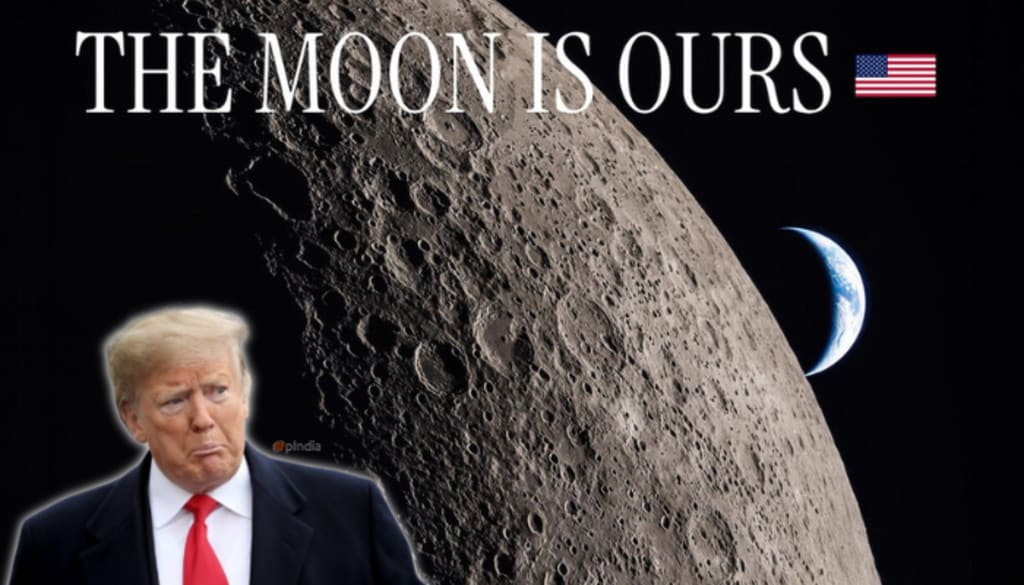
Moon Is Ours? Donald Trump’s Lunar Claim Could Trigger a Future Space War
The Moon has always been a symbol of mystery, imagination and exploration. But in the coming decades, it could become something much more important: one of the most valuable strategic locations beyond Earth.
A recent statement attributed to Donald Trump about the Moon being “ours” raises a much bigger question than whether one political statement can actually change international space law. Could competition over lunar resources eventually turn the Moon into a new geopolitical battleground?
The idea may sound like science fiction, but several developments in space exploration are making it increasingly realistic.
Why the Moon Is Becoming So Important
Humanity first landed on the Moon in 1969 during NASA’s Apollo 11 mission. Neil Armstrong became the first person to walk on the lunar surface, followed by Buzz Aldrin, while Michael Collins remained in lunar orbit.
Between 1969 and 1972, humans landed on the Moon several times and brought lunar material back to Earth for scientific study.
One of the Moon’s most interesting characteristics is its weak gravity. Lunar gravity is roughly one-sixth of Earth’s gravity. That means launching objects from the Moon would require considerably less energy than launching them from Earth.
This could eventually make the Moon a useful stepping stone for deep-space missions.
Instead of launching every spacecraft directly from Earth, future space agencies could potentially use lunar infrastructure as a base for missions heading farther into space.
That possibility alone makes the Moon strategically important.
Chandrayaan-1 and the Discovery of Lunar Water
India played an important role in changing our understanding of the Moon.
The Chandrayaan-1 mission, launched by the Indian Space Research Organisation (ISRO) in 2008, helped provide evidence for water molecules on the lunar surface.
One of the most fascinating areas is the Moon’s permanently shadowed regions, particularly around some polar craters.
Because sunlight does not reach these regions for extremely long periods, temperatures can remain extremely low. Water can exist there in the form of ice.
This discovery changed the way scientists looked at the Moon.
Water is not simply useful for drinking. In space exploration, water can potentially become a source of hydrogen and oxygen.
Through electrolysis, water can be separated into hydrogen and oxygen. Those elements could potentially support life-support systems and, importantly, future rocket propulsion.
Why Lunar Water Could Become a Space-Fuel Resource
Rocket launches from Earth require enormous amounts of energy because spacecraft have to overcome Earth's strong gravity.
The Moon's lower gravity creates a different opportunity.
If future technology allows water ice to be extracted from lunar craters, it could potentially be processed into hydrogen and oxygen. These resources could then be used as propellant for spacecraft.
That would mean future missions might not need to carry all their fuel from Earth.
Instead, the Moon could eventually become a kind of refuelling station for deeper space exploration.
This is one reason the lunar south pole has become such an important target for space agencies around the world.
China’s Chang’e Missions and Lunar Resources
China has also made major progress in lunar exploration.
The Chang'e 5 mission, launched in 2020, successfully collected lunar samples and returned them to Earth.
These samples provide scientists with valuable information about the Moon's geological composition and history.
The continuing study of lunar material has also increased interest in the possibility of using lunar resources in the future.
The Moon contains many elements and minerals that could become strategically important if humans eventually establish permanent infrastructure there.
Among the resources frequently discussed in connection with lunar exploration are titanium, silicon, rare earth elements and other materials.
However, the exact economic value and practicality of mining these resources on an industrial scale remain major technological and financial questions.
The Helium-3 Question
One of the most frequently discussed lunar resources is Helium-3.
Helium-3 is an isotope that exists in very small quantities on Earth but is believed to be present in greater concentrations in lunar soil because of the Moon's long exposure to the solar wind.
Scientists have discussed its potential use in future nuclear fusion concepts.
This is where the Moon's resource story becomes even more interesting.
If fusion technology eventually becomes commercially practical and Helium-3 proves useful at large scale, lunar resources could potentially become strategically valuable.
But there is an important distinction between possibility and reality.
Large-scale Helium-3 mining on the Moon is not currently an established commercial industry, and practical fusion power based on lunar Helium-3 remains a future concept.
The Moon Could Become a Future Technology Hub
Imagine a future where the Moon is no longer simply a place visited by astronauts.
Instead, it could contain permanent research stations, communication infrastructure, solar power systems, manufacturing facilities and fuel-production facilities.
Another possibility is the development of data centres in space.
Modern data centres consume huge amounts of electricity and require substantial cooling infrastructure. If future lunar bases can produce large amounts of reliable power, some specialised computing infrastructure could potentially be established away from Earth.
The Moon's environment could also offer unique advantages for certain scientific and astronomical applications.
Quantum computing is another area sometimes connected to this discussion.
Some quantum computing systems require extremely low temperatures and sophisticated cooling systems. The availability of specialised cryogenic resources could eventually become relevant to advanced computing infrastructure.
These ideas remain futuristic, but they show why lunar infrastructure could become much more than a scientific experiment.
Why Rare Earth Elements Matter
Rare earth elements are another major reason why space resources are attracting attention.
These elements are important for modern technologies, including electronics, renewable-energy systems and advanced manufacturing.
The transcript also highlights the possibility of lunar deposits containing elements such as potassium, phosphorus and rare earth materials.
If economically viable concentrations of strategically important minerals were ever discovered and could be extracted efficiently, lunar mining could become a major geopolitical issue.
The challenge is that discovering a resource is very different from commercially mining it.
Transporting equipment to the Moon, operating machinery in extreme conditions, processing material and returning valuable products to Earth would require enormous investments.
But if lunar resources can instead be used directly in space, the economics could become much more attractive.
Who Owns the Moon?
This is where the biggest legal question appears.
The 1967 Outer Space Treaty established the principle that outer space, including the Moon and other celestial bodies, should not be subject to national appropriation.
In simple terms, one country cannot simply declare the Moon its sovereign territory.
The treaty also establishes that space exploration and use should be carried out for peaceful purposes.
That creates an important conflict between future commercial and strategic interests and the existing international legal framework.
If lunar resources become extremely valuable, countries and private companies may have powerful incentives to establish permanent operations on the Moon.
The difficult question will be how international law handles ownership, resource extraction, security and commercial activity on another celestial body.
The Growing Lunar Competition
India's Chandrayaan programme, China's Chang'e missions and NASA's Artemis programme demonstrate that major space powers are once again investing heavily in lunar exploration.
India's Chandrayaan-2 mission faced a landing failure in 2019, but the country successfully returned to the lunar surface with Chandrayaan-3 in 2023.
The Chandrayaan-3 landing near the lunar south polar region was an important milestone for India's space programme.
NASA's Artemis programme is also designed to return humans to the Moon and establish a foundation for longer-term lunar exploration.
Japan, Europe, China, India, the United States and other nations are developing different capabilities for the future of lunar exploration.
This does not automatically mean a war over the Moon is inevitable.
But it does mean that the Moon is becoming increasingly important strategically, scientifically and economically.
Could the Moon Cause a Future Space Conflict?
The biggest danger may not be someone literally claiming the entire Moon.
Instead, competition could develop around specific locations.
Imagine that one country establishes a permanent base near a valuable water-ice deposit.
Another country wants access to the same region.
A third nation wants to build a communications station nearby.
Private companies want to extract resources.
Who gets priority?
Who protects the equipment?
Who decides how much mining is allowed?
What happens if one country's spacecraft interferes with another country's operation?
These questions could become increasingly important as lunar activity grows.
The history of Earth shows that valuable resources can create competition between powerful nations.
The Moon could eventually become another arena where technology, economics and geopolitics overlap.
The Moon Is No Longer Just a Symbol
For thousands of years, the Moon was primarily an object of human imagination.
Poets wrote about it. Religions developed traditions around it. Scientists studied it from Earth.
Now the Moon is increasingly being viewed as a potential resource and infrastructure hub.
Water ice could support future missions.
Lower gravity could make the Moon useful for launching spacecraft.
Minerals could potentially support construction and manufacturing.
Solar energy could provide power.
And future technologies could create entirely new reasons to establish permanent lunar facilities.
The most important question may therefore not be whether someone can simply say, “The Moon is ours.”
The real question is whether humanity can develop international rules before competition over lunar resources becomes intense.
If the Moon eventually becomes essential for space exploration, energy, computing and industrial activity, control over access to lunar resources could become one of the most important geopolitical issues of the 21st century.
The next space race may not be about who reaches the Moon first.
It could be about who builds the infrastructure that allows humanity to stay there.
And if that happens, the Moon may become much more than a destination.
It could become the starting point for humanity's next era of space exploration.
About the Creator
parwinder singh
🎬 Movie & Entertainment Writer sharing reviews, ending explanations, story breakdowns, plot twists and hidden details from Bollywood, Hollywood, South Indian cinema, Korean dramas and OTT releases.
Enjoyed the story? Support the Creator.
Subscribe for free to receive all their stories in your feed.
Comments
There are no comments for this story
Be the first to respond and start the conversation.