
Molybdenum Market Benefits from Advanced Alloy Technology Demand
How increasing consumption of corrosion-resistant materials and high-performance alloys is supporting industrial expansion and market growth for molybdenum products

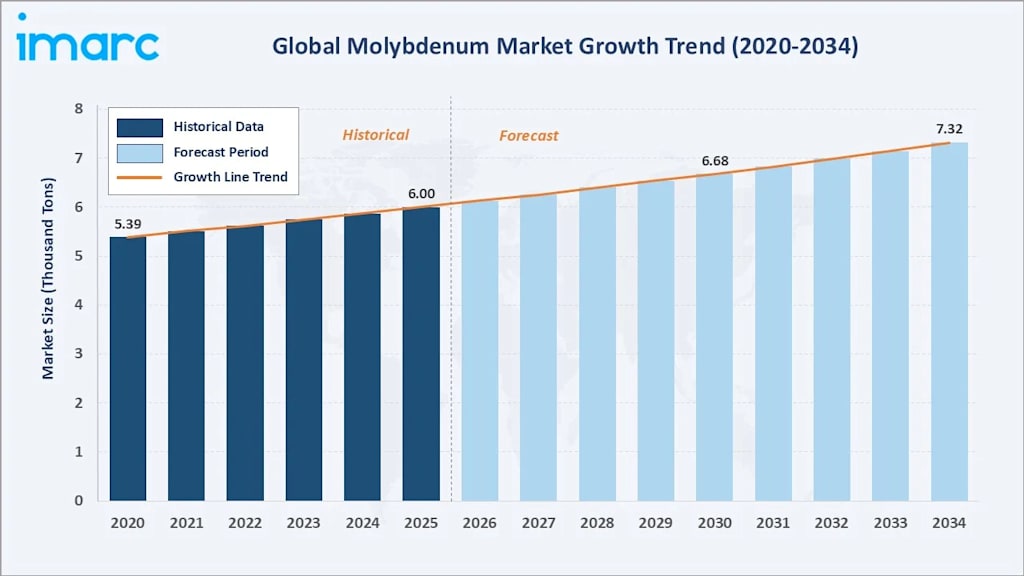
Accelerating demand for high-strength steel alloys, growing investments in green hydrogen infrastructure, and increasing utilization in semiconductor manufacturing are driving molybdenum demand, supported by expanding aerospace applications, advanced material processing innovations, and a rising focus on circular economy metal recycling. According to IMARC Group’s latest data, the global molybdenum market size reached 6.00 Thousand Tons in 2025. Looking forward, IMARC Group estimates the market to reach 7.32 Thousand Tons by 2034, exhibiting a CAGR of 2.16% from 2026-2034.
Molybdenum now represents a critical global commodity market exceeding hundreds of thousands of metric tons in mine output and displaying steady year-on-year industrial expansion. Demand is driven by accelerating infrastructure projects, automotive lightweighting, and the vital role the metal plays in enhancing the heat and corrosion resistance of stainless and engineering steels. Ongoing developments in electronics fabrication, defense manufacturing, and secondary recovery from spent catalysts are further accelerating market uptake. Major segments include steel, chemicals, foundry, and specialty alloys, with industrial buyers prioritizing strict purity grades, supply chain security, and sustainable procurement practices.
Get Instant Access to the "Molybdenum Market" Research Sample!
Molybdenum Market Growth Drivers:
- Accelerating Demand for High-Strength Alloys
Heavy industrial applications increasingly rely on molybdenum to enhance tensile strength and corrosion resistance in extreme environments. The material significantly modifies steel microstructures, allowing structural components to withstand severe stress without failure. Large-scale structural engineering and deepwater oil extraction projects require these fortified alloys to manage immense structural pressure safely. Because a significant portion of global steel production now integrates these advanced alloy blends, processing plants are actively securing raw material streams. This foundational industrial reliance keeps procurement volumes high across major manufacturing hubs.
- Rapid Expansion of Renewable Energy Infrastructure
Clean energy projects require specialized materials that resist environmental degradation while operating continuously. Wind turbine structures, high-efficiency solar photovoltaic cells, and geothermal generation plants utilize molybdenum-bearing steel to prevent premature wear and rust. As global public and private sectors rapidly deploy renewable power arrays, material specifications strictly mandate high-performance alloys. Manufacturers are optimizing component lifespans by choosing metals that tolerate intense outdoor conditions. This direct link to the modern energy transition creates a stable, long-term consumption channel independent of traditional commercial building cycles.
- Rising Technical Needs in Aerospace and Defense
Modern aviation and defense systems require components that maintain structural integrity at near-melting temperatures. Jet engine turbines, rocket propulsion nozzles, and high-speed defense shielding use molybdenum-based superalloys for their superior thermal stability. Aerospace engineering firms continuously push the boundaries of propulsion efficiency, which directly correlates with higher operating temperatures inside engines. Consequently, standard industrial metals fail under these thermal conditions, making this refractory metal completely irreplaceable. Strategic defense stockpiling and commercial fleet upgrades ensure that precision manufacturing plants maintain a steady demand for premium-grade shipments.
Molybdenum Market Trends:
- Surging Demand from Green Hydrogen Infrastructure
Decarbonization initiatives are channeling substantial funding into green hydrogen systems, creating a new market path for specialty metals. Electrolysis cells, high-pressure hydrogen distribution pipelines, and chemical storage vessels require specific stainless steel formulations to prevent hydrogen embrittlement. Engineers favor molybdenum-enhanced alloys because they effectively mitigate this specific structural weakness. This evolving application insulates producers from standard construction market volatility. As multi-megawatt hydrogen plants move from design phases to active physical construction, specialized supply networks are securing high-purity inputs to meet precise material standards.
- Integration of Advanced Compounds in Semiconductors
Next-generation semiconductor manufacturing relies heavily on advanced material layers to achieve smaller, more efficient electronic architectures. Molybdenum disulfide is emerging as a premier two-dimensional material for thin-film transistors, offering excellent electrical conductivity and dry lubrication at the microscopic scale. Major chip fabrication facilities, heavily supported by regional government subsidy programs, are expanding cleanroom production capacities worldwide. This technical evolution drives the consumption of specialized sputtering targets utilized in advanced vapor deposition processes. Consequently, high-purity processing facilities are experiencing increased orders tailored explicitly for the electronics sector.
- Expansion of Circular Economy and Recycling Initiatives
Industrial manufacturing is shifting focus toward closed-loop material supply chains to lower environmental impact and safeguard input access. Steel recyclers and refinery operations are scaling up secondary recovery operations to extract the metal from scrap and spent chemical catalysts. These recycling processes consume significantly less energy than primary ore refining, appealing directly to sustainability-minded corporate buyers. Major steel producers are redesigning sorting systems to isolate high-value alloy scrap more efficiently. This growing secondary supply stream improves overall market resilience, giving industrial consumers an alternative to primary mining output.
Recent News and Developments in Molybdenum Market
- August 2025: Freeport-McMoRan announced a comprehensive upgrade to its processing facilities, integrating automated sorting technologies to optimize recovery rates and meet rising demand for high-purity industrial grades.
- September 2025: China Molybdenum Co., Ltd. (CMOC) successfully completed a major mining expansion phase, boosting its output capacity to secure a more stable supply chain for regional steel manufacturing clients.
- January 2026: The London Metal Exchange (LME) updated its transparency and provenance documentation guidelines for minor metals, pushing producers to adopt blockchain tracking for verified sustainable supply chains.
Note: If you require specific details, data, or insights that are not currently included in the scope of this report, we are happy to accommodate your request. As part of our customization service, we will gather and provide the additional information you need, tailored to your specific requirements. Please let us know your exact needs, and we will ensure the report is updated accordingly to meet your expectations.
About the Creator
Andrew Sullivan
Hello, I’m Andrew Sullivan. I have over 9+ years of experience as a market research specialist.
Enjoyed the story? Support the Creator.
Subscribe for free to receive all their stories in your feed.
Comments
There are no comments for this story
Be the first to respond and start the conversation.