
Mobile and Wireless Backhaul Market Trends: 5G Deployment, Network Expansion & Forecast to 2034
How rising 5G deployment, increasing mobile data traffic, and network modernization initiatives are accelerating infrastructure investments in the mobile and wireless backhaul market

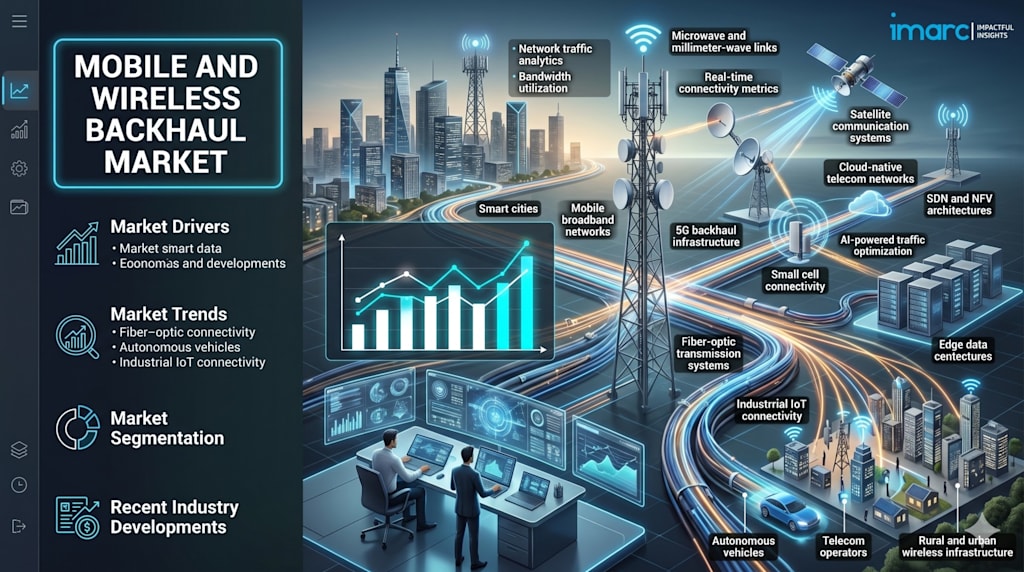
According to IMARC Group's latest research publication, The global mobile and wireless backhaul market size reached USD 47.5 Billion in 2025. Looking forward, IMARC Group expects the market to reach USD 107.3 Billion by 2034, exhibiting a growth rate (CAGR) of 9.21% during 2026-2034.
How AI is Reshaping the Future of the Mobile And Wireless Backhaul Market
- AI-Powered Traffic Optimization and Dynamic Bandwidth Allocation: AI-driven network management systems are fundamentally transforming how mobile and wireless backhaul networks handle surging data volumes across increasingly complex multi-generation infrastructure. Machine learning algorithms continuously monitor traffic patterns, predict congestion points, and dynamically reallocate bandwidth across backhaul links in real time, eliminating the manual intervention that previously caused costly network inefficiencies. Telecom operators deploying AI-enhanced backhaul management platforms have documented operational cost reductions of up to 15%, with traffic rerouting decisions now executed in milliseconds rather than minutes. This capability is particularly critical as operators simultaneously manage 2G, 3G, 4G, and 5G traffic across shared physical infrastructure, where intelligent load balancing directly determines the end-user experience quality across all connected services.
- Predictive Maintenance and Network Fault Prevention: AI is enabling mobile network operators to shift from reactive maintenance models toward fully predictive infrastructure management across backhaul networks spanning thousands of remote cell sites. By continuously analyzing sensor data from microwave dishes, millimetre wave equipment, and associated hardware, machine learning models can identify degradation signatures and predict equipment failures days or weeks before they occur, allowing maintenance crews to intervene without service interruption. This predictive approach is delivering measurable reductions in unplanned downtime across large operator networks, where a single backhaul link failure can degrade connectivity for thousands of subscribers across entire districts. The economic significance is substantial, as emergency field repairs in remote locations carry costs many times higher than scheduled preventive maintenance visits triggered by AI-generated alerts.
- Autonomous Network Configuration for 5G Small Cell Densification: The rapid densification of 5G networks through small cell deployments is creating backhaul configuration challenges of a scale that manual engineering simply cannot address. AI-powered self-organizing network (SON) capabilities are automating the configuration, optimization, and healing of backhaul connections across dense urban small cell grids, enabling operators to deploy hundreds of new nodes simultaneously without proportional increases in network engineering headcount. These autonomous configuration systems analyze signal propagation, interference patterns, and capacity requirements to determine optimal backhaul link parameters, dramatically compressing the time-to-service for new cell site activations from weeks to hours. This acceleration is proving decisive as mobile operators race to densify 5G coverage in high-demand commercial districts and transport hubs where manual site-by-site configuration would create unacceptable deployment bottlenecks.
- AI-Driven Network Slicing and Quality of Service Differentiation: AI is enabling sophisticated network slicing capabilities within backhaul infrastructure, allowing operators to simultaneously deliver differentiated quality-of-service levels across multiple virtual network segments sharing the same physical backhaul resources. Machine learning models dynamically assign backhaul capacity to individual slices based on real-time demand, contractual service level agreements, and application priority, ensuring that mission-critical industrial IoT traffic and emergency communications maintain guaranteed throughput even during periods of peak consumer mobile data consumption. This intelligent resource partitioning is opening new revenue streams for mobile network operators, who can now offer guaranteed-performance enterprise connectivity products over existing backhaul infrastructure without deploying dedicated physical links to individual corporate customers, significantly improving the return on existing infrastructure investments.
- Satellite and Terrestrial Integration Orchestration: AI is emerging as the critical orchestration layer enabling seamless integration of terrestrial microwave backhaul with low earth orbit satellite connectivity, creating hybrid backhaul architectures capable of extending reliable high-capacity connectivity to geographically remote and underserved areas. Intelligent traffic steering algorithms dynamically route backhaul traffic between microwave links, fibre connections, and satellite segments based on latency requirements, available capacity, and cost optimization rules, without manual intervention from network operations teams. The April 2025 agreement by SES to acquire Intelsat for USD 3.1 billion exemplifies the strategic importance of building multi-orbit satellite carrier capabilities that can serve as backhaul providers for operators extending coverage into regions where terrestrial infrastructure deployment remains economically unviable, with AI orchestration making these hybrid architectures operationally practical at commercial scale.
Mobile And Wireless Backhaul Industry Overview:
The global mobile and wireless backhaul market is witnessing steady expansion driven by the accelerating worldwide deployment of 5G networks, the exponential growth of mobile data traffic, and the escalating connectivity demands of billions of IoT devices across industrial, commercial, and consumer applications. Mobile backhaul infrastructure, which carries traffic from cell site air interfaces to operator core networks via combinations of microwave, millimetre wave, fibre, and satellite links, has become the critical capacity bottleneck determining whether 5G networks can deliver on their promised performance improvements to end users. Mobile data traffic is projected to exceed 77 exabytes per month globally, placing immense pressure on operators to expand and modernize backhaul infrastructure at a pace matching the densification of their radio access networks. The transition from traditional time-division multiplexing architectures to all-IP backhaul networks is underway across operator fleets globally, with this modernization reducing operational costs by 30 to 40% compared with legacy TDM and ATM solutions while simultaneously improving network scalability to accommodate continued traffic growth. Government policy frameworks are providing critical acceleration across key markets, with India's National Frequency Allocation Plan 2025, effective from December 2025, specifically allocating E-band spectrum at 71 to 76 GHz and 81 to 86 GHz for high-capacity point-to-point terrestrial backhaul links, while the United States Federal Communications Commission adopted rules in April 2025 to unlock the lower 37 GHz spectrum band for wireless broadband and internet backhaul connections. As of March 2025, only 46% of Indian base stations were connected via fibre, underscoring the vast and durable demand for microwave and millimetre wave backhaul solutions across one of the world's largest and fastest-growing mobile markets. The integration of network functions virtualization and software-defined networking technologies into backhaul architectures is further transforming the market, enabling operators to optimize traffic flows and introduce new network services at a fraction of the cost and time required under traditional hardware-centric models.
Mobile And Wireless Backhaul Market Trends and Drivers
The global rollout of 5G networks is the single most powerful structural driver reshaping the mobile and wireless backhaul market. Fifth-generation radio access networks generate backhaul capacity requirements dramatically exceeding those of 4G LTE, as the combination of massive MIMO antenna arrays, millimetre wave radio frequencies, and dense small cell grids produces data flows that legacy microwave links cannot accommodate without significant capacity upgrades. Operators in China, Japan, and South Korea, who have already blanketed major metropolitan areas with standalone 5G, are driving steep procurement demand for 10 Gbps microwave hops and millimetre wave equipment capable of supporting emerging applications including industrial IoT, autonomous vehicle communication, and smart city infrastructure. The U.S. FCC's USD 9 billion 5G Fund is incentivizing cell-site upgrades in remote and rural counties, creating additional backhaul investment requirements in areas where wireless connectivity is the only economically viable transport technology. This government-backed investment in network densification is translating directly into sustained procurement cycles for microwave, millimetre wave, and Sub-6 GHz backhaul equipment from vendors across the global market.
The explosive growth of mobile data traffic and the rapid proliferation of connected IoT devices represent the second transformative demand driver for the mobile and wireless backhaul market. Each additional connected device, whether a consumer smartphone, an industrial sensor on a manufacturing floor, or a connected medical monitor in a hospital ward, generates backhaul traffic that must traverse the operator's transport network to reach core processing systems and cloud applications. The deployment of network functions virtualization and software-defined networking within backhaul architectures is enabling operators to address this traffic surge more efficiently, with SDN-enabled backhaul systems capable of dynamically rerouting and prioritizing traffic flows across available links without hardware modifications. Mobile network operators integrating these software-defined capabilities into their backhaul refresh programs are unlocking the ability to introduce new enterprise and IoT connectivity services rapidly, transforming backhaul infrastructure from a pure cost center into a platform enabling revenue diversification and competitive differentiation in increasingly commoditized mobile markets.
The expanding requirement for broadband connectivity in rural, remote, and underserved geographies is establishing the third major demand driver sustaining market fundamentals across the global mobile and wireless backhaul industry. Wireless backhaul solutions utilizing microwave and satellite communication infrastructure provide the only economically and logistically viable mechanism for connecting cell sites in areas where trenching fibre is prohibitively expensive or geographically impossible. The January 2025 partnership between Ericsson and the European Commission, backed by USD 569.20 million in funding to expand 5G coverage throughout rural Europe, illustrates the scale of government commitment to bridging the urban-rural digital divide through targeted backhaul infrastructure investment. These government-backed rural connectivity programs are creating long-duration demand pipelines for wireless backhaul vendors, as the economics of fibre deployment in remote regions ensure that microwave and satellite backhaul will remain the preferred transport technology for a significant portion of the global cell site estate for the foreseeable future.
Leading Companies Operating in the Global Mobile And Wireless Backhaul Industry:
- AT&T Inc.
- Bridgewave Communications Inc. (REMEC Broadband Wireless Networks)
- Broadcom Corporation (Avago Technologies)
- Cambridge Broadband Networks Ltd.
- Cisco Systems Inc.
- Ericsson AB
- Fujitsu Ltd.
- Huawei Technologies Co. Ltd.
- Nokia Oyj
- Tellabs Inc. (Marlin Equity Partners LLC)
- ZTE Corporation
Mobile And Wireless Backhaul Market Report Segmentation:
By Equipment Type:
- Microwave Equipment
- Millimetre Wave Equipment
- Sub-6 GHz Equipment
- Testing and Measurement Equipment
Microwave equipment represents the dominant segment, as it delivers the proven reliability, cost efficiency, and deployment flexibility that operators require for connecting cell sites across both urban and rural environments where fibre deployment is either economically prohibitive or logistically constrained.
By Network Topology:
- Point to Point Configuration (PTP)
- Point to Multipoint Configuration (PTM)
Point to point configuration holds the largest share of the market, driven by its ability to deliver dedicated, high-capacity links with guaranteed throughput between individual cell sites and aggregation nodes, making it the preferred topology for operators prioritizing performance consistency in high-traffic urban and suburban deployments.
By Services:
- Network Services
- System Integration Services
- Professional Services
Network services account for the largest segment, as mobile network operators increasingly rely on managed and outsourced network service arrangements to operate and maintain their expanding and increasingly complex backhaul infrastructure without proportional increases in internal engineering headcount.
Regional Insights:
- North America (United States, Canada)
- Asia Pacific (China, Japan, India, South Korea, Australia, Indonesia, Others)
- Europe (Germany, France, United Kingdom, Italy, Spain, Russia, Others)
- Latin America (Brazil, Mexico, Others)
- Middle East and Africa
North America exhibits clear dominance in the mobile and wireless backhaul market, driven by the rapid and extensive deployment of 5G networks across the United States and Canada, substantial telecom infrastructure investment by major operators, proactive spectrum allocation initiatives by the FCC supporting backhaul connectivity, and the presence of leading technology vendors continuously advancing the capabilities of microwave and millimetre wave backhaul platforms serving both commercial and government network requirements.
Recent News and Developments in the Mobile And Wireless Backhaul Market
- May 2025: Ericsson and Turkcell commenced W-band backhaul trials delivering 100 Gbps links while achieving energy consumption reductions of 30% compared with E-band solutions, demonstrating the viability of next-generation high-frequency backhaul architectures capable of supporting the capacity demands of densely deployed 5G and future 6G networks.
- May 2025: U Mobile selected Telekom Malaysia for a USD 570 million backhaul services agreement to underpin Malaysia's second 5G network rollout, representing one of the largest single backhaul procurement commitments in Southeast Asia and highlighting the scale of infrastructure investment required to support parallel national 5G network deployments.
- April 2025: SES agreed to acquire Intelsat for USD 3.1 billion, creating a multi-orbit satellite carrier with significantly enhanced mobile backhaul reach across underserved geographies, a transaction that signals growing strategic convergence between satellite communications operators and terrestrial backhaul infrastructure providers seeking to offer operators end-to-end hybrid connectivity solutions.
- January 2025: Ericsson unveiled a partnership with the European Commission, backed by USD 569.20 million in funding, to extend 5G coverage throughout rural Europe by deploying high-capacity 5G network infrastructure across underserved and digitally isolated communities, with enhanced backhaul capacity forming a central component of the connectivity architecture underpinning the initiative.
- December 2024: Huawei launched a new AI-driven mobile backhaul solution in collaboration with Japan's leading telecom operators, employing machine learning to optimize traffic management and network efficiency, delivering operational cost reductions of 15% while supporting Japan's government-backed initiative to accelerate 5G infrastructure digitalization and modernization across the national network estate.
Note: If you require specific details, data, or insights that are not currently included in the scope of this report, we are happy to accommodate your request. As part of our customization service, we will gather and provide the additional information you need, tailored to your specific requirements. Please let us know your exact needs, and we will ensure the report is updated accordingly to meet your expectations.
About the Creator
Abhay Rajput
I am working in market research company that provides market and business research intelligence across the globe.
Enjoyed the story? Support the Creator.
Subscribe for free to receive all their stories in your feed.
Comments
There are no comments for this story
Be the first to respond and start the conversation.