
Mobile Advertising Market Trends: 5G Expansion, Video Ads Surge & Industry Trends
How 5G connectivity, video ad formats, and immersive content are accelerating engagement levels and redefining performance metrics in the mobile advertising ecosystem

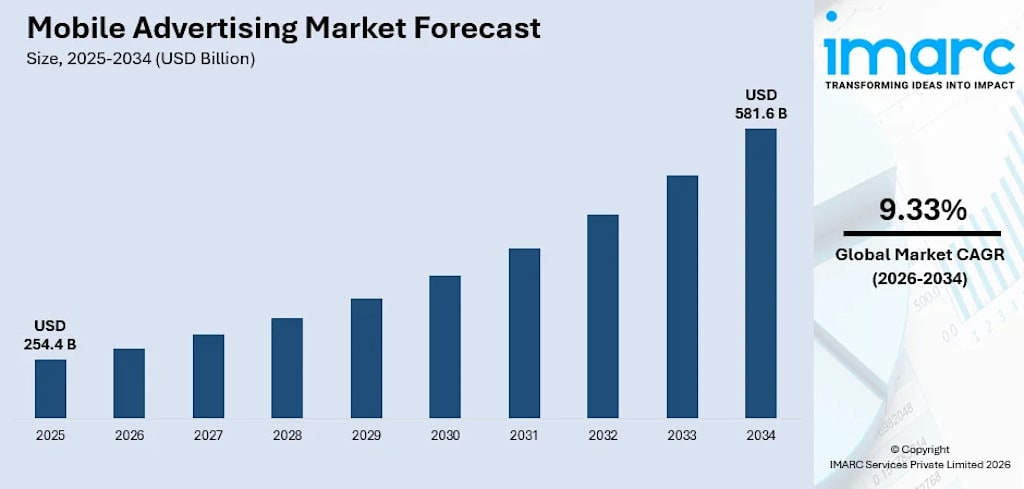
The global mobile advertising market is experiencing sustained expansion, driven by increasing smartphone penetration, widespread mobile internet access, and evolving consumer media consumption patterns. The rapid growth of social media platforms, combined with advancements in artificial intelligence and data analytics, is transforming how businesses engage with audiences through mobile devices.
According to IMARC Group’s latest data, the global mobile advertising market size was valued at USD 254.4 Billion in 2025. Looking forward, IMARC Group estimates the market to reach USD 581.6 Billion by 2034, exhibiting a CAGR of 9.33% during 2026–2034.
Mobile advertising has become a central component of the broader digital advertising ecosystem, accounting for a substantial share of total digital ad spending worldwide. This growth reflects a mobile-first user environment, where individuals increasingly rely on smartphones for communication, entertainment, shopping, and information access. Average daily mobile usage continues to rise globally, contributing to increased exposure to digital advertisements.
Unlock Premium Insights with a Free "Mobile Advertising Market" Report
Mobile Advertising Market Growth Drivers:
- Ubiquity of Smartphones and High-Speed Connectivity
The widespread adoption of smartphones remains one of the primary drivers of mobile advertising growth. With billions of mobile users worldwide, smartphones have become the primary medium for internet access, particularly in emerging economies.
Advancements in network infrastructure, including the rollout of 5G technology, are further supporting market expansion. Enhanced connectivity enables faster data transmission, lower latency, and improved user experiences, making it feasible to deliver high-quality advertising formats such as high-definition video and interactive media.
These technological improvements allow advertisers to deploy more engaging content while ensuring smooth performance across devices. As a result, brands are increasingly investing in mobile channels to reach a larger and more connected audience base.
- Surge in Mobile Video Consumption and Social Commerce
Consumer behavior is shifting toward video-centric content, particularly short-form formats delivered through social media platforms. Mobile devices have become the primary medium for consuming such content, leading to increased engagement with video-based advertisements.
Mobile advertising campaigns are increasingly integrating entertainment and commerce, enabling users to transition directly from content consumption to purchase actions. Features such as embedded purchase options within social media feeds support seamless transactions and enhance conversion rates.
The growing importance of social commerce is encouraging brands to prioritize video advertising formats that combine visual storytelling with product promotion. This trend is expected to continue as mobile platforms introduce more commerce-enabled features.
- Advancements in AI-Powered Targeting and Personalization
Artificial intelligence is playing a significant role in enhancing the effectiveness of mobile advertising. AI-driven systems enable advertisers to analyze user data, optimize ad placements, and deliver personalized content in real time.
These technologies consider various data points, including user location, browsing behavior, and device usage patterns, to present relevant advertisements. The use of automated bidding systems and predictive analytics helps improve campaign performance while optimizing advertising budgets.
By delivering more relevant content to users, AI-powered advertising contributes to higher engagement rates and improved return on investment. At the same time, advancements in data processing allow advertisers to operate efficiently within evolving privacy frameworks.
Mobile Advertising Market Trends:
- Shift Toward Privacy-First and Contextual Advertising
Increasing regulatory scrutiny around data privacy is reshaping mobile advertising practices. Regulations such as the General Data Protection Regulation (GDPR) and the California Consumer Privacy Act (CCPA), along with platform-level changes like Apple’s App Tracking Transparency (ATT), are limiting the use of third-party tracking.
In response, advertisers are adopting privacy-focused strategies that rely on contextual targeting and first-party data. Contextual advertising involves delivering ads based on the content a user is currently viewing rather than relying on historical browsing data.
This approach aligns with evolving consumer expectations regarding data privacy while enabling advertisers to maintain campaign effectiveness. The adoption of secure data-sharing environments and privacy-compliant measurement tools is also increasing across the industry.
- Growth of Retention-Focused Marketing Strategies
Rising customer acquisition costs are prompting businesses to focus more on retaining existing users. This shift is leading to increased investment in remarketing and customer engagement strategies within mobile platforms.
Brands are using personalized notifications, targeted offers, and in-app messaging to re-engage users and encourage repeat interactions. Retention-based approaches are particularly important in sectors such as e-commerce and mobile gaming, where ongoing user engagement directly influences revenue generation.
By focusing on long-term customer relationships, companies can improve lifetime value while reducing dependency on new user acquisition. This strategic shift is expected to remain a key trend as competition intensifies across digital channels.
- Emergence of Augmented Reality (AR) and Interactive Ad Formats
The integration of augmented reality into mobile advertising is introducing more immersive and interactive experiences. AR-enabled advertisements allow users to interact with products in virtual environments, improving engagement and decision-making.
Applications such as virtual product trials and 3D visualizations enable consumers to better understand product features before making purchases. These interactive formats are particularly relevant in industries such as retail, fashion, and home décor.
The growing adoption of AR technology is contributing to higher engagement rates and improved user experiences. As mobile hardware capabilities continue to advance, immersive advertising formats are expected to become more prevalent.
Recent News and Developments:
- April 2026: Government-led digital infrastructure initiatives expanded the development of 5G-enabled application environments to support high-bandwidth mobile services, including advanced advertising solutions.
- March 2026: A global e-commerce platform reported a significant increase in mobile-driven sales, supported by the integration of video-based shopping features that allow users to purchase products directly through mobile content.
- January 2026: Several ad-technology providers introduced privacy-focused identification frameworks designed to replace traditional tracking methods, enabling advertisers to maintain targeting efficiency while complying with evolving data protection standards.
Note: If you require specific details, data, or insights that are not currently included in the scope of this report, we are happy to accommodate your request. As part of our customization service, we will gather and provide the additional information you need, tailored to your specific requirements. Please let us know your exact needs, and we will ensure the report is updated accordingly to meet your expectations.
About the Creator
Andrew Sullivan
Hello, I’m Andrew Sullivan. I have over 9+ years of experience as a market research specialist.
Enjoyed the story? Support the Creator.
Subscribe for free to receive all their stories in your feed.
Comments
There are no comments for this story
Be the first to respond and start the conversation.