
Mining Waste Management Market: Resource Recovery Strategies, ESG Compliance & Market Expansion
Rising demand for water recycling, resource recovery, and eco-friendly disposal solutions is accelerating innovation across the global mining waste management industry

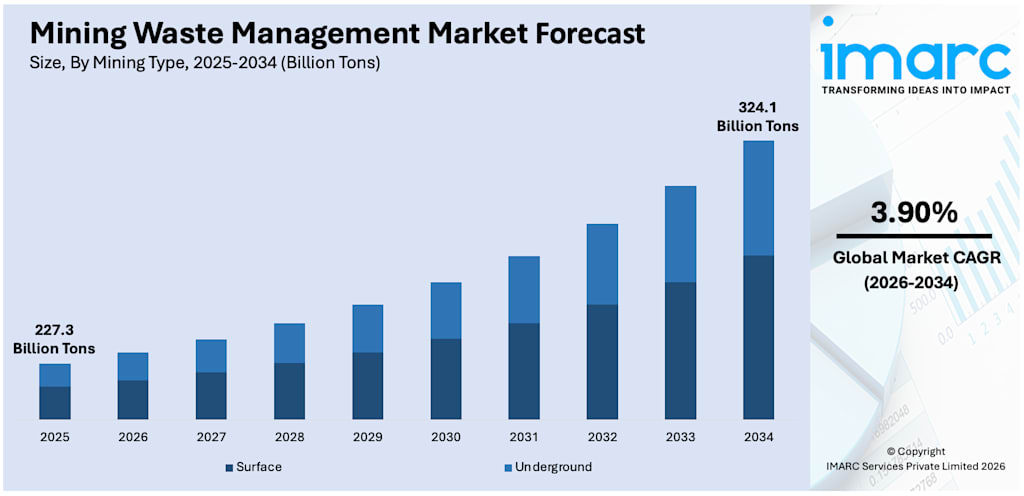
Rising environmental concerns, the rapid growth of the global mining industry, and the increasing demand for metals like lithium and cobalt for electric vehicles are driving mining waste management demand. This is further supported by the introduction of smart technologies, stringent government regulations, and expanding infrastructure projects worldwide. According to IMARC Group’s latest data, the global mining waste management market size reached 227.3 Billion Tons in 2025. Looking forward, IMARC Group expects the market to reach 324.1 Billion Tons by 2034, exhibiting a CAGR of 3.90% during 2026-2034.
The management of mining waste has evolved from a secondary operational task into a multi-billion-dollar strategic necessity. The industry is currently processing hundreds of billions of tons of waste, including overburden, tailings, and mine water, driven by the shift toward low-grade ore extraction which requires moving more material to obtain the same mineral yield. As global economies accelerate their energy transitions, the volume of waste generated from mining critical minerals has surged, necessitating advanced containment and recycling solutions.
Receive Your "Mining Waste Management Market" Research Sample PDF
Mining Waste Management Market Growth Drivers:
- Surging Demand for Critical Transition Minerals
The global shift toward renewable energy and electric mobility is a massive catalyst for waste management needs. Electric vehicle production requires a complex concentration of metals such as lithium, cobalt, and nickel, which are often extracted from lower-grade deposits. For every ton of lithium produced, hundreds of tons of waste material are typically moved and managed. Currently, the market handles over 249 billion tons of material globally. This high volume necessitates sophisticated waste rock and tailings management to prevent land degradation while meeting the rapid industrialization needs of the green energy sector.
- Technological Integration and Smart Mining Solutions
The introduction of automated and smart waste management technologies is significantly reducing the reliance on highly trained manual labor for handling hazardous materials. Innovations like IoT-enabled sensors for real-time tailings dam monitoring and AI-driven predictive analytics are becoming standard in modern operations. These systems allow companies to manage billions of tons of mine water and solid waste with higher precision, reducing the risk of catastrophic failures. By deploying automated filtration and recycling units, miners can recover process water and minerals from waste streams, turning potential liabilities into valuable secondary resources
- Stringent Environmental Regulations and Compliance
Governments worldwide are implementing rigorous frameworks to mitigate the impact of mining on local ecosystems, particularly regarding acid mine drainage and soil contamination. Compliance is no longer optional, as international standards like the Global Industry Standard on Tailings Management (GISTM) push firms toward safer disposal methods. In regions like Asia Pacific, which manages nearly 92 billion tons of waste annually, these mandates drive investment in advanced stabilization and solidification techniques. This regulatory pressure ensures that waste management is integrated into the earliest stages of mine planning, prioritizing long-term reclamation and environmental safety.
Mining Waste Management Market Trends:
- Circular Economy and Waste Valorization Initiatives
Mining companies are increasingly viewing waste as a potential revenue stream rather than a pure disposal cost. Waste rock is being reprocessed to extract trace minerals or crushed for use as construction aggregate in road building and infrastructure projects. For example, tailings are now being utilized in the production of glass, bricks, and concrete, effectively diverting millions of tons from traditional storage facilities. This trend toward "zero-waste" mining is supported by industrial symbiosis where mining outputs serve as raw materials for the construction and manufacturing sectors, enhancing overall project sustainability.
- Advancements in Tailings De-watering and Dry Stacking
One of the most significant shifts in the industry is the move away from conventional wet tailings ponds toward filtered or "dry-stacked" tailings. This method mechanically removes water from waste, creating a stable, soil-like material that significantly reduces the risk of dam breaches. Major industry players like BHP and Rio Tinto are actively researching large-scale filtered tailings technology to manage volumes ranging from 100,000 to 400,000 tonnes per day. This approach not only improves safety but also allows for better water recovery in arid mining regions where water scarcity is a critical operational constraint.
- Focus on Sustainable Mine Closure and Land Reclamation
Modern market trends emphasize the "cradle-to-grave" management of mining sites, with a heavy focus on comprehensive closure strategies. Companies are investing in long-term waste stabilization to ensure that once a mine's life cycle ends, the land can be safely returned to community or ecological use. This includes advanced contouring using overburden and the treatment of mine water to prevent long-term leaching. As the industry moves toward ESG-aligned operations, the ability to demonstrate a clear and funded reclamation plan has become a defining factor in securing financing and maintaining a social license to operate.
Recent News and Developments in Mining Waste Management Market
- May 2026: BHP and Rio Tinto released a joint whitepaper through the Tailings Management Consortium (TMC) titled "Unlocking Large Tonnage Filtered Tailings Stacks," aiming to scale up dry-stacking technologies for the world's largest mining operations to improve safety and water efficiency.
- March 2026: A major expansion in "urban mining" and electronic waste recovery was launched in the United States, utilizing AI-enabled sorting systems to recover critical metals from discarded components, complementing traditional mining waste recovery efforts.
- January 2025: IMARC Group highlighted the surge in deepwater and ultra-deepwater extraction activities, which is generating new technical requirements for managing offshore mining waste and subsea tailings disposal to protect marine biodiversity.
Note: If you require specific details, data, or insights that are not currently included in the scope of this report, we are happy to accommodate your request. As part of our customization service, we will gather and provide the additional information you need, tailored to your specific requirements. Please let us know your exact needs, and we will ensure the report is updated accordingly to meet your expectations.
About the Creator
Andrew Sullivan
Hello, I’m Andrew Sullivan. I have over 9+ years of experience as a market research specialist.
Enjoyed the story? Support the Creator.
Subscribe for free to receive all their stories in your feed.
Comments
There are no comments for this story
Be the first to respond and start the conversation.