
Military Robotics and AI: The Technologies Shaping Future Défense
Explore how autonomous systems, unmanned vehicles, and intelligent machines are transforming military operations across the globe.

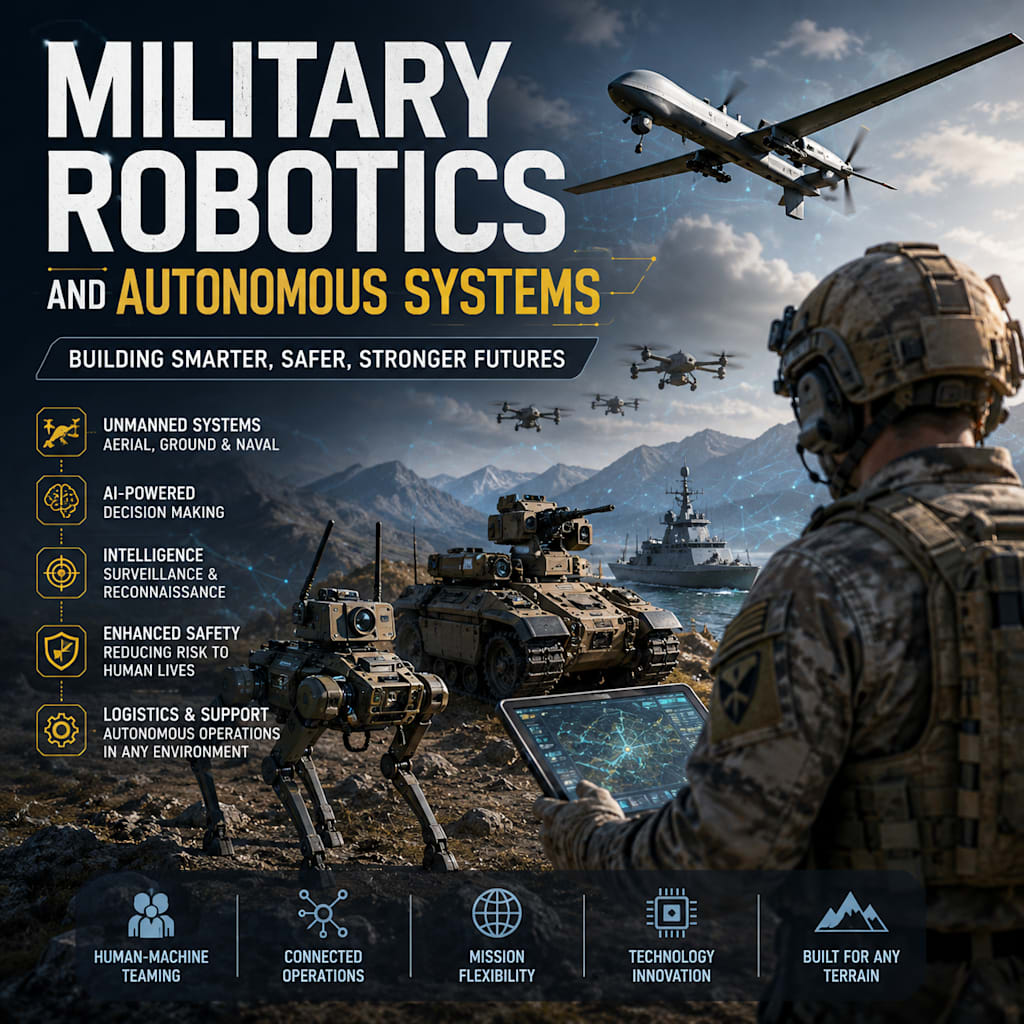
The future of the battlefield is rushing toward us faster than we anticipated. Across the planet, military organizations are dumping money into robots, autonomous vehicles, artificial intelligence, and unmanned vehicles. Once a futuristic dream, the battlefield of tomorrow is becoming an everyday reality, with armies using robots and AI to gather intelligence, perform logistics, and conduct direct military action.
Whether it’s automated drones soaring over borderlines or robotic ground vehicles crawling over dangerous territory, military robots and autonomous vehicles are changing the way defense forces conduct their operations and have become a key pillar in modern military strategy as nations continue to pursue technological advantages.
The rise of the global military robots and autonomous system market size is clear: valued at $11.8 billion in 2025, this sector is expected to grow to $26.7 billion by 2034 with a CAGR of 9.22%. This massive growth reflects a profound shift in priorities that favors smarter, safer military operations.
Military Robotics: Why the Boom?
Modern warfare is no longer the relatively straightforward affair of old.
Defense organizations need to make decisions quickly in diverse environments, get real-time information about events occurring anywhere in the world, and react instantaneously.
That is where robots and autonomous systems come into the picture: Robotic systems have the ability to conduct long-term reconnaissance missions, gather intelligence on hostile territory, and travel through locations that no soldier could. These characteristics are particularly advantageous in today’s complicated battlefield environment where threats and rapidly developing events must be addressed quickly and effectively. Reduced risks for personnel in the field while simultaneously increased military operational effectiveness have fueled major investments in military robots.
How Warfare is Evolving Robotic and autonomous systems also offer distinct advantages in addressing some of the new complexities of warfare itself. Future warfare will likely incorporate a wide range of tactics-from urban fighting, to cyber and hybrid operations-and threats that may be far less conventional in their approach. When the battlescape is filled with hidden enemies, tunnels, and densely packed urban populations, precise and up-to-date intelligence is key.
Unmanned vehicles provide this by sending real-time battlefield information back to command without risking human lives.
In the wake of new and complicated battleground realities, defense officials increasingly rely on robotics and unmanned vehicles to improve battlefield situational awareness. AI as the Future Commander If robots provide the muscles for a modern defense force, AI offers the brains. Artificial intelligence will enable autonomous systems to take in information, identify patterns, recognize threats and recommend a plan of action in near real time. Autonomous robots will be capable of collecting battle data, navigating difficult terrain and obstacles, even intelligently prioritizing key information that the human commanding officer will need during combat.
This is one of the many reasons why military leaders have hastened investment in the new class of autonomous military-grade hardware.
Not only will this tech bolster human intelligence, but will increase overall human and military readiness. Flying into the Unknown – the Robotic Drones Drones lead the charge in this military technology sector. Autonomous reconnaissance drones have forever altered intelligence gathering and observation by allowing a human the ability to view the situation in the field without directly risking human lives.
This technology will only continue to grow with breakthroughs in AI, smart systems, and communication technology. Military drones will provide: Real-time surveillance over borderlines, vital areas and operational sectors Surveillance capabilities across large distances The capacity for effective and efficient combat Search-and-rescue operations to support individuals in disaster situations and in the field A strategic force with the flexibility to respond rapidly to developing events in a variety of environments Drones continue to remain one of the most promising military technologies and continue to experience rapid growth. Broads of Bots – Swarm Intelligence One of the most significant advances in robotics technology will have to be that of military-grade swarm robotic intelligence.
Unlike previously-autonomous defense robots who would work solely, a squadron of autonomous robots will be programmed to work in a synchronized, unit formation.
This unit of bots will continue to communicate back and forth in real-time and adapt to dynamically changing battlefield situations. Defense experts expect swarm capabilities to provide revolutionary insights during intel gathering, increase offensive abilities by overpowering adversaries and offer unparalleled mission fluidity. Swarm technology represents one of the newest military technologies available and it continues to become one of the most anticipated technologies in the future defense technology market. Humans and Machines, A Teaming Partnership Not too long from now, autonomous weapons may very well be paired with humans to better combat the enemy.
The new military concept referred to as ‘human-machine teaming,’ blends the experience and intuition of humans with speed and data processing capabilities that are exclusive to robotics systems.
This human element will provide intelligent thought and creative strategy, whilst remaining in tandem with the precision and processing power that these robotics technologies already hold. Autonomous robotic support systems will enable human military members to operate far more intelligently, effectively and safely on any given battlefield scenario. The Security Implications of Expanding Robotic Usage In addition to these more tactical advantages, the expanding proliferation of military robotics also plays a role in addressing issues related to global security and stability.
In response to geopolitical challenges in various regions, governments are rapidly investing in robotics as a means of deterring potential adversaries and enhancing national defense readiness. Robotic systems offer the ability to provide 24/7 surveillance, quick intervention times, reduced human risks in high-threat areas, and the capacity for extensive intelligence gathering – all crucial elements in today’s dynamic global security environment. These robots can contribute to a wider array of security needs beyond traditional warfare: Border surveillance and monitoring Emergency response and humanitarian aid activities Infrastructure inspection and security Public safety applications However, with increased reliance on robotic systems, the need for responsible design, implementation, and regulation of these technologies becomes increasingly urgent.
As advancements continue, discussions regarding ethics, accountability, and cybersecurity must inform the deployment and integration of robotic warfare.
As military robots progress with ever-improving AI and autonomous operations capabilities, one thing becomes clear: the future battlefield, while still dominated by human leadership, will increasingly feature the crucial assistance of the modern soldier’s intelligent, autonomous partner.
About the Creator
Robert
Senior Market Researcher at IMARC Group, specializing in global market analysis, industry trends, and data-driven insights across diverse sectors.
Enjoyed the story? Support the Creator.
Subscribe for free to receive all their stories in your feed.
Comments
There are no comments for this story
Be the first to respond and start the conversation.