
Micro-pumps Market Growth: Insulin Pumps, Smart Therapeutics & Forecast to 2033
How precision drug delivery, portable diagnostics, and chronic disease management needs are transforming the global micro-pumps market outlook worldwide.

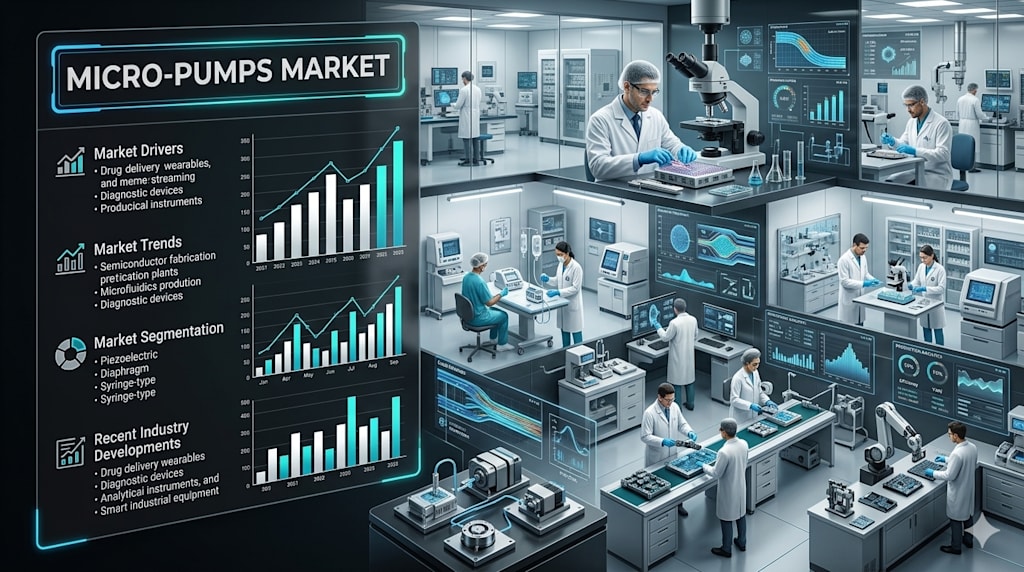
Micro-Pumps Market
The increasing demand for portable and miniaturized fluid delivery systems, rapid advancements in microfabrication techniques, and rising adoption of compact devices across medical, energy, and aerospace sectors are driving micro-pump demand, supported by lab-on-a-chip innovations, wearable device integration, and expanding pharmaceutical and environmental applications. According to IMARC Group's latest data, the global micro-pumps market size was valued at USD 2.6 Billion in 2024. Looking forward, IMARC Group estimates the market to reach USD 9.0 Billion,exhibiting a growth rate (CAGR) of 13.83% during 2025-2033. North America currently dominates the market, driven by its advanced healthcare infrastructure, strong pharmaceutical R&D ecosystem, and significant investments in aerospace and defense technologies.
Micro-pumps are miniature devices engineered to deliver precise and controlled fluid flows at a small scale. These compact pumps are driving innovation across medical devices, analytical instruments, lab-on-a-chip systems, and drug delivery platforms. Their ability to enable accurate dosing and sample handling in diagnostic and analytical applications sets them apart from traditional pumps, offering improved repeatability and reduced sample waste. They also provide advantages such as low power consumption, compact size, and compatibility with portable and wearable devices, making them ideal for handheld and point-of-care integration. In the medical field, these pumps play a critical role in insulin pumps, implantable devices, and controlled-release drug delivery systems, significantly improving patient care and treatment outcomes across diverse clinical settings worldwide.
Micro-Pumps Market Growth Drivers:
Expanding Healthcare and Medical Device Sector
The rapidly growing healthcare sector represents the most powerful demand driver for micro-pumps globally. Rising product applications in insulin pumps, wearable diagnostic devices, and point-of-care testing platforms are significantly accelerating adoption. The pharmaceutical industry relies on these pumps for drug formulation, delivery, and laboratory testing workflows, ensuring precise dosing and improved patient care outcomes. Chromatography systems and mass spectrometers, standard in drug development labs, depend on micro-pumps for reproducible solvent flow at nanoliter-to-microliter volumes. As chronic disease prevalence rises and demand for home-based and ambulatory care solutions grows, manufacturers are scaling production of micro-pump-integrated therapeutic devices to meet evolving clinical and consumer requirements across global healthcare markets.
Growth of Microfluidics and Lab-on-a-Chip Systems
The microfluidics revolution has fundamentally expanded the addressable market for micro-pumps, with lab-on-a-chip platforms becoming central to modern diagnostics and life sciences research. These platforms consolidate complex laboratory processes onto a credit card-sized chip and require micro-pumps to enable precise, contamination-free fluid manipulation for genomics, proteomics, and infectious disease diagnostics. Demand for automation in manufacturing, food processing, and agriculture further propels uptake as micro-pumps enable precise fluid dispensing and control in production environments. As biotechnology investment scales toward miniaturized diagnostics and analytical systems, micro-pump integration has transitioned from an optional design feature into a core engineering requirement for next-generation scientific and industrial instrumentation platforms.
Rising Demand in Energy and Environmental Applications
The energy sector's growing adoption of micro-pumps is emerging as a strategically important growth driver. In renewable energy systems, these devices optimize fluid circulation and cooling in photovoltaic and concentrating solar power setups, while in fuel cells they enable precise reactant delivery critical to clean energy conversion efficiency. Lithium-ion battery thermal management, particularly in electric vehicles and grid-scale storage, depends on micro-pumps to regulate temperature and extend battery lifespan. Environmental monitoring devices also rely on these pumps for sampling and analysis of water, air, and soil for pollution detection. Escalating global focus on sustainability, combined with regulatory mandates for environmental compliance, is strengthening long-term demand for micro-pump-enabled monitoring and energy management solutions across both industrial and governmental applications.
Micro-Pumps Market Trends:
Miniaturization and Integration with Wearable Technologies
The accelerating trend toward miniaturized, body-worn health technology is reshaping micro-pump design priorities and manufacturing standards. Wearable therapeutics, including continuous drug infusion systems and biosensor-integrated patches, require ultra-compact pumps capable of operating reliably on limited battery power for extended durations. This demand is pushing innovation in MEMS-based micro-pump architectures, where pump components are fabricated at the microscale using semiconductor manufacturing techniques. Device manufacturers are collaborating closely with micro-pump suppliers to co-develop customized fluidic subsystems that meet stringent biocompatibility, size, and power specifications. As wearable health devices move from clinical pilot programs to mass-market deployment, the need for scalable, cost-efficient micro-pump production is intensifying across the global medical device manufacturing ecosystem.
Aerospace and Defense Adoption Driving Technical Advancement
Rising utilization of micro-pumps in aerospace and defense applications is pushing the technical boundaries of what these devices can achieve in demanding environments. In aircraft, micro-pumps manage fuel distribution, lubrication, hydraulic flight control systems, and thermal management of avionics components. The miniaturization imperative in modern defense platforms, where weight and spatial constraints are critical, makes micro-pumps especially attractive for integration into compact, multi-function fluidic systems. Defense-specific applications also include chemical agent detection and decontamination systems, where calibrated fluid dosing in field-deployable analytical platforms is essential. Continued government investment in next-generation aerospace systems and unmanned platforms is expected to sustain strong procurement demand for high-reliability micro-pump assemblies specifically engineered for extreme-condition operational requirements.
Precision Agriculture and Smart Irrigation Applications
Micro-pumps are increasingly being integrated into precision agriculture systems, supporting real-time soil nutrient analysis and targeted irrigation delivery that optimizes crop yield while minimizing water and fertilizer consumption. Miniaturized agricultural sensors equipped with micro-pump assemblies can continuously monitor soil composition and moisture levels, transmitting data to farm management platforms for automated decision-making. The push toward sustainable farming practices, particularly in water-stressed regions, has intensified interest in technologies that deliver resources precisely where and when they are needed. Government-backed programs supporting smart agriculture infrastructure in major agricultural economies are further catalyzing adoption. This emerging application vertical represents a significant expansion of the micro-pump addressable market beyond its traditional healthcare and industrial strongholds.
Recent News and Developments in Micro-Pumps Market
January 2025: Bartels Mikrotechnik announced the expansion of its mp-series micro-pump production line in Germany, responding to growing demand from European pharmaceutical and diagnostic device manufacturers requiring miniaturized fluid handling systems for next-generation lab-on-a-chip and point-of-care platforms.
March 2025: Dolomite Microfluidics launched a new generation of micro-pump modules specifically optimized for lab-on-a-chip platforms, targeting genomics and point-of-care diagnostics customers across North America and Asia-Pacific, with emphasis on improved flow precision and reduced device footprint.
August 2024: The U.S. Department of Energy issued new funding under its Advanced Manufacturing Office for MEMS-based micro-pump development focused on improving thermal management in next-generation electric vehicle battery packs, underscoring the growing strategic overlap between clean energy and miniaturized fluid control technologies.
November 2024: Lee Company unveiled an updated series of solenoid-driven micro-pumps engineered for aerospace fluid control applications, meeting stricter weight, reliability, and operating temperature specifications mandated by commercial aircraft original equipment manufacturers.
February 2026: A Singapore-based medtech company secured significant Series B investment to commercialize an implantable micro-pump platform for targeted oncology drug delivery, reflecting the accelerating convergence of precision medicine and miniaturized fluidic systems in high-value therapeutic markets.
Note: If you require specific details, data, or insights that are not currently included in the scope of this report, we are happy to accommodate your request. As part of our customization service, we will gather and provide the additional information you need, tailored to your specific requirements. Please let us know your exact needs, and we will ensure the report is updated accordingly to meet your expectations.
About the Creator
Suhaira Yusuf
I specialize in Consumer Insights, focusing on transforming detailed market data into strategic business solutions that accelerate growth and improve customer engagement.
Enjoyed the story? Support the Creator.
Subscribe for free to receive all their stories in your feed.
Comments
There are no comments for this story
Be the first to respond and start the conversation.